• Recent Posts

  • Archives

  • Categories

  • Meta

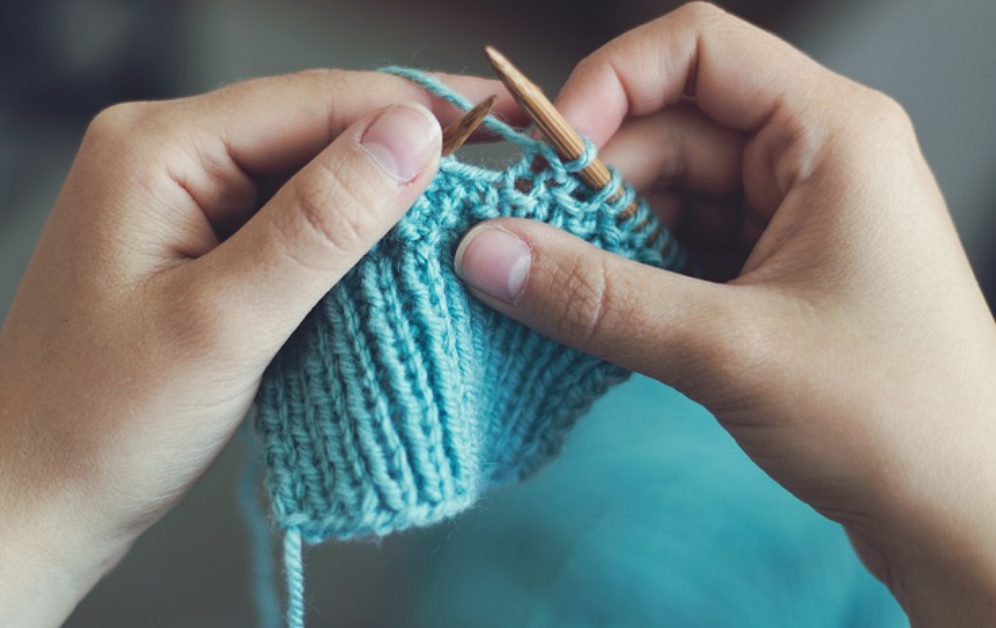
Get Out the Knitting Needles

Two sweaters, one green and one brown, are hidden away in the bottom of my cedar chest. I haven’t worn either sweater in decades, yet I won’t part with them. When I was teenager, Mom decided she and I would learn to knit, and Mom’s aunt agreed to teach us, if we were serious and would finish the sweaters we started.

The pattern I chose for a springtime green sweater was simple: only knit and purl stitches. But Mom, always eager for a challenge, chose a cable pattern. Before beginning the sweaters, we had to knit perfect squares to pass Aunt Dorothy’s standards. She was a stern teacher. If every knitted row, every stitch, wasn’t perfect, Aunt Dorothy ripped out stitches for us to do over.

After supper meals, Mom and I sat together, under a bright floor lamp, and knitted and talked and half-listened to whatever TV program Dad had chosen to watch. When we finally completed the sweater fronts, backs, and sleeves, we took them to Aunt Dorothy and learned how to stitch them together.

Mom sewed wool skirts and jumpers to match my two sweaters, and I wore them with pride for years. She continued knitting and made more sweaters and several afghans. But during my years of college and early marriage and teaching and raising children, I didn’t picked up knitting needles.

Then about 15 years ago, when a local yarn shop opened, I got the knitting bug and gave scarves for Christmas gifts. When our first Grand was a toddler, I took him to the yarn shop to choose yarn for a knitted cap and now his little brother wears it. But I haven’t progressed past scarves and caps.

Last winter, while Annabel and Lou visited overnight, I got out knitting needles and yarn and showed my two Grands how to knit. Lou, now 11, keeps a knitting project in her bag that goes everywhere just in case she has five minutes with nothing to do. Lou’s interest in knitting and a recent article I read have encouraged me to finish a scarf I started two years ago. (There’s my bad habit of starting a project and not finishing it! That was another column.)

I read that knitting acts as a natural antidepressant and helps ease anxiety and depression and aids with keeping the brain healthy. Repetitive knitting motions help the body relax, lower blood pressure and heart rate, and decrease muscle tension. Also, the movements of looping and purling can have the same effects on the brain as meditation.

And knitting helps the brain stay sharp because it is engaged and focused. Knitting is a mathematical activity: counting stitches, rows, changing from one stitch to another, increasing and decreasing stitches.

What better time to knit than the dead of winter?  It’s good way to relax and avoid depression. Everyone can knit – young, old, men, women. And maybe, someone will keep a scarf or cap or sweater tucked away as a happy memory made with love.

####

Lessons Learned from Cranes

I heard them before I saw them. Loud, rattling calls like a bugle stuck on an off key F#. Sometimes a single Sandhill Crane flew overhead, but most often it was a flock in a V-shaped formation. And sometimes I heard them, but never saw them, probably because their calls can be heard up to 2.5 miles away.

I wish I’d kept track of the number of times I looked up to see cranes during December. Whether in my house or outside, I could hear their loud calls as they flew from their northern habitat to warmer grounds. Many Sandhills stopover or winter at the Hiawasse Wildlife Refuge in Meigs County, about 85 miles from Cookeville.

The cranes unique bugle calls amuse me, but I’m amazed by the way they fly in formation. The V shape serves two purposes: to conserve energy and to keep track of each bird. The first bird works hardest to break the wind and splits it into smaller currents. The birds that follow catch those currents and use them as support. And the currents are split from bird to bird until the ones at the tail of the V practically get a free ride.

Each bird flies about a meter behind and a meter beside the one it follows. In this arrangement, they can keep track of each other. One day I watched a flock of at least thirty birds and as they went out of sight, I heard a weak rattle. One lone bird flapped slowly at a lower level than those I’d watched and as he seemed to struggle, I heard another crane calling and flying toward him.

When the hard-working strong leader of the V becomes tired, he drops back, often to the end of the line, and another crane takes the #1 position. According to nationalgeaographic.com, a scientist studied pelicans that were fitted with heart-rate monitors and he found that birds at the back of the V had slower heart rates than those in front and flapped less often. Each bird in the V formation can take a turn as leader working hard for a short time and then slacking near the end.

Sandhill cranes gather in social units and families and they mate for life. But a lone, isolated crane will be taken into a flock and it even helps parent young birds.

These birds’ instinctive behavior teaches lessons. Work together and follow a leader, and take turns being the leader. No one has to be in charge all the time and everyone needs time out. Watch out for each other and when a teammate, a friend, or a member of the group needs help, drop out of routine and lend a hand. Look for the loners. Watch those that don’t have built-in support and include them.

As I write the last words of this column, a loud call, a rattling “kar-r-r-r-o-o-o” grabs my attention. A couple of Sandhills. I hope they find a flock.

####


Ten Years Later

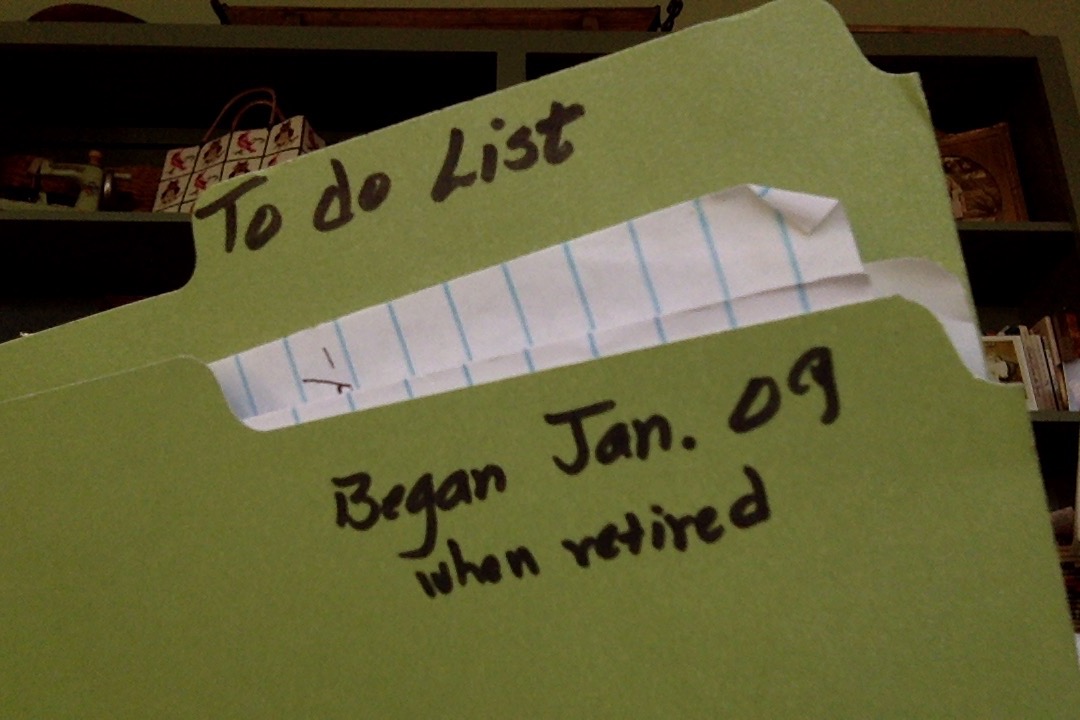
A green folder is in my filing cabinet. It’s labeled “To Do List” with a subtitle “Began Jan. ‘09 when Retired.” After teaching for 25 years, I retired December in 2008. On a cold January morning, I remember sitting in my home closet office in our basement and making a list.

I’ve always been a list maker so writing the things I wanted to do and thought I needed to do seemed practical. I thought I’d review the list regularly to update. How good it would feel to set goals and achieve them, but I don’t even remember the last time I saw this green folder.

It caught my eye recently and I didn’t open it. I stuck it under my writing desk calendar because January 2019 would be the perfect time to look inside, but now I’m hesitant. I’m sure I’ll see fun things and tasks that I haven’t done.

Taking a deep breath, as if facing something dreaded, I open the folder. Four notebook paper pages are clipped together. There are some things marked through – completed! I exhale in relief.

I had written categories: shopping, clean out, visit, learn new things, fun days, write, and sew. Evidently, I last updated the to-do list in 2012. Among the shopping items checked off are a rechargeable baby monitor, a toddler car seat for Samuel (Grand who was then 3 ½ ), and a bedspread for a guest bedroom. I baked and delivered cinnamon rolls to a few friends and regularly visited Aunt Doris and Uncle High. I completed a quilt that Grandma and Mom began, made a king-size quilt from scratch, and several baby quilts for Grands. I’ve read some really good books, worked some crossword puzzles, and have written about my childhood, essays that I hope my children and Grands read someday.

I haven’t learned to crochet or had our hutch repaired or made biscotti or walked a 5K race or written a book for children or organized the many letters my parents wrote each other. I haven’t taken a computer class or completed a denim quilt using the fabric of old blue jeans or ridden in a hot air balloon, although that adventure is on my 2019 calendar.

There are also loose pages in this folder. A Just for Today List. A bucket list of places to travel. A page dated June 27, 2012 is entitled, “What I’m glad I’ve done since being retired 3 ½ years.” Weekly suppers with Daughter’s family. Grands spend the night here weekly. Visit Son’s family more frequently. Twice monthly breakfasts with friends. Music classes with Grands. Exercised more often. Morning meditations. Written some memoirs. Writing a weekly newspaper column.

The green folder is now filed away again. I marked off some things on the to-do list and highlighted some to do for sure in 2019. And I added two: keep on keeping on and play with Grands. That’s been my life for the past ten years, and I hope will be for the next ten and more.

####

Heart Tugs

 “Have Yourself a Merry Little Christmas” played as I sipped hot tea and wrote notes on Christmas cards. White lights sparkled on our Christmas tree. This moment. All is right and heart warming.

I promised myself to be mindful of when my heartstrings tighten and to appreciate memories. To imprint them in my head and heart. To make notes because by writing just a few words I can relive experiences, most brief and jumbled among the busyness of life. Especially during the hustle and bustle of Christmas preparations and celebrations heart tugs are rays of sunshine.

I almost missed Dean’s wave. My 7-year-old Grand picked up his backpack, got in line to board the morning school bus, glanced my way, moved his hand from side to side, but didn’t raise his arm, his palm faced toward the ground. I smiled, winked, and waved toward the ground too. Dean grinned, ducked his head, and stepped onto the bus.

Ann, age 3, held my hand as we watched her big brother’s bus leave their neighborhood. “Let’s take a little walk before we go back to your house,” I said. Sunshine warmed the chilly 24º temperature. My Grand and I were bundled in coats, gloves, and hats, and she led the way as we walked on the sidewalk. She stopped, crouched low, bent her head so that her nose almost touched a basketball size landscaping rock. She patted the rock and asked, “Gran, did you ever see a rock go to sleep?”

I shook my head and Ann ran toward the neighborhood park. She stopped for me to catch up, grabbed my hand, and said, “This is a really good day for us to take a little walk together, Gran! Come on!”

Three Grands, Lou, Ruth, and Elaine, hung ornaments on my Christmas tree. For three minutes. “You probably should hang the rest, Gran. We might break them,” 11-year old Lou said and smirked. Her two younger sisters agreed and asked, “Is the hot chocolate ready? What kind of cookies do you have?” We drank from Christmas mugs and ate vanilla wafers.

The dining room table centerpiece of red roses and holly was beautiful. China, silver, and crystal set eleven place settings. Our traditional Christmas meal was served: beef, potatoes, green beans. A group of six couples began a Gourmet Group (gourmet is a misnomer) in 1978, and we’ve cooked and eaten together monthly. I looked at each of these friends and Husband sitting around the table – thankful they were in my life. And I remembered Carolyn, whose absence hangs heavy since her death in the spring.

“Here, Gran! I made this for you!” Jesse’s card is red construction paper decorated with a green pipe cleaner wreath and small red pompoms glued on the front. “Look inside. I did it myself!” My four-year-old Grand had carefully arranged yellow smiley stickers and Christmas stickers. “Look, the stickers are upside down. Do you like it?” I love it.

Heart Tugs. Rays of Sunshine. I’m catching all I can.

####


Memories of Christmas 1991

Three Christmas gifts remained unopened. Gifts Mom began for her grandchildren, my daughter, son, and niece, but didn’t finish. A sudden heart attack had ended her life in April.

Six months later, Dad sold their home and moved into a one-bedroom apartment. This Christmas was even sadder as our family sat cramped in a small living room – so different from Mom and Dad’s home.

Dad looked at his grandchildren and said, “Those gifts are for you from your grannie.” My brother and I and our spouses sat nearby. Alicia and Sarah, age 17, and Eric, age 15, frowned. “She was making something special for you this Christmas,” said Dad. Tears rolled down his cheeks.

I said, “It’s three almost identical gifts.”

“It’s something you can use now, and Grannie hoped you’d keep and maybe even pass it on to your kids,” said Dad.

“How do we know which gift is ours?” asked Eric.

“By numbers. The way Grannie always did. Susan has folded papers numbered 1, 2, 3, and the packages have numbers on them,” Dad explained.

Alicia, Sarah, and Eric held their gifts. Silence filled the room. After quickly ripping into other packages, now they were silent and still on the floor beside Dad’s chair. “Go ahead, open them,” Dad said.

They paced themselves to see their gifts at the same time. “A quilt!” Sarah and Alicia said in unison. Eric stood and wrapped his quilt around his shoulders. The girls did the same, hugging their quilts close to their bodies.

“I love it!” Sarah said, “But Grannie always said that she’d never make a quilt.” She pulled her white and navy blue patchwork quilt tighter.

“But she made clothes and stuffed animals,” Alicia said. “Our quilts are exactly the same,” she said to Sarah. Alicia looked at Eric’s quilt. “Yours is the same, except dark red where ours is blue.” Each quilt had white rectangles and calico fabric.

“Grannie made lots of stuff, but this is the best,” Eric said. Alicia, Eric, and Sarah sat wrapped in their quilts. No one spoke. We wiped tears and breathed deeply.

Dad rubbed his eyes, then said, “Grannie wanted you to have something you’d keep. You’ll be going off to college soon. You can take your quilts. She began cutting and sewing about two years ago. She was determined to finish them for this Christmas, but…” Dad’s voice faltered.

I continued. “She’d finished one, was quilting the second, and had pieced the third. Dad and I found a woman, Mrs. Horst, to finish them.”

“Aunt Susan, do you know which one Grannie really made?” asked Sarah.

“I’ll answer that,” said Dad. “She made them all. That wonderful lady stitched for your grannie. We were led up the dirt road to her house. She’s a godly woman. She told me she said prayers of blessings as she quilted and hoped to make such beautiful quilts for her children.”

Mom’s quilts covered beds in college dormitory rooms and then apartments when each of her grandchildren married. And now they are on great-grandsons’ beds.

Mom’s quilts were gifts to keep.

####


Nativity is Always Here

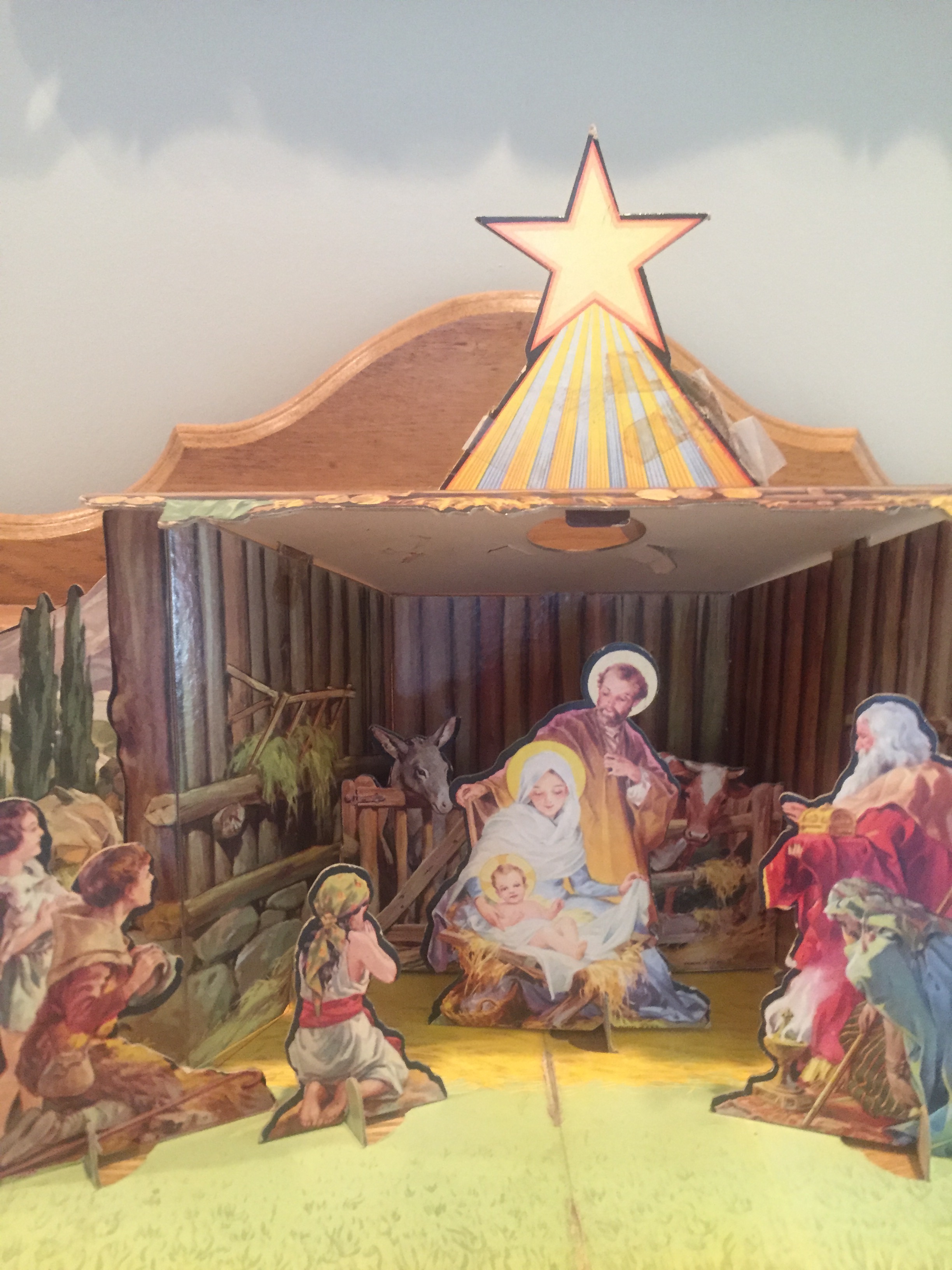
The cardboard Nativity was stored in a cardboard Christmas card box. When I was a child, I set up this scene of Jesus’s birth. I unfolded the three-section base to lay flat on top of Mom’s small living room chest with drawers. I raised the many one-inch tabs to make sure they stood straight. The hardest part was to stand the three-sided stable in the slits cut in the tabs. Thru the years those slits wore out and wouldn’t hold up the stable that was about 6” tall and 10” wide. So it was propped up in the back with a skinny jar of jelly that Mom said no one saw. The two landscape desert scenes leaned backward, almost touching the wall.

Then I placed the people and animals in slits on the tabs as labeled. Baby Jesus in a cradle in the center of the stable and Mary and Joseph beside him. A shepherd boy, two sheep, a donkey, a cow, and three Wise Men all had their places. Now, six decades later, those tabs are much more tattered and the dessert scenes and stable are propped with toy wooden building blocks. And it’s okay if anyone notices.

In another Nativity, one Wise Man’s crown is chipped. It’s shorter on one side so this Wise Man stands behind the other two. A dab of gold paint covers the crown’s white jagged ceramic edge.

For 47 years, this Nativity, that Husband and I bought the second year we were married, has been part of Christmas. Most of those years, baby Jesus slept in his cradle between Mary and Joseph and the three Wise Men stood outside the wooden stable. But when Daughter and Son were young and placed the figures, the Wise Men stood close to Jesus. Closer than the shepherd boy and his sheep. Closer than the cow and donkey. The Wise Men carried gifts and Daughter and Son thought they should be closest to the newborn baby.

As Daughter and Son got older, the Nativity characters often moved. Mary and a Wise Man switched places or the cow and donkey disappeared – hidden away. My children laughed about how long it took me to realize something was amiss.

A few years ago my oldest Grand said to me, “You know, Gran, the Wise Men weren’t there when Jesus was born. They shouldn’t be close the stable.” David said the Kings should be across the room until after December 25. “So maybe you could start moving them closer about a week after Christmas.” And that’s what happened.

A few days ago, four-year-old Jesse stood with his elbows propped on the table in front of the ceramic nativity. My Grand’s chin rested inches from baby Jesus. “Gran’s had that a long time. It’s always here,” Jesse’s big sister Lou told him. “Don’t play with it, but you can touch and move the people and animals.”

Lou is right. The Nativity is always here and it can be touched.

####

Surprising Teacher Gifts

“Open mine next! Mama said you’d like it. Is that your favorite color? Mom said everybody needed what I got you.” My students sat on the floor at my feet, and they were excited while I opened the pile of Christmas gifts on my desk. And often, they were just as surprised as I was by the gifts they gave.

During my teaching career, I taught third, fourth, and sixth graders, and parents – usually mothers – purchased gifts for teachers. So when children shouted, “Open mine next!” it was because they wanted to know what they were giving.

When I taught, poplar teacher gifts were Christmas pins and tree ornaments. I have ornaments, with students’ names written on the back, that I still put on my tree each year. And I’ve kept some pins, but the ones with the words ‘Best Teacher Ever’ were quickly stored away.

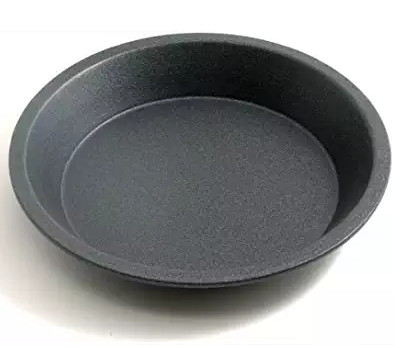
Some gifts weren’t typical teacher presents. A 3rd grade boy hung his head as he handed me a wrapped package and told me his mother had picked it out. It was a Teflon pie pan. I thanked Steven, hugged him, and assured him it was a great gift because I didn’t have a pie pan like that one. My assurances didn’t help. The other children had beamed when I held glittery red Christmas ornaments and pinned one more pin on my red sweater. This little guy couldn’t be consoled. Later his mother told me that he’d wanted to give me a sparkly Christmas tree pin, but she wanted me to have a pie pan like hers. This was a lesson. Years later, I wanted my own children to like the teacher gifts they gave.

Sometimes students told me about the cost of their gifts. When a girl gave me a store-wrapped package with gold paper and a red bow, I knew where the gift had been purchased and most items there weren’t typical teacher gifts. It was tree ornaments – a pair of beautiful green-feathered birds. As the students and I oohed and aahed, the gift giver said, “I picked them out and momma said you’d better like them because they cost a lot.” For the past twenty-five years, these two birds have decorated my tree and I still like them.

One boy was really proud of his gift and said his mother thought every teacher should be able to use it and it’d be different from everyone else’s. She was right – no one else gave me a photo album and I did use it. When I thanked him, he said, “Momma got a really good deal on it. It was on sale for half price and she had a coupon.” And then he told me exactly how much the album cost.

Students taught me that the gifts they give should be something they like, no matter what the mothers and the teachers think or the cost. Children give from their hearts.

Christmas Then and Now

That tree, the one in the middle of the field, looked perfect. Not too wide. Just the right height. Except when we got close, we saw bagworms. This wouldn’t be our Christmas tree. When I was a child, my family went to our farm to cut a cedar tree. Sometimes Mom stayed home and baked sugar cookies and made hot chocolate, using Hershey’s cocoa and sugar, and sometimes she went with Dad, my brother Roger, and me.

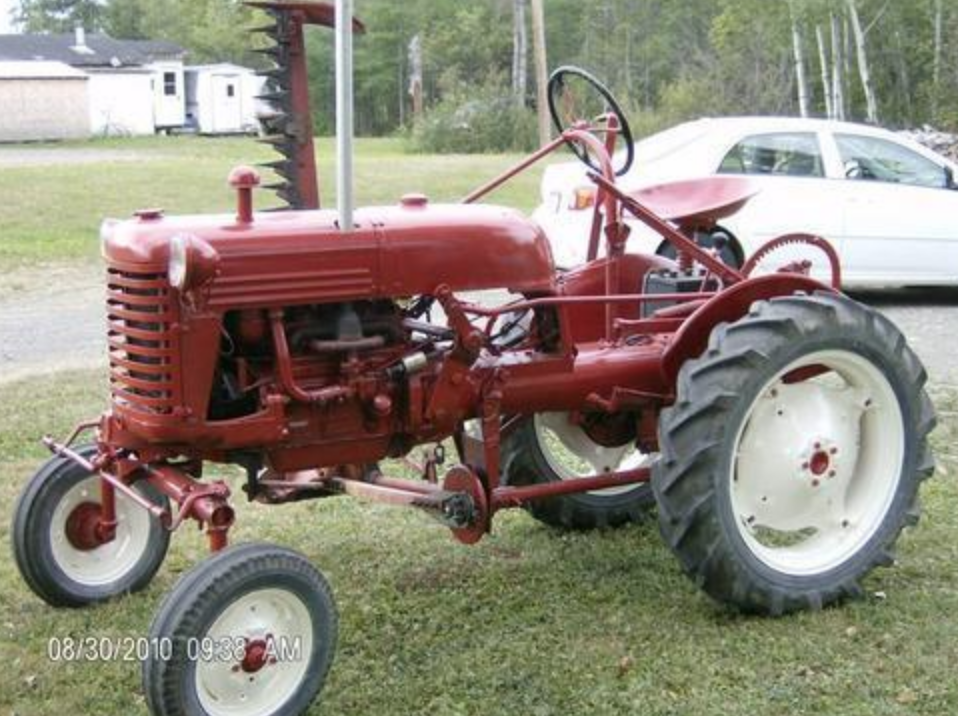
Dad drove the tractor, a red International Cub, and I sat on the seat with him so I could steer, but Dad kept his hands resting on the steering wheel. Roger and Mom walked beside the tractor unless it was really cold and then she drove the family car as far as it was safe on the dirt road.

We passed the white wooden house where Dad’s grandparents had lived and where he was born. No one lived in the dilapidated farmhouse in the late 1950s and the tobacco base and pastureland were rented to a neighboring farmer.

At the foot of Huddleston Knob in Pickett County, cedar trees were plentiful, but choosing the right one took time. Like the one with bagworms, other trees appeared perfect from a distance, but closer they were much too wide or had a gaping hole with no branches. Dad traipsed from tree to tree holding out his arms to gauge a tree’s width and standing tall to his full 6’ 2” to estimate a tree’s height.

When we finally chose one, Dad and Roger chopped it down and we carried it home, a few miles away, tied to the top of the car. One side of the tree was always thinner with fewer branches so that side faced the living room picture window. Because Mom wanted the metal star placed at the treetop to graze the ceiling, Dad cut an inch at a time off the tree’s trunk until it was exactly the height she wanted.

My two oldest Grands, ages 11 and 13, went to their family’s basement last week and lugged a cardboard box to their living room. Elsie and Samuel opened the box and unpacked the sections of their 8’ tall artificial tree. They lay the pieces on the floor to determine which one had the longest branches and would be at the bottom of the tree. They and their parents stacked and secured each section to build their Christmas tree.

Then they adjusted the long metal branches so that they looked like a tree that had been cut in the woods.   And the whole family fluffed the pine needles on each limb, unfolding and ruffling the small plastic twigs that have been squashed in a box for eleven months.

I cherish the memory of cutting a tree in the woods. But, you know what, my Grands will cherish their memory of putting up their Christmas tree too because they’ll remember family time. Time together – that’s the happy memory.

####

Rich Memories are Stirred up Looking Through Mom’s Old Recipe Box

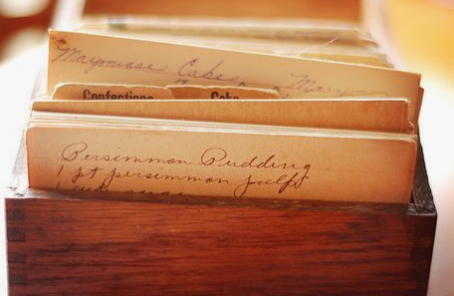
I looked through Mom’s collection of 3 x 5 index recipe cards one more time. Surely, I’d find her corn bread dressing recipe. Surely, Mom wrote it down and filed it in her wooden recipe box. Surely, I overlooked it when I searched before.

Thanksgiving is about traditional foods that have been served by grandmothers, mothers, sisters, aunts, and cousins. Mom always made the dressing to go with the turkey and giblet gravy, and after her death more than twenty-five years ago, I used recipes from cookbooks to make it for family gatherings. Last week I touched every recipe card in Mom’s file. The one recipe I wanted wasn’t there. I’ve determined the reason is the recipe was in her head. She seasoned by taste and added broth by feel.

But I discovered something I hadn’t noticed previously. Almost every recipe includes two ingredients: sugar and butter. And many include flour. Mom’s file is full of desserts: pies, cookies, cakes, and candies. Those are the labeled tab dividers. The tab labeled casserole doesn’t have a single card behind it, but Mom added another category: Rolls, Biscuits, Cornbread. She was a meat- and-three cook, a really good one, and she didn’t need recipes except for desserts and some breads. Her fried chicken and chicken and dumplings were the best ever. She cooked fall-apart beef roast in a pressure cooker and smothered liver with onions. She fried tender pork chops in a black skillet, then used the drippings for gravy. No recipes needed.

I also discovered Mom and I collected many of the same recipes, and I don’t know why I didn’t get them from her. Pecan Pie. Oatmeal Cookies. Angel Biscuits. Chess Squares. Sugar Cookies. Her Old Southern Light Cornbread recipe is exactly like the one I cut from a Southern Living magazine.

Like most cooks of her generation, Mom recorded many recipes using paper and pen. Reading her handwriting brings a lump to my throat. She wrote neatly and concisely, omitting every ‘the, an, a’ and her directions were simple. The last notes on most cards are numbers, such as 350º, 45 minutes.

My favorite finds are Never Fail Pie Crust and Southern Pecan Pie*. I wonder why I didn’t notice these recipes before and made them my own. Mom could make piecrust blindfolded and she always made two. One she put in the refrigerator for another day. Studying her recipe for pecan pie, I now know why the flavor of my pie isn’t as rich as Mom’s was. My recipe is exactly like hers except she used dark Karo syrup and I’ve always used light. (Dark is made with molasses and light corn syrup that is flavored with vanilla.)

For our family’s Thanksgiving Dinner tomorrow, I’ll have to use the corn bread dressing recipe I’ve created, combining several recipes, and titled “Dressing Most like Mom’s.” But the pecan pie I’ll serve my cousins and sister-in-law and their children will be exactly like Mom’s. As close as I can make it.

*Recipes online at susanrray.com

Earth’s Biggest Natural Spa

A trip to Israel wouldn’t be complete without seeing the Dead Sea. The lowest place on Earth, sitting about 1300 feet below sea level and one of Earth’s saltiest bodies of water, ten times saltier than oceans. And my trip wouldn’t have been complete without floating on the Dead Sea. Not floating in, floating on.

The Dead Sea lies at the edge of the Judean desert where rainfall averages 2½ inches per year and is fed by the Jordan River.   Freezing temperatures never occur here. January’s temperatures average 60º and summertime temperatures hover between 90º-100º.

As I walked one block from my hotel on the sidewalk toward the Dead Sea, the October blue sky was filled with soft fluffy clouds. The beach looked like resort beaches. A snack bar. White plastic lounge chairs. Palm trees.

“Just walk in and lie back,” the tour guide had said. “Don’t try to turn over and swim. Don’t get the water in your mouth or eyes. And if you have cuts or scraps on your skin, you’ll feel the burn of salt.”

I saw friends from my tour group in the water so I put my towel on a chair nearby and kicked off my flip-flops at the water’s edge. A friend, wearing street clothes, said, “Are you sure you want to get in that water? I felt it with my hand. It’s really slimy and oily.” I nodded and smiled.

I avoided stepping on the scattered salt rocks that dotted the shallow water, took a few steps and stopped. I should have realized the salt rocks would be denser in deeper water and have sharp edges, like coral.   The bottoms of my feet hurt, but my flip-flops were far out of reach. Thankfully, a friend saw my dilemma and handed my shoes to me so I could walk until the water was above my knees. I lowered myself into the water.

What a strange sensation to lie completely still and feel as if I were on an invisible float. Only the heels of my feet and the back of my body were underwater. I raised my head and put both arms to my sides and continued to float. As I waved my hand high toward a camera, drops of water splashed onto my lips. It tasted like sticking my tongue in a bowl of salt.

I wasn’t concerned about being bitten by fish or bothered by other animals. Nothing, not animals nor plants, can live in the extreme salinity. This body of water, also called the Salt Sea, is a place for healing. The extremely high salt and mineral content is said to help people with arthritis, respiratory problems, and chronic skin conditions.

Floating on the Dead Sea was calming. I liked the smooth, slightly oily feeling, and the ability be still and completely relax in warm water. No wonder this body of water is known as earth’s biggest natural spa.

####