• Recent Posts

  • Archives

  • Categories

  • Meta

We’ve Got a Problem

woman-upset-broken-computer-22267785Most times when I call to a help center, I choose to talk to a real person. But when Ms. Automated Help Line took my phone call, she intrigued me so that I played her game.

Three times in one week I lost Internet service. The first two times I disconnected the cable from our wireless router, restarted my computer, reconnected the cable, and I could surf the world. The third time my trouble-shooting trick didn’t work, and I called tech support. Ms. Automated answered, with perfect diction.

“Welcome. Your call may be monitored and recorded for quality assurance. Please enter your 10 digit telephone number.” Hoping to get a real person on the line, I pushed 0. “Your selection was not recognized. Enter your 10 digit telephone number.” I did nothing. Would someone pick up the call?

Ms. Automated said, “I can help you. Let’s try this. Push 1 for payment information. Blah. Blah. Blah. 6 for technical support.” I pushed 6. “Say your 10 digit phone number beginning with the area code.” I did. “How may I help you today?” Ms. Automated asked.

“I don’t have Internet service,” I said slowly and clearly. “All right.   Enter your 16-digit customer account number or say ‘I don’t have it.’” I didn’t have it. “I can help you,” Ms. Automated said, “but at any time that I’m not addressing your problem, say agent. To continue working with me, say continue.” It was at this point when I hadn’t responded as Ms. Automated first requested and she seemed positive that she could help that I took it as a challenge to work with her. Could she really tell me how to connect to the Internet? If she couldn’t, what would she do?

Ms. Automated said, “Let me check the modem from my end. It looks good on my network. We are on our way to solving your problem. To continue working with me, say continue. To speak to a service person, say agent.” Was she trying to get rid of me?

Following Ms. Automated’s instructions, I shut down my computer and unplugged the router cable. I booted up my computer and connected the router – exactly what I’d done before calling her. Ms. Automated said, “If this does not resolve the issue say there’s a problem.” After I repeated her last three words, she again spoke with confidence. “We are on our way to solving your problem… Blah. Blah…” What now? “Continue,” I said.

Two more times I followed her directions and two more times I said, “There’s a problem.” And I chose to continue working with Ms. Automated. The phone line was silent for almost sixty seconds. And then Ms. Automated said, “We’ve got a problem. I will connect you with an agent.” She gave up!

I heard a friendly male voice. “Hello, my name’s Musa. I’m sorry your Internet isn’t working. I know how frustrating it is when technology doesn’t work.” Musa listened as I explained my problem, and after a few minutes he and I concluded that I needed a new wireless router. We had a pleasant conversation and not once did he ask me to enter numbers or say continue and he seemed to really care.

Ms. Automated did her best, but it took a real person to identify the reason for the problem and determine how to solve it. Just as I thought.

Canning Tomatoes


searchThe sign read, ‘Canning Tomatoes $15.’ A 5-gallon bucket was filled to the rim with tomatoes of all sizes. All dusty, with garden dirt. I’d planned to buy a few tomatoes to eat, but I could almost taste Mom’s vegetable soup that she made from home canned tomatoes when I was a kid.


“These were picked a couple of hours ago,” said Mr. Smith. I couldn’t resist. He transferred the tomatoes to a brown cardboard box. “Here, take more.” He piled another dozen tomatoes in the box.


Some tomatoes needed to ripen a few days. I washed the ones ready to can – those that were dead ripe or had cracks near the stems. No need to look at a recipe book. Mom taught me the basics of canning many years ago.


I filled my biggest pot half full of water and searched my cabinets for empty quart jars. I found only three, but I had plenty of pint jars. I started to the basement to get my blue hot water bath canner and remembered that last time I use it the bottom was so warped that I’d gotten rid of it. Maybe my kitchen pot could work as a canner.


Using a long handled spoon, I dropped tomatoes into the boiling water and when the skins cracked open, I plunged them into cold water. After all the tomatoes were scalded, I washed the pot and refilled it with water for a boiling water bath.


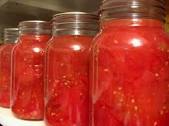
The tomato skins slid right off. I filled three quart and four pint jars with cored and quartered tomatoes. I added a little salt to each filled jar, wiped the rims clean and dry, and screwed on scalded two-piece canning lids. There are many ways to can tomatoes. I learned my way when I stood on a kitchen chair beside Mom, and now admiring my filled jars, I felt a connection to her that felt good.


I set the quart jars into the pot of almost boiling water and the water barely covered the top of the jars and almost overflowed the pot. Then I pulled out my vintage Ball Blue Book for Canning and Freezing, copyright 1956 and read that the water level should be 1-2 inches above the can tops. Surely, my 18-quart stockpot would work.


It wasn’t easy transferring boiling water and filled jars to another pot. Although this pot was plenty deep, it was big enough for only six, not seven, jars. So I decided to do the quarts and then the pints. The glass lid for this pot had been broken several years ago so I ripped off a piece of heavy-duty aluminum foil and made a lid, with the edges hanging over the pot. I set a timer for 45 minutes, the processing time, adjusted the temperature control to keep the water boiling, and walked away for maybe two minutes.


What was I thinking? I could hear Mom say, “Be sure you have everything you need before you start.” Which would’ve included a real canner with lid. Steaming hot water dripped from the foil and also ran down the sides of the pot onto the ceramic stovetop. What a mess. For 45 minutes, I stood by the stove wiping up water, and then did the same for another 35 minutes to process the pint jars.


Those seven jars of tomatoes will make really good vegetable soup. And there are more tomatoes to can. But first, I’m going shopping – for a canner.


Birthday Reflections

664-02041346er

When a burn permit is needed before the birthday candles are lit, it’s time to stop putting candles on the cake, right? My Grands didn’t think and they decorated my cake with exactly the right number of candles. Husband asked, “Did you get a burn permit?” That wasn’t one bit funny. My Grands said, “There’s so many candles, we’ll help you blow them out!” All the candles weren’t lit, but the cake still looked like an inferno. It took four Grands and me so long to blow out all those candles that the ice cream melted in the carton.

After my birthday last week, it occurred to me that I’m the age Granny was when she was old. So old that I’d pinch the skin on the back of her hand and count the seconds until her skin lay flat. So old that a hard day’s work was hoeing two rows of corn in her garden. So old that she wore long dresses and black leather lace-up shoes and stuffed a handkerchief in her bosom.

Times have changed. We grandmothers of today aren’t like my grandmother, there are some things women of Granny’s generation did that I’ve promised myself I won’t do.

  1. Hold my purse in my lap.
  2. Carry a plastic rain cap in my purse.
  3. Take a sweater everywhere I go – especially during the summer.
  4. Talk about bathroom habits.
  5. Say, “I lost ____.” (Fill in the blank with the most recently missing item.)

When I was a young thirty-something, I attended a luncheon for senior citizens and I set my purse on the floor. The two women seated across from me whispered to each other and then one said, “Your purse is on the floor.” I nodded, smiled, and agreed. They looked as if I’d just announced that there was a fire in the building. With big eyes and a stern voice, one lady said, “Honey, the floor is no place for your purse.” Then I noticed that all the older women at the table held their purses, with thin paper napkins covering them, in their laps. And I swore that I’d never, ever hold my purse in my lap.

I don’t even know if those little plastic rain caps are still available. Granny always carried two in her purse, one for herself and one for anyone who didn’t have one. Yes, sometimes rooms are overly air-conditioned and a sweater is needed – but no one needs a sweater at an outside Fourth of July celebration. About the bathroom talk – when I was a little girl, I learned that what happens in the bathroom isn’t talked about. That goes for everybody, no matter how old.

I really don’t lose things. I put things in safe places or logical places to use them another time. Recently I said to Husband, “When you see my little gray camera laying around somewhere, please tell me where it is.” And he said, “So that’s what you’ve lost today?” I didn’t say that.

Here’s my plan. As long as my Grands will put candles on my birthday cake and help me blow them out, I want birthday candles. And I won’t act old, like Granny and her friends did, and I’ll never let my Grands pinch the back of my hand.

I Know the Feeling


Screen Shot 2014-07-31 at 6.58.02 AMLast summer Robbie invited me to bring my Grands, ages 8 and 6, to swim at her house while her 9 ½ year old grandson Noah was visiting. The children splashed and played along beside each other, just as children do when they meet someone new. At lunchtime, we all dried off and spread our towels to sit around the pool. Noah started inside the house, turned, and asked my Grands, “Do you’ll want a Luncheable?”


David and Lou frowned. I answered for them. “No, but thank you, Noah. We brought our lunches.” I handed my Grands the small cooler in which Daughter had packed their food. Rollup sandwiches, made with flour tortillas filled with thin sliced turkey and shredded mozzarella cheese. Hunks of watermelon. Clusters of grapes. Homemade cookies.


Noah settled himself beside David.   He ripped the thin cellophane covering off a square plastic package. Lou tilted her head and looked at the package. David eyed it and said, “What’s that?”


“What’s what?” Noah said.


“Your lunch?” David asked. Inside the six-inch square plastic package were three small round tortillas, 5 slices of pepperoni, some white shredded cheese, and a take-out ketchup sized packet of pizza sauce.  Lou furrowed her eyebrows as if memorizing the package’s contents.


“It’s like little pizzas,” Noah said. Using his teeth, he ripped open the packet and he squirted red sauce on a tortilla.


“Where’d you get it?” David asked.


“Nana gets them at the grocery or somewhere,” Noah said. David held his roll up sandwich close to his mouth but he didn’t bite it, instead he watched as Noah covered the tortilla with a pepperoni slice and cheese.


“That looks really good,” David said and he laid his sandwich back in the cooler. “Does every grocery store have them?” Noah shrugged his shoulders. “I wonder if Mama could find them.”


“I think they’re by the milk and stuff,” Noah said and bit into his miniature pizza. David and Lou watched as red sauce dribbled down Noah’s chin. I knew exactly how my Grands felt. I remember being envious when I was young and spent the night at a friend’s house and for breakfast her mother spread Blue Bonnet margarine on toast. At my house, we spread home-churned butter on Mom’s homemade biscuits.


Now, watching Noah and David and Lou, I restrained myself from raiding Robbie’s refrigerator for two more packaged lunches. “Noah, would you like some watermelon?” I said. He bit into the watermelon and somehow that reminded David and Lou that they, too, had food to eat.


But that’s not quite the end of the story. Last week Robbie again invited us to her house. “We’ll eat lunch and swim, just like last year,” I told my Grands. “Noah is there. And on the way, we’ll stop at the grocery store to buy your lunch, maybe Lunchables.” They chose exactly what they’d watched Noah eat a year ago.


My Grands and Noah pulled the cellophane covering off their lunches and each ate every morsel packed in those small plastic boxes. I knew exactly how my Grands felt. The way I felt decades ago when I carefully unwrapped a stick of yellow margarine, put it on a serving plate, and told my friend, “Mom is making toast for breakfast.”


###


More Cornbread

search

When my friend Tommy Sue offered corn light bread* that she’d baked the day before, I was skeptical and almost chose a commercial bun that came with the carry out barbeque supper. “If you don’t want a bun, here’s some corn light bread I made yesterday.” Cold corn bread? The only way my mother served cold cornbread was crumbled into a glass of milk and eaten with a spoon, which was Sunday night supper. I went along with my girlfriends who also sat around Tommy Sue’s dining room table and I laid a piece of her homemade bread, baked in a loaf pan and sliced like banana bread, on my plate. Slathered with soft butter, it was delicious.

During dinner we college girlfriends discussed how we make and bake cornbread differently. We agreed that it is usually baked in a black skillet and in a hot oven, but Tommy Sue’s mother baked cornbread in a loaf pan and often served it cold. We realized that we bake cornbread like our mothers did. Blondie’s mother told her to remember 2, 2, and 2. *  Two cups of cornmeal, 2 eggs, and 2 cups of buttermilk. Heat ¼ cup oil in a black skillet in a 450° F oven and pour about half the oil in the batter, stir well, and watch the batter sizzle when it’s poured into the skillet.

Jo Ann’s family had milk cows and no milk was ever wasted so her mother used the old milk, no-longer-good-for-drinking-milk, to make cornbread. After baking, she turned the bread onto her tiled countertop and covered it with the skillet until the middle was soft. Friend Alicia learned to heat ½ cup oil in a black skillet and drop spoonfuls of thick batter into the skillet allowing the oil to bubble around each spoonful. After baking, the spoonful-size portions break apart easily. All of us agreed that the best cornbread was baked in hot bacon drippings. Our mothers kept a jar or small crock close to the stove to pour bacon grease into and that was used for cornbread and to season vegetables.

Kathy’s mother always baked plain cornbread to serve with pinto beans, and she made Mexican cornbread to serve with vegetable soup. The mention of Mexican cornbread started a whole new topic. Broccoli Cornbread* is made with Jiffy cornbread mix, butter, eggs, cottage cheese, onions, and chopped frozen broccoli and baked in a 9 x 13 pan. There’s Creamed Corn Cornbread, Zucchini cornbread, and Green Chili Cornbread. I googled cornbread recipes and got 3,950,000 results. That’s more varieties of cornbread than there are black skillets!

After the first column about cornbread, readers have shared their stories. Tricia’s mother was born and raised in Ohio and her Sunday night supper was a one-pan meal. She cooked pork sausage – either patties or crumbled – and then poured cornbread batter into the hot skillet and baked it. Seems like this should be a good Southern dish. I’ve heard about hush puppies, cornbread dressing, spoon bread, hoecakes, Johnny cakes, hot water cornbread, cornbread salad, vegetable spoon bread, and crackling cornbread.

This cornbread saga may not be ended yet. There may be yet another cornbread story.

*Recipes posted http://susanrray.com


Cave Walk


search “Wear supportive shoes, no flip-flops.  The temperature is a cool 55 degrees.  It’s about a mile and a half walk.  Nothing strenuous.  Just uneven ground and some steps.  You have to watch where you walk.”  That’s what Tucker told me about a cave tour when I called Cumberland Caverns.  He said all the right things to encourage Husband and me to take our nine-year-old Grand to the cave.


The tour starts with a 600-yard walk along a narrow gravel road.  “Does this count as part of the 1 ½ mile walk?”  Husband asks Tucker, who is now our tour guide.  It does.  We walk into the first cave huge room and David is mildly impressed.  We are all impressed by the waterfalls and the pond with albino crayfish.


Tucker points out stalagmites, stalactites, and columns, and he assures us that the huge cracks in the ceiling prevent it from falling.  We walk along a rough pathway that’s wide enough for a jeep.  Then Tucker says, “This next section is 350 steps, up 175 and back down.  If you don’t want to go, you can sit on that bench and wait.  We’ll be back in a few minutes.”  Steps up – rock steps, some tall, some short, all uneven, and narrow.  That wooden bench  is inviting.


Tucker looks toward three people: Husband, me, and a man who is carrying his toddler son in a large, metal frame backpack. “It’s a bit slippery in some places.  You can hold on to the railing.  Anybody want to wait?”  The railing is a one-inch metal pipeIs it stable?  Backpacking Daddy takes a deep breath and says, “I think I’ll wait.”  Tucker tells him that the lights may go off, but some emergency lights will turn on.   Husband and I both nod our heads – we’re going.  Backpacking Daddy takes another deep breath and says, “I guess I’ll go, too.”  Did he change his mind because if someone like me, at least 30 years older than he, thinks she can walk up and down all those steps, he figures he can?


David and two other young boys fall in right behind Tucker.  Ten steps up and a ninety-degree turn.  All three boys grab the handrail. Tucker says, “Feel how wet that railing is?  That’s bat pee.”  The boys immediately wipe their hands on their pant legs.  “Just kidding.  Do you know what condensation is?”  I cling to the railing, wet or not.


With a few huffs and puffs and gripping the railing, everyone makes it up and back down.  And those young boys practically step on Tucker’s heels as he leads.  We see the bare cave, so named because it’s empty and the meat grinder tunnel, named for what an early spelunker looked like he’d been through when he came out.   Finally, we toured the concert hall for Bluegrass Underground.  A perfect tour, I think.


“What’d you think of your first cave tour, David?” I ask.


“It would’ve been a lot better if we’d been able to climb the rocks and not have to walk on a road somebody made.  You know, really see the cave, without electricity.”  he says.


Yes, I know.  There’s such a cave tour.  David can crawl through tight squeezes and along a muddy bottom.  I’ll tell his daddy about it.


Hot Cornbread


search


Once again at Farmer’s Market, there are fresh green beans to be broken and cooked with a slab of thick bacon.  There’s yellow crookneck squash to slice, sprinkle with salt, roll in cornmeal and fry.  There’s nothing quite as good as summer vegetables, except the cornbread that goes with them.


Mom was a good cook.  Just before Husband and I married she told me, “Here’s what you do.  Set the table every night.  Even if supper is leftovers, your family knows that you’re making supper.  And serve hot bread.”   Mom’s bread was usually cornbread.  When I was about 9 years old, making cornbread was my supper chore.  Two cups of Martha White self-rising cornmeal, one beaten egg, and enough buttermilk to make the batter just right.  Stir with a wooden spoon.


Mom’s cornbread skillet didn’t have a handle – it had broken off.  That skillet was used only for baking cornbread.  She turned the oven to 425° F, put a couple of spoonfuls of bacon grease in the skillet, and both skillet and grease got hot while I stirred the batter.  Mom poured about half of the hot grease into the cornbread batter, and I gave it one last stir and dumped it into the hot skillet.  But my chore wasn’t done.  The cornbread bowl had to be washed immediately.  If not, the batter dried and stuck like glue to the bowl.  More than once, I didn’t wash the bowl and after supper, Mom washed the dishes and I dried them, and then I had to scrub the cornbread bowl.


The cornbread baked for twenty minutes and came out of the oven with a golden brown crust just as Mom called Dad, my brother, and me to the supper table.  She turned the bread onto a dinner plate and it was the only food we were allowed to have on our plates before the prayer.  Mom cut the cornbread into wedges, put a piece on everyone’s plate, and we slathered it with butter, then Dad said the blessing.  Sometimes I’d eat my first piece of cornbread before even filling my plate with meat and vegetables.  And if I didn’t like anything else for supper, I’d fill up on cornbread and milk.


Mom’s cornbread recipe never changed, but sometimes she fried hoecakes and sometimes she baked corn sticks and muffins.  On hot summer days when she didn’t want the oven heat, she dropped spoonfuls of the batter into a black skillet on top of the stove and fried hoecakes.  My favorite was the corn sticks.  Thin, crunchy sticks of cornbread with browned crust with every bite.   I didn’t keep up with Mom’s cornbread skillet, but I have the black iron corn stick and muffin pans.


I made Mom’s basic cornbread recipe for years.  Then I discovered Corn Light Bread, made with cornmeal, flour, sugar, buttermilk, and an egg.  Sweet, finer textured cornbread.  When my Grand, Louise, was four years old, she proclaimed it, “The best bread ever!”  She may be right.


I know that there are many cornbread recipes, and that’s a column for another day. Right now, I’ve got a mess of Roma green beans cooking, squash ready to fry, and I’m stirring up some of the best bread ever to bake in Mom’s corn stick and muffin pans.  A fine summertime supper.


###


4th of July


Bicsearchycle spokes laced with crepe paper streamers.  Red, white, and blue balloons tied to the handlebars.  American flags taped to the back of bicycle seats.  Daughter wore blue shorts, a white t-shirt decorated with stars and stripes, and a red ribbon was tied around her ponytail.  Son put on his red shorts, white socks with blue stripes, and a t –shirt with the words Happy Birthday America written with magic markers across its back.  My children and their bikes were ready for the 4th of July parade!

 

It doesn’t seem that long ago, but it’s been more than 30 years since the neighbors on Flatt Circle threw their annual 4th of July parties.  Small-town style.  They invited many families to celebrate our country’s birthday, and they blocked off their cul-de-sac street.  We neighbors and friends showed up carrying our lawn chairs and funeral home, cardboard fans.


What a grand event!  Anyone could enter the parade, but mostly children came decked out to march the two-block parade route.  My children’s bikes were decorated that morning, but it was obvious that some families had planned ahead.  Parents and children wore matching outfits, complete with holiday hats.  Painted signs and red, white, and blue banners were taped to the sides of Radio Flyer wagons in which toddlers rode.  We all waved American flags and patriotic music blasted during the ten-minute parade.


Our hosts loaded buffet tables with barbeque, hot dogs, cole slaw, baked beans – perfect for a hot summer day picnic.  Blankets and quilts spread on the ground were the dining tables.  After eating, the children raced their bikes and trikes and skateboards up and down the street while we adults talked and laughed and shared stories we’d told time and time again.  As darkness fell, everyone found a place to watch the fireworks show.  Young children settled in their parents’ laps, and big kids got as close to the fireworks as was allowed.  Bright, sparkling fireworks shot higher than the houses’ rooftops, and then the grand finale – red, white and blue flashes burst toward the sky.


When the party ended, we adults gathered chairs and blankets and children, who were too tired to ride their bikes home and begged to be carried.   Friends and neighbors hugged and shook hands and promised to get together more often.  After all, we lived just down the street from each other.


Our friends on Flatt Circle certainly knew how to host a party.  A parade and lots of fun and food and fireworks.  But looking back, the best thing about that celebration was that neighbors and friends gathered together.  It reminds me of the cookouts in our backyard when I was child.  Mom called her cousins and sisters who brought bowls of potato salad and fresh green beans and platters of sliced tomatoes.  Dad fired up the charcoal grill and cooked hamburgers. It was a big family social event. We young cousins played tree tag and hide-and-seek and eventually sat with the adults to hear the stories they told time and time again.


Let’s celebrate our country’s 238th birthday on July 4th with family and friends. Fireworks aren’t necessary, but there has to be food for any good southern celebration.  And there’s sure to be laughter and more than a few stories told.

For Better, Not Worse


retired_logo


My friends said that I’m in trouble.  Said I have some adjusting to do.   Said I should give Husband and me some time. Said it’ll work out, but it won’t be easy.  Said it’s not like anything we’ve experienced in our marriage.  These four college girlfriends have known Husband and me since he and I first met, and my friends have all been where we’re going, but I think they’re wrong.


For all the 44 years of our married life, Allen, husband who I must call by name for this column, has worked.  Except for short vacations, he’s showered, shaved, dressed, and gone to work five days a week.  Next week, he won’t.  He won’t go to the office before 8:00 a.m., come home around noon, make his own lunch, eat, go back to work, and come home for the evening after 5:00.  Allen is retiring.


My friends told horror stories about some newly retired husbands, but not theirs.  One husband completely reorganized everything in the kitchen cabinets.  One expected three meals a day, cooked and served.  Another thought he should know where his wife was every minute of every day and what she was doing.  One walked from his bed to his living room recliner and called it exercise.  And one husband suddenly needed to know the exact cost of every item that his wife bought at the grocery store.


Allen won’t do any of those things.  So why are my girlfriends concerned?  When they ask what Allen planned to do, I said that he might want to work part time.  He’ll want somewhere to go and something to do.  And I said that I plan to continue my erratic come-and-go-as-I-please schedule, and I have a list of places for Allen and me to go and things to do.


I retired five years ago and adjusted quiet easily.  I like my quiet mornings.  No TV, no radio, and a leisurely breakfast on our back deck, if the weather is good.  During the past five years, Allen went to work and I spent the day however I wanted.  Exercised at the YMCA.  Played with my Grands.  Hid in my closet office and moved my fingers across my computer keyboard.  Ate lunch with friends.  Piddled the day away.  I didn’t completely neglect household chores.  Laundry and dusting and grocery shopping got done – in due time.


I’m really happy for Allen.  He began working when he was 12 years old.  He stocked shelves and swept the floor at his family’s grocery store where he continued to work through his college years.  And he’s worked ever since.  In retail business.  For Tennessee Tech.  Owned and managed convenience stores.  For an insurance agency.  But starting next week, he won’t go to work.  And he and I will have a grand time together, won’t we?


I think my girlfriends are wrong. Just because they and their husbands struggled through a year-long adjustment period after they both retired, doesn’t mean the same for Allen and me.   This chapter of our marriage is the ‘for better’ not ‘for worse,’ isn’t it?


Band Concert in the Park

full_211

I carried Ruth’s and my folding chairs across Dogwood Park to a flat grassy area in front of the performance pavilion.To keep my Grand interested, we needed to sit close to the action at the Community Band Concert.  I greeted my friends, Mary Dell and Robert, who were seated at a picnic table just a few feet behind our chairs.  I introduced Ruth to them and to their dog Button, a hospital therapy dog.  Button is an Australian Silken Terrier, is less than a foot tall and weighs only a few pounds.  She stood on the picnic table.  Ruth tentatively raised her hand to touch Button, and Mary Dell explained that Button likes to have her chest scratched.

Button sniffed Ruth’s hand and turned away.   My Grand and I settled into our chairs while the band members warmed up their instruments.  A cacophony of sound – Ruth put her hands over her ears and looked back at Button.  Mary Dell’s smile encouraged her to stand by Button.  With one finger, Ruth scratched Button’s chest and gently rubbed her back.

The concert began.  The band played  “The Star Spangled Banner” and Ruth and I stood, as did all the 250 people in the audience.  Then my Grand crawled into my lap and I tapped my toes to the rhythm of  “Good Ole Summertime.”

“Watch those trombones.  See how the musicians playing them made them long and then short?  That’s how a trombone makes different notes, like on our piano,” I told Ruth.  We teachers think we have to make every outing a learning experience.  Ruth quickly ate the cheese and cracker snack I’d brought, and she looked back over my shoulder at Button.

Mary Dell nodded her head and motioned with her fingers that it was okay for Ruth to see Button again.  Robert put a dog treat in Ruth’s hand and showed her how to hold her hand flat.  She laughed when Button’s tongue licked her hand and then her face.  Ruth went from that first tentative touch and scratching Button’s chest to giving her treats and laughing when Button licked her.

The music played on.  So much inspiring, upbeat, summertime music performed by the sixty musicians on stage.  Robert Jager masterfully directed each song.  I tapped my foot, applauded, and enjoyed and appreciated every note.  Especially the percussion instruments when the circus came to town.  And I sat alone.  My Grand sat on the picnic table bench between Mary Dell and Robert, and Button stood right in front of her.

The hour-long concert ended.  Ruth told her new friends good-bye, held my hand, and we walked toward our car.  “That music was weird,” Ruth said.

“Weird?” I said.  “It’s different from what we usually listen to.  Maybe not weird, but different.  I like band music.”

“Me, too.”

“So do you want to come to another concert?”

“When?  Will Button be there?”  Ruth asked.  Monday night, June 23, 7:30 p.m.  I don’t know if Button will be there.  The free concert will take us Around the World on a Musical Tour.  I’m sure we’ll have fun – enjoy music that’s not what we hear every day and greet old and new friends.  All outside, under the stars, in the park.

group534cd79bab770