• Recent Posts

  • Archives

  • Categories

  • Meta

A Box Full of Letters

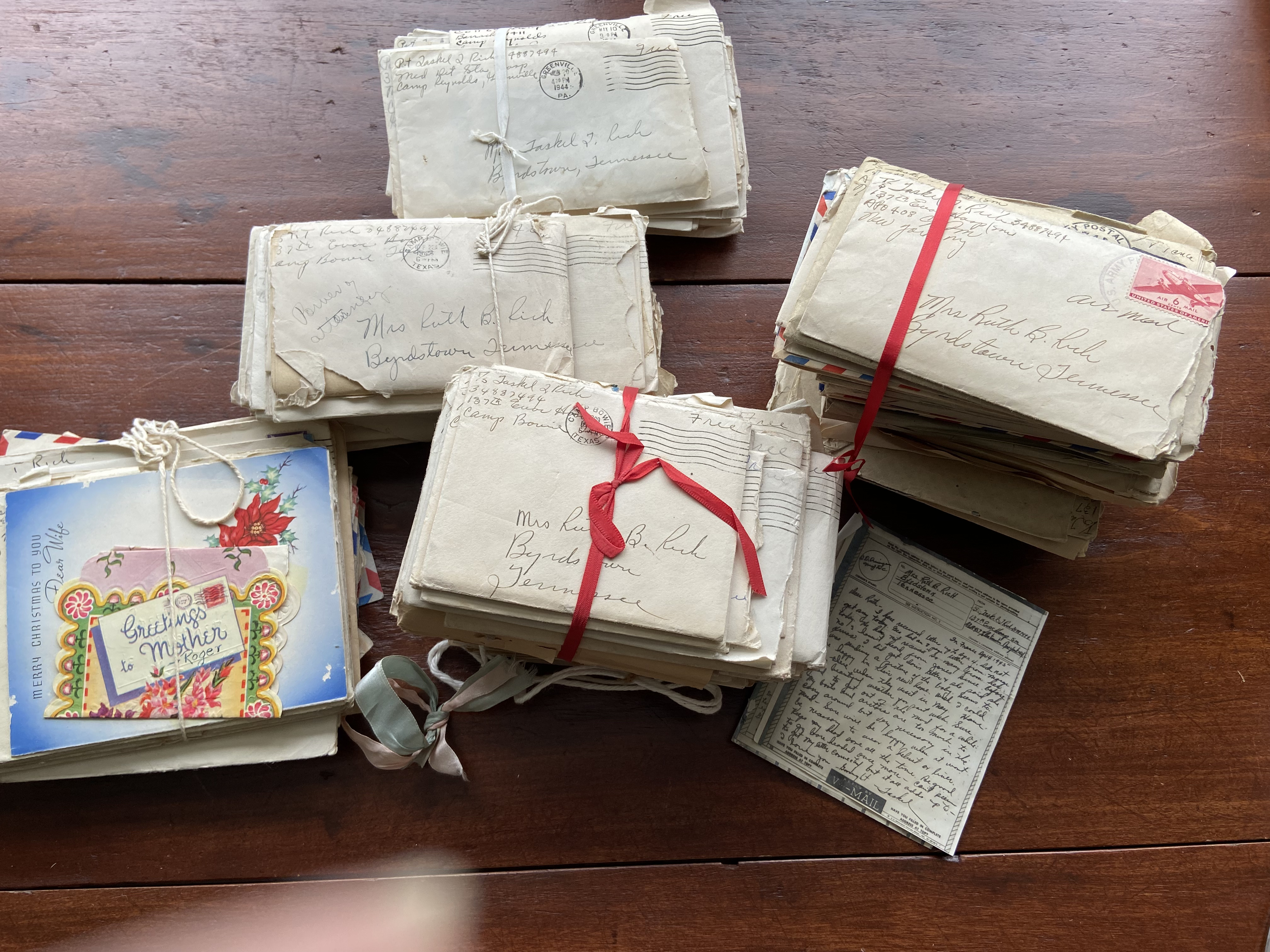
A tattered cardboard box filled with letters has been in a corner of a room at our house since 1992.  Not long after Mom’s death, Dad moved from his home in Byrdstown, Tennessee.

            Dad sold the house that he and Mom built in 1947, the house I grew up in, and he moved to an apartment here in Cookeville. My emotions were too raw to read those letters so soon after Mom’s death and after helping Dad clean out the only house I’d known as his and Mom’s home.

            The letters were tied with narrow satin ribbons.  Some red.  Some pink and blue – the soft hues that would be wrapped around a baby’s gift.  I looked at those ribbons and thought Mom tied those.

            At the time, Dad explained that most were letters he’d written to Mom while he was in the Army.  He served from October 1943 to April 1946, the last two years of World War II and seven months after the end of the war.  

Dad didn’t want to talk about his letters – only to tell me that the signatures on the bottom left-hand corner of envelopes that he’d mailed while stationed in Europe indicated that the letters had been approved by an examiner. 

Dad died in 1997, never looking at the letters. He did identify himself and friends in some black-and-white photos. He was a really good looking solider when he was stationed in Camp Barkley, Oklahoma for basic training.

            Through the years, I’ve read a few letters and every time I had to be careful that my teardrops didn’t smudge the ink.  And every time, I’d think that I needed to get the letters out of the box, but the task seemed overwhelming and I didn’t know how to best store them. 

            About two months ago, I gave up the excuse that I didn’t know how.  I met Megan Atkinson, Tennessee Tech University archivist, and told her about Dad’s letters.  “What should I do to save them?” I asked.

            Her response, while kind and gentle, was immediate and direct.  “Get them out of the envelopes and lay them flat.”  She explained that folded paper becomes weak and tears easily.  “Use a plastic paper clip to attach each letter and its envelope to a blank sheet of paper and store them in acid free folders.”

And I learned that I shouldn’t lay the folders on top of each other because weight weakens paper and to use acid-free storage boxes.   

I asked for help.  Following Megan’s directions, Daughter, two Grands, and I sorted and stored Dad’s 147 letters. We reminded ourselves to stay on task, but my two teen-age Grands found some treasures.  One is a picture of their great-grandfather standing in front of the Arc de Triomphe in Paris.

            Since Mom’s birthday is November 7 and Veteran’s Day is November 11, it’s a good time to honor Mom and Dad.  Time to read and share these letters with their grandchildren and great-grands.    

Is there an age limit?

Micah sat beside me, riding shotgun, in my van.  His three older sisters sat behind us. Someone noticed a sign on a building, read it aloud and we all laughed. 

            I don’t remember the sign.  I remember how tickled my Grands were and their loud laughing, then forced laughs, as if there were a contest for who could laugh longest.  Then silence – until Micah asked a question while we were stopped at a traffic light.  “Is there an age limit for laughing out loud?”

            “What?” said two of Micah’s sisters.

            My nine-year-old Grand repeated, “Is there an age limit for laughing out loud?”      

            I bit my tongue to not say what came to mind. No, everyone can laugh out loud.  What made you think that?

            “Micah, why’d you say that?” his fourteen-year-old sister asked.

            “Well, grown-ups don’t laugh much,” he answered.

            “Like who?” Micah named a few names and I admit I was glad he didn’t say mine.

            “Grown-ups work more than we do and maybe they just don’t have as much to laugh about,” Micah’s sister said.

            Again, silence filled my van. Micah looked out the passenger side window. “But they can laugh loud if they want to?”

            “Yes!” All four of us answered.

            Micah grinned.  “Good,” he said.

            Since that day a month ago, I’ve listened and watched.  We grown-ups chuckle.  We snicker.  But I can count on one hand the times I’ve heard adults laugh out loud – even for a few seconds.   

            One of those times was last week when two friends and I sat in the basement of First United Methodist Church on the monthly food distribution day. I usually stand outside, greet those who drive through the car line and ask the best place in their vehicles to put the boxes of food. 

But that day others were outside and I was tired.  “Is there anything to do sitting down and not have to think?’ I asked the person in charge.  I hoped she’d say there wasn’t and I’d go home.

            “Yes, get tea bags ready to give next month.”  So, for an hour, Ellen, Jennie, and I opened boxes of 100 teabags and put six teabags in zip-lock bags.     

           Ellen had worked alone before Jennie and I joined her. She showed us how to lay the tea bags flat and where to put the zip lock bags to keep a running total. Jennie and I determined one of us could open and close the bags and the other could put the teabags in. 

          Maybe it was because I thought it was faster to not lay the teabags flat or the questioning frown on Ellen’s face or the overwhelming aroma of tea or the flakes of tea that fell on our clothes or that opening zip lock bags isn’t easy. Whatever.  We three got our tickle-boxes tuned over and laughed out loud for an hour.  Oh, it felt good.

            So, Micah, there’s no age limit for laughing out loud.  If you’d been there, you’d laughed with us.

The Stuff of Nightmares

I walk down the school hallway to my 4th grade classroom, open the door, and my students aren’t there – even though I’d left the room only minutes earlier.  What happened?  Where are they?  Maybe they’re in the gym or the music classroom or the library.  They aren’t.  I checked the cafeteria, but no one is there.

            As I hurry to the outside playground, I meet my principal in the hallway.  I can’t let her know I’m looking for twenty-five kids.  A teacher doesn’t lose her students.  So, I smile, walk past her, run to get outside.  But nobody is on the playground. 

            That’s my stress nightmare.  Although I’ve been retired for fourteen years, I still sometimes awake in a panic.  During my twenty-six years teaching, I never lost my students so why does this dream still haunt me?

            When I read Ty Kernea’s Facebook posts and the many comments that followed, I laughed and at the same time felt compassion for each person who wrote.  Ty, former Herald-Citizen photographer extraordinaire, shared his nightmare.  He positions people for a group photo, turns around to walk to the shooting spot, turns back around, and everyone is leaving.  Ty runs to stop them and repeatedly yells, “I haven’t taken the photo yet!” 

            Kimberly shared The Actor’s Nightmare.  After being cast in a play and nearing opening night, she is ready to walk on stage and doesn’t know her lines or the play. 

            Former caterer Diana dreams that she is to prepare food and serve a large group of people at a banquet.  The meat is frozen and the people are walking through the doors of the banquet hall.

            Fellow Herald-Citizen columnist Drucilla dreams take her to the days when she owned a beauty shop.  She gets behind doing her work and many women are sitting with permanent rollers in their hair. 

            Donnie, a truck driver, pulls his tractor trailer to the side of the road and gets out to walk around his truck.  When his foot falls, he sees a huge void underneath.  Sometimes the void is a cliff; sometimes it’s burning like a volcano.  He gets back into his truck to drive it onto the road, but the truck falls.  All he can see is the sky above.  He braces for impact, but the fall never ends.

            Most of us can relate to Sharon’s dream.  She is driving to work and her car breaks down so she’s   going to be late. No matter what she does, she can’t get to work. Even when she runs, she’s held back.

Sharon also shared a student or teacher nightmare.  She’s locked in the English building in the dark at TTU and the building is haunted.

            Thanks to all who let me share your nightmares.  I laugh at these impossible situations, and, at the same time, I take comfort knowing that others occasionally awake in a panic, a cold sweat. 

            Diana commented under Ty’s Facebook post that maybe he could start a therapy group.  I think he did.

Lunch at a Gas Station

While listening to Tommy Tomlinson’s podcast, SouthBound, I was taken back to a time when my dad and his friend owned a Gulf Service Station in small-town USA, and I thought of food sold at gas stations through the years.

Tomlinson’s guest was Kate Medley, a photojournalist who has, in her words, spent years roaming the South to take pictures of gas station food and the people and places that serve it.  Her recently published book entitled Thank You Please Come Again includes 200 photographs.

Medley talked about service stations, convenience stores, and quick stop markets.  She sampled tamales, fried fish, and sandwiches of all kinds: everything from bologna to ham and cheese to banh mi, a sandwich combination of meat and vegetables.

In the 1950s, the only food and drink for sale at Dad’s and Omer’s Gulf Station were salted peanuts, candy bars, and cokes, sold in a big drink machine.  Cokes, of course, refer to all carbonated beverages and they were in thick glass bottles.

After drinking some of a coke, I carefully poured peanuts from a small cellophane package into the thick glass coke bottle.  The drink fizzed.  The peanuts rose to the top.  And almost every time I drank this concoction, I spilled it on my shirt.  

There was an electric coffee percolator in Dad’s and Omer’s office, but the coffee wasn’t for sale.  It was for everyone who wanted a cup of coffee. Mechanics who worked in the garage, employees who pumped gas, cleaned windshields, and checked oil, and friends who stopped by to visit.  A service station was place for men to hang out and swap stories, but no one expected to buy lunch there. 

When did gas stations begin serving food?  Or maybe when did quick stop markets started selling gas?

 By the 1970s, convenience stores that sold gas, grocery items, and fast food were popular.  For a few years, Husband and his business partner owned three Lickity Split Markets here in Cookeville.  Lickity Split Fried Chicken, whole pieces with bones and a thick breaded coating, and potato wedges were big sellers.  Cold custom-made sandwiches were also available.  Customers could fill their car with gas and clean their windshield, buy lunch, and pick up a few groceries all in one stop. 

Now, it’s common for most of us when driving long distances to make one stop for everything:  a bathroom, fill the gas tank, and buy a snack or meal, that could be hamburgers, soup, tacos, fruit, salad, chicken wrap – almost anything.

Photojournalist Medley discovered that today’s markets supply more than food and gas.  On her website she wrote, “In an ever more divided America, these iconic gathering spaces provide unexpected community, generosity, labor, and creativity.”

Community gathering places – much like Dad’s service station seven decades ago. 

The book’s subtitle is How Gas Stations Feed & Fuel the American South.  Makes me want to drive the blue highways and check out gas station food.  And the book will be on my Christmas want list. 

Catching Up with Slang

I asked a Grand if he’d like more milk and he answered, “I’m good.” I didn’t immediately understand.  I knew he was good.  A good kid.  A good eater. But what did that have to do with my offer to pour milk into his empty glass while we ate supper?

            “I know you’re good.  Do you want more milk?” I asked.

            He shook his head.  “No, I’m good.”  I understood that answer.  No more milk.  Why didn’t he say so?   Later, after listening for this phrase as people talked, I realized that my Grand responded as many others do.

            Maybe you’ve heard the phrase I’m good to answer questions and refuse offers.  Would you like to go to the movies with me tomorrow afternoon?  Are you cold?

I tried a new recipe for pecan pie.  Would you like a piece?  

I’m going for a walk.  Want to go with me?

It seems that I’m good can be the response to all of these questions.

            What happened to direct, simple answers?  No, I can’t go to the movies.  I’m not cold – I’m comfortable.  No, thank you seems like a polite answer for a pie offer or to go for a walk.

            Now, I interpret I’m good as no, but when I hear those two words, I sometimes think of my dad, a high school English teacher sixty years ago.  He taught me a lesson I’ve never forgotten.  I’m well refers to physical well-being and I’m good to mood.

I ask friends, “Are you okay?” When they say I’m well, I know they feel physically healthy.   When they say I’m good, I know my friends are happy and having a good day.  

            When did people start saying I’m good not to describe their mood, but instead as a refusal?  The online Urban Dictionary listed I’m good as slang to mean rejection or ridicule in its 2008 edition.  

            Sidenote: The Urban Dictionary, according to its site, was created in 1999 by a then-college freshman who was a computer science major at California Polytechnic State University as a mockery of Dictionary.com.  The Urban Dictionary is like Wikipedia in that anyone can edit, revise and submit text so I take information on both websites with a grain of salt, as Granny used to say, when she doubted something she’d been told.

            But I have confidence in the online Oxford English Dictionary and I’m surprised to read that I’m good was first listed in 1966.  The phrase is used in response to a question or request to mean no thank you or I’m not in need of anything.

            So, I’m way behind the times.  However, Dad’s grammar lesson has stuck with me and I’ll continue to say what my parents taught me when I’m offered something I don’t want: No, thank you.

But I do understand my Grand when he says I’m good.  And I always think he’s a really good kid.

When You Meet an Astronaut

Astronaut Roger Crouch was born in 1940 in Jamestown, Tennessee, an hour’s drive from Cookeville and thirty minutes from Byrdstown, my childhood hometown.  While an elementary student, Crouch saw the movie “Destination Moon” and dreamed of flying in space.  

            To work toward that dream, Crouch applied to the Navy and Air Force, but was rejected because of his color blindness.  He earned a B. S. in physics at Tennessee Tech, and a master’s and Ph. D. in physics from Virginia Tech.  While Crouch was a college student, a new organization NASA, the National Air and Space Administration, put out a call for its first astronauts.  But again, his color blindness ruled Crouch out.

            After completing college, Crouch worked as a NASA program scientist on five spacelab flights for the space shuttle.  He was a group leader and researcher at the NASA Langley Research Center.  Although his experiments were flying in space, he was still on the ground. 

            Then NASA created a new class of astronauts: payload specialists, who would work with onboard experiments. The physical requirements were different.  Colorblindness couldn’t hold Crouch back.  He was accepted and trained as the back-up payload specialist for a 1992 mission.

April 1997, Crouch, at age 56, finally realized his dream.  He flew aboard the Space Shuttle Columbia on a planned fifteen-day mission to complete microgravity experiments, but the mission was aborted due to a fuel problem.  Columbia was repaired. Three months later, Crouch returned to space where he flew a complete mission.  He logged nineteen days in space. 

            Last Wednesday, Husband and I and our 16-year-old Grand, Elsie, toured the Kennedy Space Center.  Looking over the day’s activities, we saw that Astronaut Roger Crouch would be signing autographs.  Husband and I stood in line, but we had nothing to autograph.

“I just want us to meet him, say we know where he grew up, and maybe get a picture,” I said.  Others had stood behind Crouch, seated at a table, while a NASA employee snapped a picture.  We looked for Elsie who was studying Atlantis Shuttle displays while we waited.

“Maybe Elsie has something to autograph,” Husband said.  She did. Her brand-new gray cap with the meatball NASA logo.

Roger Crouch, age 83, nodded a greeting.  Elsie laid her cap on the table. “Will you sign this, please?” With a shaky hand, Crouch wrote his name.

“You’re from Jamestown,” I said. “Not far from where I grew up in Byrdstown.”

“Byrdstown!” Crouch looked surprised.

“We live in Cookeville now.”

“I went to Tennessee Tech!” Crouch shook his head and grinned.

“We’d like a picture.”

“Come around here.” Astronaut Crouch stood quickly, gestured to all three of us, put an arm around Elsie’s shoulders, and grabbed my hand.  “Byrdstown. Cookeville.  Oh, my.”

We talked briefly (he hasn’t been to Jamestown since his mom died in 2021), and we could’ve talked a while, but others waited.  “You folks have a good day,” Crouch said.

When you meet an astronaut, who through determination, hard work and perseverance fulfilled his childhood dream, it’s a good day.

Write to Become More Human

Sometimes I read a book that I want everyone to read.  A book that’s positive, offers hope, and encourages.  A book filled with quotes, practical advice, and humor.  A book in which I’ve turned down page corners, underlined sentences, and filled with post-it notes. 

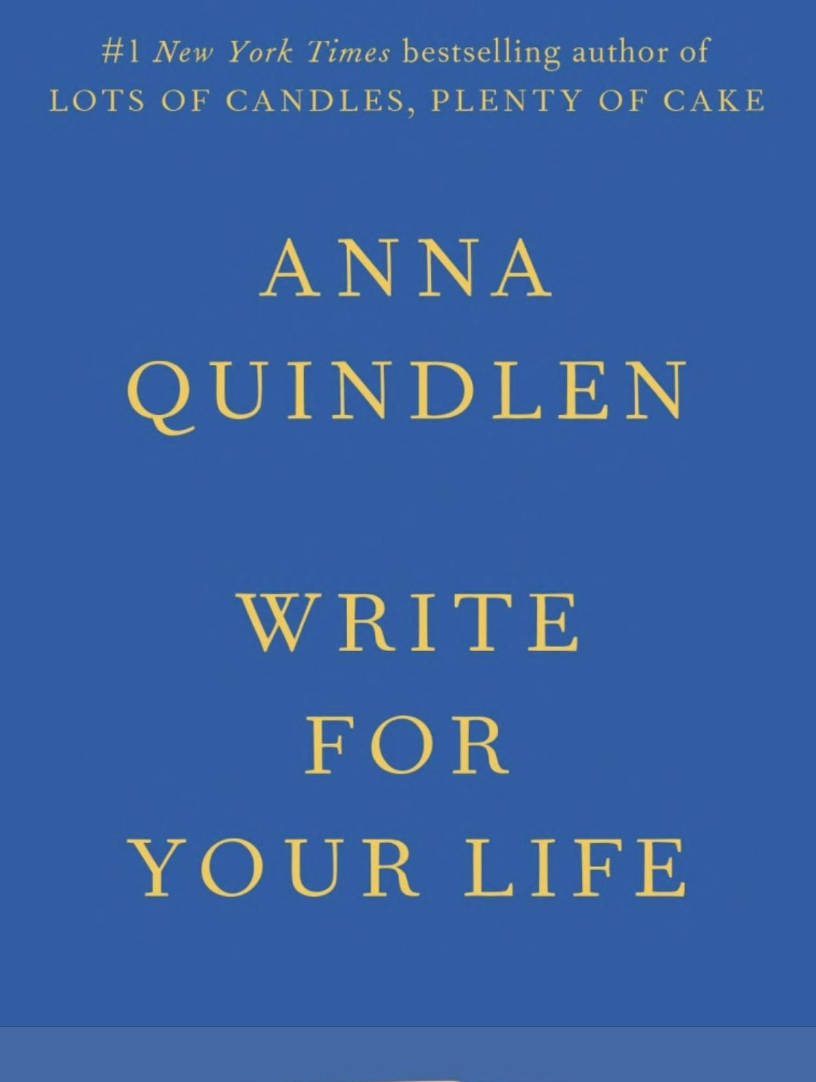
            Write for Your Life by Anna Quindlen is such a book.  Maybe you recognize Quindlen’s name for her best sellers Still Life with Bread Crumbs and Object Lessons or one of her other six fiction books.  Her non-fiction books speak to wide audiences from young to old, and she won the Pulitzer Prize for Commentary in 1992 for her op-ed column, Public & Private, in the New York Times. 

            Quindlen’s successes give credence to Write for Your Life.  She says this book is for those of us she calls “civilians,” people who want to use the written word to become more human, more themselves.  She states that there has never been a more important time than now to record what we are thinking and feeling.  Writing connects us to ourselves and to those we cherish.

            This is not to suggest that we write a book or a short story or even a newspaper column. Think of writing to yourself or those you love most.  A journal, a diary, free writing – call it what you want.  Quindlen says, “Write your daily story.”

            The book begins by telling of a girl who received a diary for her thirteenth birthday in 1942.  On the first page the young girl wrote, “I hope I shall be able to confide in you completely and I hope you will be a great support and comfort to me.”  We’ve read her writings in The Diary of Anne Frank, first published in 1947.

            Quindlen reminds us, that Anne Frank wasn’t writing a book.  She was talking to herself in the same way any of us can.  Day after day, she wrote her thoughts and feelings.

If I weren’t already hooked, the author states that writing is the gift of your presence forever.  “Think of it this way:  If you could look down right now and see words on paper, from anyone on earth or anyone who has left it, who would that be?  And don’t you, as do I, wish that person has left such a thing behind?  It doesn’t really matter what you say.  It matters that you said it.”

            I treasure all writings left by my grandparents and parents.  Even the scribbles on bank deposit slips and notes on birthday cards.  And while I treasure saved letters, those aren’t their daily thoughts.  How I wish I knew their feelings, their daily lives.

            For those who feel uncomfortable putting pen to paper or your fingers on a keyboard, Quindlen lays out examples and says “Don’t get it right, get it written.” 

            Take ten minutes to put today’s thoughts, feelings, plans, and activities on paper.  It’ll clear your mind and leave your legacy.   

            And read the book.

Some Food Fads Stick Around

Who remembers the first salad bars?  Chopped iceberg lettuce, tomatoes, cucumbers, and carrots.  Two dressings: 1000 Island and French.  When shredded cheese, ham cubes, and croutons were added, a salad became a meal.  Then every type of greens and all things purple (think diced pickled beets) and red and orange and yellow were added.  Even diced canned peaches and cottage cheese.

            As make-it-yourself restaurant meals became popular, we are offered soup and salad bars.  We fill bowls with tomato soup, ate it, and then ate a bowl of chicken noodle soup.  There’s no limit – all we can eat for one flat price.  Start with a spinach and mushroom salad with vinegar and oil dressing and end with fruit and pudding.  

            Restaurant owners have created serve-yourself bars beyond soup and salad.  Potato bars – every topping possible on baked potatoes, not just traditional sour cream and butter.  Bacon bits, green onions, sauteed mushrooms are popular.  A pasta bar Husband and I recently passed up offered six kinds of pasta and red and white sauces, even a pink one.  I wondered if it was a mixture of marinara and alfredo sauces  It looked like Pepto Bismol which was a reason to skip the whole pasta bar.  

            A few years ago, I learned to pronounce charcuterie at the same time I learned which deli meats and cheeses to lay side-by-side.  Now, that’s called a Classic Charcuterie Board.  An article in a recent Taste of Home magazine is entitled, “32 Best Charcuterie Board Ideas for Every Occasion.”  Anything and everything can be placed together on anything and everything – from a dinner-plate size wooden disc to a twelve-person dining room table – and it’s a charcuterie board.

            Two of my favorites are a chocolate board and a pancake board.  Who wouldn’t like all things chocolate?  Hot chocolate, chocolate covered strawberries and cherries and pretzels, chocolate chunk cookies, even homemade chocolate ganache to dip fruits.  And all kinds of chocolate:  dark, milk, white and salted.

            My Grands would probably like the fluffy pancakes I make even better if I served beside banana slices and berries, peanut butter and Nutella, sprinkles, chocolate chips, marshmallow cream, and flavored syrups.  And we all like pancakes topped with whipped cream – some like a cherry on top.

            A Thanksgiving Board looks interesting, but sliced pears and apples, spiced pecans, olives, and cheese can never replace turkey, cornbread dressing, and giblet gravy.

            I don’t keep up with food fads, but I’ve noticed pimento cheese isn’t just for sandwiches and to stuff celery.  Last week I ate a hamburger topped with pimento cheese and it was delicious. Have you tried pimento cheese dip or pimento cornbread muffins?  How about pimento cheese and ham pizza?  Deviled eggs?  Breakfast bake? 

            Surely pimento cheese could be featured on a charcuterie board.  Think of the possibilities.  With bacon or red onion or toasted pecans or shredded apples.  White sharp cheddar cheese.  Creamy Velvetta.  Even pimento Brie. 

            And pimento cheese on a salad bar?  Why not?  It’ll be right beside the celery.

She Threw Her Arms Around Him

She was 7 when he was born.  From the stories I’ve heard, Husband was his aunt Shirley’s live doll and she carried him until he got too heavy for her – maybe that’s when she started calling him Big Boy.  My first memory of Shirley was when Husband and I were dating and I visited his family’s holiday gathering.  Shirley held her arms wide, wrapped them around Husband and said, “My Big Boy.” 

            At that time, I didn’t understand their relationship.  As children and through her teen-age years, they had lived next door to each other and their parents worked together in the family-owned Ray’s Bi-Rite grocery, next to her home.  Shirley was like a big sister who adored her nephew and she spoiled him.  

            Because Ray’s Bi-Rite didn’t stock Fritos and Husband like them, Shirley, a high school student, bought them for him at another store.  When she was a TPI student, she gave him a purple sweat shirt embossed with Golden Eagle, now known as Awesome Eagle.  Husband wore that shirt to school at least twice a week.

She celebrated his every birthday, every milestone, and was sad when she couldn’t attend Husband’s and my wedding, but she had good reason: her son was born just hours after we said I do.

During the early years of our marriage, we saw Shirley, her husband Owen, and their two children at holiday gatherings at Husband’s grandparents’ home here in Cookeville.  

But I got to know Shirley and Owen well when Husband, our two young school-age children, and I visited them in Athens, Georgia.  They welcomed us with smiles and hugs and gave us a tour of their work place, the University of Georgia. Owen was a professor and she worked in an administrator’s office.  

The campus was beautiful, but the football game between the hedges was the highlight of the visit. Owen and Shirley recognized that Son was taken with their Dawgs so both he and Daughter left Athens wearing Georgia sweatshirts. 

Son’s bedroom was redecorated: Georgia wallpaper border, a Georgia comforter and curtains.  Through the years, Shirley and Owen gave t-shirts, caps, and banners, and all our family, especially Son, are still avid UGA football fans.

Husband often talks with Shirley, but they hadn’t been together for a few years so he and I recently visited Owen and her – not in Athens – in Ohio where they moved five years ago to a senior living facility near their daughter and her family. 

Shirley opened the door of their independent living apartment.  She wrapped her arms around Husband, lay her head on his chest, and said, “My Big Boy.”  Owen, wearing a Georgia t-shirt and a red Bulldog cap, held his arms toward me, then hugged tightly, and said, “I’m so glad you’re here.”

Our two-day visit was perfect.  Time to talk, share photos, catch-up on family news, and reminisce.  As Husband and I drove out of the senior living parking lot, Shirley stood on her second story apartment balcony, waved and blew kisses. 

            Everybody should have an Aunt Shirley.

Celebrating Grandparents


 Daughter sent a quote to Husband and me:  The only real parenting hack is to live close to grandparents.         

I don’t know Peter Yang, Canadian writer, entrepreneur, and public speaker, but I agree with the 86,700 people who liked his twitter post.  Daughter added five red hearts and THANK YOU! at the end of her text message. I wiped a happy tear from my cheek when I first read it, and now that I’ve lived with this quote for months, I treasure it.

            Those of us who grew up near grandparents knew we could hide away at their house.  Granny, my paternal grandmother, lived close by – what would be half a city block, but in Byrdstown there weren’t blocks, just roads.  I often nonchalantly said, “I’m going to Granny’s,” and I’d run out our back door and be sitting beside Granny on her pea green nylon covered couch before Mom could ask if I’d finished my homework.

            Granny’s screen door was always unlocked and she always had milk, Hershey’s cocoa, sugar and butter to make grainy chocolate candy.  

            My maternal grandparents lived a ten-minute drive away and I often visited.  Although my grandparents weren’t ‘huggers,’ I knew they loved me no matter if I showed up wearing a dirty t-shirt and shorts or my Sunday dress.

            When Daughter and Son were toddlers, Husband and I moved back to Cookeville; we wanted our children to be closer than three hours away from grandparents.  Through the years, I watched as children and grandparents bonded in everyday life.

After Daughter and Son became independent adults, I realized that their grandparents were the stabilizers for them and me when they were teenagers.  When Daughter drove to Grandmother’s (Husband’s mother), I knew she was going for more than the orange sherbet ice cream push-ups in Grandmother’s freezer. And I remember Mom said, ‘They’ll grow out of it.  Just love them.’ 

Curious to know professional opinions about the influence of grandparents, I googled why grandparents are important.  One article published by Focus on the Family rings true:  We provide unconditional love, perspective, stability, adventure and connections.  

Daughter’s family lives about a 1½ miles from Husband and me.  These five Grands gave me birthday greetings that confirm research.  My gift was a quart canning jar filled with notes that my Grands had written – most words of appreciation.

All wrote of time spent together: making a quilt, learning cursive, Purple Cow stories, reading poems and books, writing stories, playing cards and board games, putting puzzles together, bedtime back rubs, going places, spending the night. And they wrote about food:  bread and rolls, pancakes with sprinkles, fried dill pickles, bacon and scrambled eggs, fried okra.

            Our fourteen-year-old Grand could write the book on grandparenting.  My favorite notes from her: You never give up on us even when we’re extremely aggravating.  You always want the best for us, no matter what you want. You love us so much and care for us and expect nothing in return…..except our smiles.

            She’s right.