• Recent Posts

  • Archives

  • Categories

  • Meta

Is there an age limit?

Micah sat beside me, riding shotgun, in my van.  His three older sisters sat behind us. Someone noticed a sign on a building, read it aloud and we all laughed. 

            I don’t remember the sign.  I remember how tickled my Grands were and their loud laughing, then forced laughs, as if there were a contest for who could laugh longest.  Then silence – until Micah asked a question while we were stopped at a traffic light.  “Is there an age limit for laughing out loud?”

            “What?” said two of Micah’s sisters.

            My nine-year-old Grand repeated, “Is there an age limit for laughing out loud?”      

            I bit my tongue to not say what came to mind. No, everyone can laugh out loud.  What made you think that?

            “Micah, why’d you say that?” his fourteen-year-old sister asked.

            “Well, grown-ups don’t laugh much,” he answered.

            “Like who?” Micah named a few names and I admit I was glad he didn’t say mine.

            “Grown-ups work more than we do and maybe they just don’t have as much to laugh about,” Micah’s sister said.

            Again, silence filled my van. Micah looked out the passenger side window. “But they can laugh loud if they want to?”

            “Yes!” All four of us answered.

            Micah grinned.  “Good,” he said.

            Since that day a month ago, I’ve listened and watched.  We grown-ups chuckle.  We snicker.  But I can count on one hand the times I’ve heard adults laugh out loud – even for a few seconds.   

            One of those times was last week when two friends and I sat in the basement of First United Methodist Church on the monthly food distribution day. I usually stand outside, greet those who drive through the car line and ask the best place in their vehicles to put the boxes of food. 

But that day others were outside and I was tired.  “Is there anything to do sitting down and not have to think?’ I asked the person in charge.  I hoped she’d say there wasn’t and I’d go home.

            “Yes, get tea bags ready to give next month.”  So, for an hour, Ellen, Jennie, and I opened boxes of 100 teabags and put six teabags in zip-lock bags.     

           Ellen had worked alone before Jennie and I joined her. She showed us how to lay the tea bags flat and where to put the zip lock bags to keep a running total. Jennie and I determined one of us could open and close the bags and the other could put the teabags in. 

          Maybe it was because I thought it was faster to not lay the teabags flat or the questioning frown on Ellen’s face or the overwhelming aroma of tea or the flakes of tea that fell on our clothes or that opening zip lock bags isn’t easy. Whatever.  We three got our tickle-boxes tuned over and laughed out loud for an hour.  Oh, it felt good.

            So, Micah, there’s no age limit for laughing out loud.  If you’d been there, you’d laughed with us.

Catching Up with Slang

I asked a Grand if he’d like more milk and he answered, “I’m good.” I didn’t immediately understand.  I knew he was good.  A good kid.  A good eater. But what did that have to do with my offer to pour milk into his empty glass while we ate supper?

            “I know you’re good.  Do you want more milk?” I asked.

            He shook his head.  “No, I’m good.”  I understood that answer.  No more milk.  Why didn’t he say so?   Later, after listening for this phrase as people talked, I realized that my Grand responded as many others do.

            Maybe you’ve heard the phrase I’m good to answer questions and refuse offers.  Would you like to go to the movies with me tomorrow afternoon?  Are you cold?

I tried a new recipe for pecan pie.  Would you like a piece?  

I’m going for a walk.  Want to go with me?

It seems that I’m good can be the response to all of these questions.

            What happened to direct, simple answers?  No, I can’t go to the movies.  I’m not cold – I’m comfortable.  No, thank you seems like a polite answer for a pie offer or to go for a walk.

            Now, I interpret I’m good as no, but when I hear those two words, I sometimes think of my dad, a high school English teacher sixty years ago.  He taught me a lesson I’ve never forgotten.  I’m well refers to physical well-being and I’m good to mood.

I ask friends, “Are you okay?” When they say I’m well, I know they feel physically healthy.   When they say I’m good, I know my friends are happy and having a good day.  

            When did people start saying I’m good not to describe their mood, but instead as a refusal?  The online Urban Dictionary listed I’m good as slang to mean rejection or ridicule in its 2008 edition.  

            Sidenote: The Urban Dictionary, according to its site, was created in 1999 by a then-college freshman who was a computer science major at California Polytechnic State University as a mockery of Dictionary.com.  The Urban Dictionary is like Wikipedia in that anyone can edit, revise and submit text so I take information on both websites with a grain of salt, as Granny used to say, when she doubted something she’d been told.

            But I have confidence in the online Oxford English Dictionary and I’m surprised to read that I’m good was first listed in 1966.  The phrase is used in response to a question or request to mean no thank you or I’m not in need of anything.

            So, I’m way behind the times.  However, Dad’s grammar lesson has stuck with me and I’ll continue to say what my parents taught me when I’m offered something I don’t want: No, thank you.

But I do understand my Grand when he says I’m good.  And I always think he’s a really good kid.

When You Meet an Astronaut

Astronaut Roger Crouch was born in 1940 in Jamestown, Tennessee, an hour’s drive from Cookeville and thirty minutes from Byrdstown, my childhood hometown.  While an elementary student, Crouch saw the movie “Destination Moon” and dreamed of flying in space.  

            To work toward that dream, Crouch applied to the Navy and Air Force, but was rejected because of his color blindness.  He earned a B. S. in physics at Tennessee Tech, and a master’s and Ph. D. in physics from Virginia Tech.  While Crouch was a college student, a new organization NASA, the National Air and Space Administration, put out a call for its first astronauts.  But again, his color blindness ruled Crouch out.

            After completing college, Crouch worked as a NASA program scientist on five spacelab flights for the space shuttle.  He was a group leader and researcher at the NASA Langley Research Center.  Although his experiments were flying in space, he was still on the ground. 

            Then NASA created a new class of astronauts: payload specialists, who would work with onboard experiments. The physical requirements were different.  Colorblindness couldn’t hold Crouch back.  He was accepted and trained as the back-up payload specialist for a 1992 mission.

April 1997, Crouch, at age 56, finally realized his dream.  He flew aboard the Space Shuttle Columbia on a planned fifteen-day mission to complete microgravity experiments, but the mission was aborted due to a fuel problem.  Columbia was repaired. Three months later, Crouch returned to space where he flew a complete mission.  He logged nineteen days in space. 

            Last Wednesday, Husband and I and our 16-year-old Grand, Elsie, toured the Kennedy Space Center.  Looking over the day’s activities, we saw that Astronaut Roger Crouch would be signing autographs.  Husband and I stood in line, but we had nothing to autograph.

“I just want us to meet him, say we know where he grew up, and maybe get a picture,” I said.  Others had stood behind Crouch, seated at a table, while a NASA employee snapped a picture.  We looked for Elsie who was studying Atlantis Shuttle displays while we waited.

“Maybe Elsie has something to autograph,” Husband said.  She did. Her brand-new gray cap with the meatball NASA logo.

Roger Crouch, age 83, nodded a greeting.  Elsie laid her cap on the table. “Will you sign this, please?” With a shaky hand, Crouch wrote his name.

“You’re from Jamestown,” I said. “Not far from where I grew up in Byrdstown.”

“Byrdstown!” Crouch looked surprised.

“We live in Cookeville now.”

“I went to Tennessee Tech!” Crouch shook his head and grinned.

“We’d like a picture.”

“Come around here.” Astronaut Crouch stood quickly, gestured to all three of us, put an arm around Elsie’s shoulders, and grabbed my hand.  “Byrdstown. Cookeville.  Oh, my.”

We talked briefly (he hasn’t been to Jamestown since his mom died in 2021), and we could’ve talked a while, but others waited.  “You folks have a good day,” Crouch said.

When you meet an astronaut, who through determination, hard work and perseverance fulfilled his childhood dream, it’s a good day.

Celebrating Grandparents


 Daughter sent a quote to Husband and me:  The only real parenting hack is to live close to grandparents.         

I don’t know Peter Yang, Canadian writer, entrepreneur, and public speaker, but I agree with the 86,700 people who liked his twitter post.  Daughter added five red hearts and THANK YOU! at the end of her text message. I wiped a happy tear from my cheek when I first read it, and now that I’ve lived with this quote for months, I treasure it.

            Those of us who grew up near grandparents knew we could hide away at their house.  Granny, my paternal grandmother, lived close by – what would be half a city block, but in Byrdstown there weren’t blocks, just roads.  I often nonchalantly said, “I’m going to Granny’s,” and I’d run out our back door and be sitting beside Granny on her pea green nylon covered couch before Mom could ask if I’d finished my homework.

            Granny’s screen door was always unlocked and she always had milk, Hershey’s cocoa, sugar and butter to make grainy chocolate candy.  

            My maternal grandparents lived a ten-minute drive away and I often visited.  Although my grandparents weren’t ‘huggers,’ I knew they loved me no matter if I showed up wearing a dirty t-shirt and shorts or my Sunday dress.

            When Daughter and Son were toddlers, Husband and I moved back to Cookeville; we wanted our children to be closer than three hours away from grandparents.  Through the years, I watched as children and grandparents bonded in everyday life.

After Daughter and Son became independent adults, I realized that their grandparents were the stabilizers for them and me when they were teenagers.  When Daughter drove to Grandmother’s (Husband’s mother), I knew she was going for more than the orange sherbet ice cream push-ups in Grandmother’s freezer. And I remember Mom said, ‘They’ll grow out of it.  Just love them.’ 

Curious to know professional opinions about the influence of grandparents, I googled why grandparents are important.  One article published by Focus on the Family rings true:  We provide unconditional love, perspective, stability, adventure and connections.  

Daughter’s family lives about a 1½ miles from Husband and me.  These five Grands gave me birthday greetings that confirm research.  My gift was a quart canning jar filled with notes that my Grands had written – most words of appreciation.

All wrote of time spent together: making a quilt, learning cursive, Purple Cow stories, reading poems and books, writing stories, playing cards and board games, putting puzzles together, bedtime back rubs, going places, spending the night. And they wrote about food:  bread and rolls, pancakes with sprinkles, fried dill pickles, bacon and scrambled eggs, fried okra.

            Our fourteen-year-old Grand could write the book on grandparenting.  My favorite notes from her: You never give up on us even when we’re extremely aggravating.  You always want the best for us, no matter what you want. You love us so much and care for us and expect nothing in return…..except our smiles.

            She’s right.

In the Middle

 Recently, a friend said that she has an older sister and younger brother and as a middle child she struggled to find her place in her family.  I thought of one of my Grands.  Annabel is one of five and she’s smack dab in the middle:  boy, girl, girl, girl, boy.  My friend shook her head and said, “And I thought I had it tough!”           

Those who study family dynamics acknowledge that birth order can affect a person’s personality and I saw some of the stereotypical traits while teaching elementary age students.  First-borns tended to be perfectionists and had three sharpened pencils; the youngest felt entitled and searched for a pencil.  Middle-born children were usually flexible, sociable, peacemakers, creative, and liked to try something new or different, even colored pencils.

             Middle Child Day is August 12, but I can’t wait until August to celebrate middles because Annabel is celebrating her birthday this week.  She showed her middleness when she and I talked about her birthday gift. I suggested that Husband and I give her an experience – not a wrapped-in-a-box gift – and offered two things I knew she liked to do.  She didn’t smile or show a positive response. “Tell me why those aren’t good ideas,” I said.

            “Because I’ve already done both of those,” my Grand said.  So, we have talked about a day at a museum and lunch at a restaurant where she’s never eaten.  But we might, in her words, “do something we haven’t thought of yet.”   

            If you have a middle in your life – friend or family member – you know that they made life a bit more fun.  Maybe you’ve accompanied a group of children on a field trip. While most walk calmly on the sidewalk, the middles likely dance, hop and twirl.  An older middle is often the life of the party, the one who tells jokes and pries the wallflowers from the wall.

            Middles are peacemakers and pleasers.  When a group can’t agree on a restaurant, a middle suggests somewhere that everyone will like.  Middles survey the situation and offer ideas for a decision that all can accept. 

            Middles’ need for independence and to fit in can be strengths, but are sometimes seen as problems. Young middles might misbehave and demand their way to get their parents’ attention.  Yet, as they get older, they are sociable and have a need for friends, often labeled as the family’s ‘Social Butterfly.’ 

            Being a middle child can be tough. Middles are younger siblings, but also older ones, and they can be overshadowed by their siblings.  Dr. Kevin Leman wrote in his book, The Birth Order Book, that middle children are tenacious adults because they learn that life isn’t fair so they are more adaptable and value compromise.

            Obviously, birth order is only one possible factor that determines a person’s personality, but most adult middle children say being stuck in the middle wasn’t easy.  And that’s all the more reason to celebrate my Grand’s birthday.

It’s Girl Scout Cookie Time

“Hi, Pop and Gran. Do you want to buy some Girl Scout cookies?” Our Grand tilted her head, raised her eyebrows and grinned, across many miles as we visited using FaceTime. Of course, Husband and I wanted to buy cookies.  In fact, if our 7-year-old Grand had offered sawdust patties, we’d have been happy to buy some.

            Ann held a colorful brochure in front of her computer camera and named thirteen cookie varieties available this year.  “You’ll probably want the Raspberry Rally.  It’s new this year.” Thirteen varieties!  Thankfully, our favorites are still available: Peanut Butter Tagalongs and Trefoils.   

             “Do you want to know how many are in a box?” Ann held the brochure ready to read, but we didn’t need that information. 

            “Do you want to know about Raspberry Rally? It’s really good. I tasted it at the Cookie Sales Rally. You have to buy it online.  I can’t sell it.”  Since our Grand couldn’t order it, we had an easy out. And who’d want to eat a raspberry flavored cookie when a peanut butter and chocolate Tagalong is a choice?

            Husband and I listened as Ann described each cookie and then we ordered our favorites.

            “How do you want to pay?  Credit card or cash?”  Our Grand had been well trained. 

            Girl Scout cookies have come a long way since the first sales in 1917 when the cookies were baked in homes by Oklahoma troop members and their moms to pay for a troop activity. 

            Five years later, The American Girl magazine, published by the Girl Scouts of the USA included a recipe and suggested that cookies be baked at home and sold for twenty-five to thirty cents per dozen.   Throughout the 1920s, Girl Scouts across the country baked sugar cookies, packaged them in wax paper bags and sold them door-to-door. That century-old recipe inspired Trefoils, the iconic shortbread cookies.

            In 1936, the national Girl Scout organization licensed commercial bakers to produce cookies, using traditional recipes, and cookies were sold nationwide.  Today, two commercial bakers produce the cookies -over 200 million boxes in 2022.

            In the 1950s, local Girl Scout troops set up tables on sidewalks in front of shopping malls for Saturday cookie sales, a tradition that continues.  Fast forward to 2014, cookie sales began online, Digital Cookie® and was deemed a successful program for Girl Scouts of the 21st century. 

            Until the mid-1980s when I worked for the Cumberland Valley Girl Scout Council, I wondered if all the money earned by children paid the salaries of adults sitting behind desks?   That’s not true. The profits provide programs and activities that are determined by the council members, troop leaders and scout members. 

            Do scout members benefit in ways besides earning money?  Our young Grand showed confidence in her sales pitch and she used math skills to determine how much our order of ten boxes cost.  And she was surprised we didn’t order Thin Mints. “They are the most popular, you know?”

            As I said, my Grand was well-trained.

PS. If anyone tries the Raspberry Rally cookies, let me know if they measure up to Tagalongs.

Something from a Box

“Anything special you want to eat while you visit?” I asked two Grands who planned to stay overnight with Husband and me.

            Annabel tilted her head.  “How about Pop Tarts?”

            “For breakfast?” I asked.  Surely, my 11 and 13-year-old Grands wouldn’t choose something from a box over my pancakes.  I’ve made pancakes for my Grands’ breakfasts for longer than these two are old.

            I was relieved when Lucy said, “No, Gran.  We want pancakes for breakfast.  Pop Tarts can be snack.”  Both girls nodded.  Their blue eyes open wide.  Their blond hair shaking.

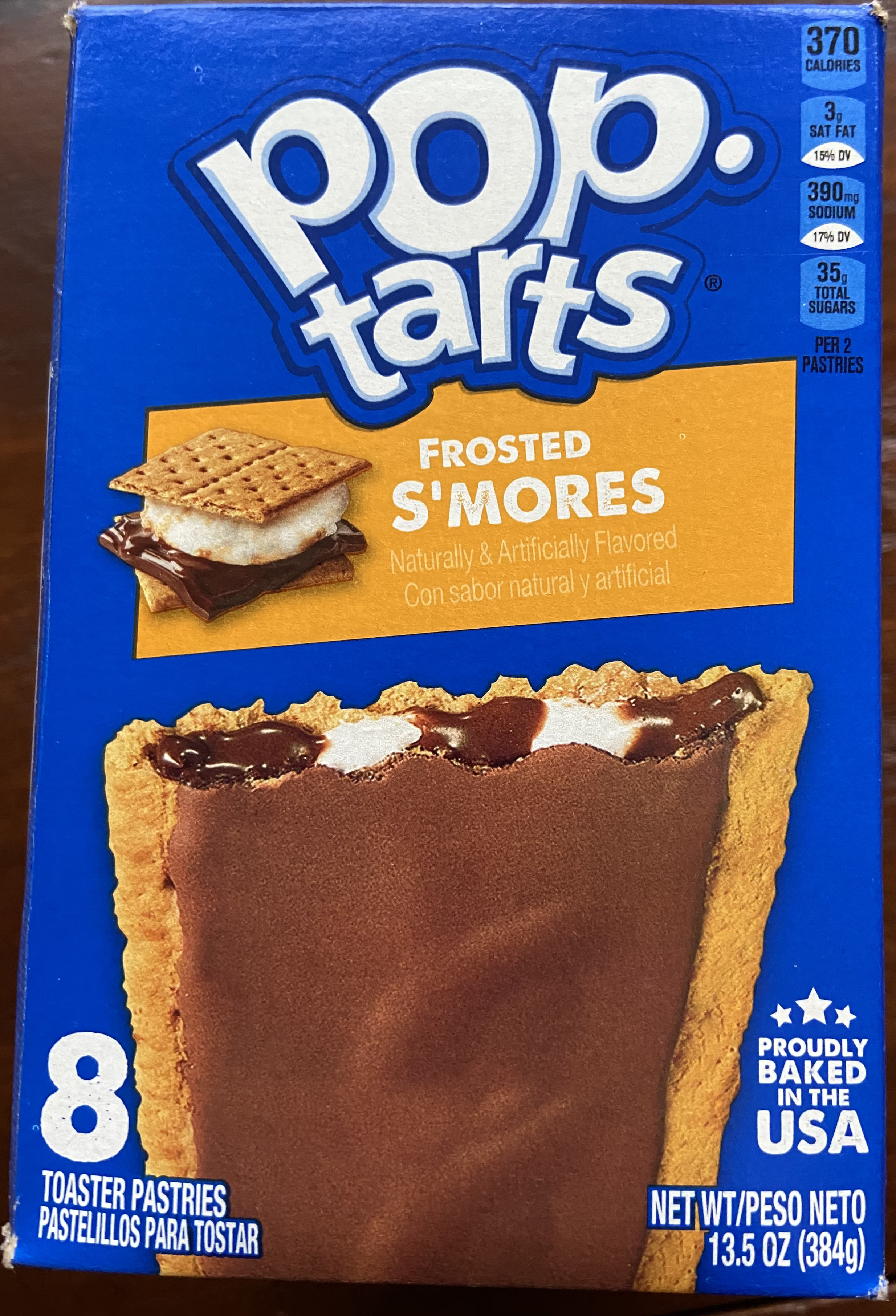
            I added Pop Tarts to my grocery list. “What kind?  Strawberry? Cinnamon?”

            “S’mores!  They’re the best!” said Lucy.

            “The ones with frosting,” Annabel added.

            I was stuck in the 1970s, probably the last time I bought Pop Tarts.   “You mean they have marshmallows and chocolate in them?  Doesn’t the frosting melt when they are heated in the toaster?”

            Again, those enthusiastic nods and the girls gave each other a high-five.

            I was shocked by the display of Pop Tarts at Food Lion.  Six feet long and seven shelves!  Obviously, Pop Tarts are a big seller to warrant such a so much space.  After I’d I counted more than twenty flavors, I wondered when Pop Tarts were first on shelves and how many kinds are available.

            In 1963, Kellogg’s chairman, Bill Lamothe, had an idea to make a breakfast toaster-ready rectangle that could go anywhere. He asked the Kellogg’s kitchen crew to ‘create an ingenious hack on toast and jam,’ according to poptarts.com.  The name Pop Tarts was inspired by the Pop Culture movement of the day, which some of us remember.

            When I suggested strawberry or cinnamon to my Grands, I remembered two of the four original flavors: strawberry, blueberry, apple currant, and brown sugar cinnamon. Frosting was added in 1967 and sprinkles in 1968 and by 1973, there were nineteen flavors which seems like enough choices, but the kitchen crew continues to create choices.

            There’s not a flavor list because the production of flavors changes during a calendar year, but there is something for everyone’s taste.  Traditional flavors are still available: strawberry, chocolate, grape, cherry, and cinnamon.  For those more adventurous, try Frosted Boston Creme Donut, Snickerdoodle, Lemon Cream Pie, Cookies and Cream, Red Velvet, or Apple Fritter.

            My Grands and I made a celebration out of our afternoon snack.  Hot chocolate with marshmallows – the more the better.  Warm, lightly toasted delicious S’more Pop Tarts.  

            We talked about real s’mores. “Remember that time in Colorado when we’d couldn’t build a fire to make s’mores?” Annabel asked.

            “It was really windy,” I said.

            “Was that when Mom and Uncle Eric roasted marshmallows over the stove?”  asked Lucy.  That was the time.  We reminisced and laughed. 

Next time, I think we’ll try Frosted Chocolate Fudge – Annabel says they’re better than S’mores.

Since my Grands talked and laughed while eating something from a box, I’ll gladly spend $3.69 for eight Pop Tarts.  Just don’t expect me to serve them for breakfast.

Kids Talk About Banned Books

While driving with four Grands in my van, their discussion about a Harry Potter book made me think of banned books and recent columns my friend, Jennie Ivey, wrote.  So, here’s another column about banned books – this one from my Grands’ perspectives.

            “Have you talked about banned books in school or at home?” I asked. 

            “What’s a band book?” said my 8-year-old Grand. 

To simplify this writing, the children are identified by age.  Because I was concentrating on driving – not writing notes during the conversation or who said what – quotes may not be exact, but are close.

“Gran said banned books.  Not band books.  Banned comes from b-a-n. Ban.” age 15 said.

“So, what’s a ban?” asked 8. 

The 11 and 13-year-olds giggled.  “Ban means to not allow.”

“Like Gran might ban candy and we can’t have any.”

“We can’t have candy!” 8 asked.  Everyone laughed.

“We can have candy,” 15 said. “That was just a way to say what ban means.  A banned book isn’t allowed to be read.”

“Why couldn’t you read a book?” 8 asked.

I tried to explain, “Sometimes people think a book shouldn’t be read because it might be scary or include things that are aren’t real or death. Like “Charlotte’s Web” because animals talk and they die.”

“But that’s just fiction if it’s not real,” 11 said.

“Then I guess “Animal Farm” would definitely be a banned book and not just because animals talk. I read it for school,” said 15. 

“You read it for school so it’s not banned. Right?” asked 11.

Through several questions and explanations, I think everyone understood that a book can be banned from some schools and public libraries, like the Putnam County Library, but not all schools and libraries. “So, we can still buy a banned book or get it online?  If Momma says we can?” Yes and yes.

“Do you know some banned books, Gran?”  13 asked. When I said that Harry Potter books are banned in some places, my Grands reacted and I listened.

“What! That’s crazy. Why?”

“Probably the spells and witches.”

“And the Quidditch games and riding on broom sticks.”

“And Voldemort and all the mean stuff he does.”

“But it’s all pretend. It’s fiction.  Everybody knows that.”

“Maybe some people think it’s real.”

“Why? Nobody rides on broom sticks in the sky to play a game.”

These children have read the Harry Potter books and watched the movies at home with their parents and siblings.  After a few minutes of talk about favorite scenes and who has read which books and seen which movies, the van was quiet. We were almost home.

Thirteen-year-old ended the discussion. “That’s really sad that somebody couldn’t get to read Harry Potter books.  There’s lots of imagination and fun and the books are a whole lot better than the movies.”

Remember that time when…

I sat in the back seat between Granny and my big brother Roger.  Dad drove our family’s 1956 hardtop Dodge, and Mom held a road map as we travelled from Tennessee to Oklahoma the summer I was ten years old. Granny and I sometimes swapped places and I could feel the breeze from the front seat window, rolled down just a few inches, and I’d crack my window enough to blow my ponytail.The reason for this trip was Granny wanted to visit her nephew’s family; it was my family’s only long-distance driving trip with her.  She wore a shirtwaist cotton dress, heavy black shoes and white anklets, and her white hair was cut short – all common for a 71-year-old-woman.  I thought she was old, really old. 

            As we traveled the two-lane highways, Granny and I played the alphabet game and searched for letters printed on billboards and road signs.  We could claim only one letter per sign from A to Z.  It took a long time to spot the end of the alphabet:  V, X, and Z.  Then we spelled words – our full names and random words.  

            Mom gave updates of how many miles to the next town, which might be just a gas station, grocery store and post office. We stopped at roadside parks to eat the picnic lunch Mom had packed.  Sandwiches, chips, cookies, and Cokes, in thick glass bottles. 

             Recently, I rode with Daughter’s family of seven in their ten-passenger van from Winter Park, Colorado to Cookeville, Tennessee.  During the first hour of travel, all eight of us took in the scenery.  Snow on the mountains above the tree line, arrow straight evergreens below, and deep slopes to valleys.  Switchbacks and steep inclines led to Bethoud Pass at 11,307 feet above sea level, then more curves down the mountain toward Denver.

            Son 2 and 17-year-old Grand sat in the front captains’ seats, taking turns as driver and navigator.  Four other Grands sat in their ‘regular’ seats: two-person bench seats, a three-person bench seat, and a jump seat.  During the two days travels, Daughter and I sat beside each Grand.  They had over-the-seat hanging bags filled with craft and drawing items, small toys, and snacks. And each had a device, a ‘screen.’

            Leaving the mountains, I sat beside Lucy, age 11, who stretched her legs across my lap, leaned against her pillow, covered herself with a quilt and listened to a book downloaded on an iPod.  Another Grand listened to music and solved Rubix Cubes.  Two watched a favorite movie for the umpteenth time.  Daughter took in a downloaded podcast.  All had earbuds or headphones.

            Enjoying the quiet, I read a book downloaded on my iPad.  But we weren’t quiet for the entire twenty-one hours trip, when I sat with my Grands we talked, played pencil and paper games, rubbed backs, and cuddled. 

            Maybe my Grands will have happy memories as I do when Granny and I rode side-by-side to Oklahoma.  They might say, “Remember that time Gran rode home with us from Colorado?” 

Helpful Technology Goes Awry, Again

Today’s guest columnist is Daughter Alicia.  After she read my column about my frustration with QR Codes, she shared a recent technology experience at her house.

Background: our laptop has a pesky habit of interrupting on-screen work with a multitude of notifications. It interrupts with no regard of manners or propriety. No doubt, there is a way to stop notifications, but I haven’t done that. 

When it was time for 15-year-old Elsie to take the drivers’ permit test, we learned it could be taken online. Hooray! How convenient!  I registered to become Elsie’s test proctor and jumped through the hoops downloading the TN proctor ID application, and we were good to go.

I welcome a second teen driver. Every time I get behind the wheel, my offspring share much needed tips in the form of side-eyed comments: “Blinker,” “It’s yellow, Mom,” and “Turn here.”   

Elsie had studied diligently; she was ready. Step one: scan a QR code, after my proctor ID app recognizes my face. In the two weeks since I had installed the app, my face must have morphed to a state of non-recognizability. I timed out three times due to ‘security concerns’ for having the wrong face.    

After a live chat with Josh, an online assistant, who verified I was who I said I was, we were admitted to the testing site. I tried to play it cool as my girl was a shade anxious, but I sweated from the effort of being recognized by the wizardry of biometric identity. 

Elsie read the instructions, which told her to not have any web-connected devices nearby and to not open other on-screen windows (presumably to prevent wayward teens from on-the-spot research/cheating/tom

foolery). Ever the rule follower, she put her phone and Apple watch several feet away. She began.

I sat quietly. No hints. No ‘Are you sure?’ mom-interference. About a dozen questions in, an email notification popped onto the computer screen.  To be able to see question behind the pop-up,  Elsie hit the x to delete the notification.

Immediately, the test screen blacked out and words in big red letters appeared: YOU HAVE FAILED.  Surely not. Oh, but yes. “An alternate tab was opened. This is against the rules. This test is marked FAILED.” 

We stared at each other in disbelief. I cannot think of one thing Elsie has ever failed, and to be suspected of cheating – devastating. I was gobsmacked when I realized she FAILED because she closed a notification: ‘You have a new email.’ Good grief.

Elsie buried her head and came out laughing. We laughed until we cried. I don’t know which was worse for my girl: failure or being found guilty of cheating without a jury of peers. She carries the burden of being the oldest daughter who has a rather high self-imposed bar of success.  The next chance to take this test is 24 hours later.  At which point, we’ll load up and head to the good ole Department of Motor Vehicles Office to test in person, just like God and Henry Ford intended.