• Recent Posts

  • Archives

  • Categories

  • Meta

Mother’s Day Picnic

images

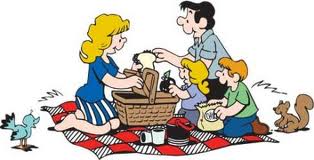
“Oh, make it easy,” I told my family.  “You know I like Kentucky Fried and a picnic.”  My family, like most families, wanted to get me out of the kitchen on Mother’s Day.

“Are you sure you don’t want to go out to eat somewhere?”  Husband asked.  I assured him that a picnic with just him and our children was my choice.  “So where do you want to go?”

“Surprise me!”  I said.

Our children, ages 9 and 11, teased me later that Saturday afternoon.  “You won’t believe where we’re having a picnic.  Guess.  Like 20 questions.”  Have we ever picnicked there?  No.  Have we even been there?  Not really.  Is this a place you think I want to go?  Yes!  Questions and answers all evening long.

Sunday morning, on the way to church, Daughter said, “Guess some more, Mom.  You’ll never figure it out.”  Will we have to walk a long way?  No.  Should I wear my hiking boots?  Husband and Son raised their eyebrows and glanced toward each other.  Yes.  Finally, I refused to ask another question.  It was time for clues.  A place I really liked.  I’d have to climb.  There wasn’t a picnic table.  There were lots of trees.  There weren’t any bathrooms.  We wouldn’t have to drive far.

On the way home from church, we picked up fried chicken – crispy, my favorite – and I got to choose the side dishes.  At home, we changed from church clothes into shorts and tee shirts, and I put on my hiking boots.  We gathered drinks, a roll of paper towels, a couple of folding chairs, and a quilt.  “On the way,” Husband said, “I need to stop at the house to check on something.”  ‘The house’ was the one we were building.  The first level was framed, and the carpenters had just started on the second level.

Husband opened the back of our van and grabbed something.  “I’ll be right back.  You don’t need to get out,” he told me.  Both our children followed him.  A few minutes later, Husband motioned for me.  “Come here.  I want to show you something.  The kids are upstairs where their rooms will be.”

I questioned if climbing the ladder to the second level was safe.  Had he let the kids climb up?  I clutched each rung as I carefully placed my big boots on the narrow ladder steps.  The blue sky, with a few puffy cumulus clouds, opened wide.  “Is there a floor up there?”  I asked.  Husband encouraged me to keep going.  Just as my head reached sight of the second level, my son and daughter jumped up from the quilt they had been lying on.  They stood tall; arms stretched high above their heads.  “Happy Mother’s Day!”  they shouted.

It was the perfect place for a picnic.  A plywood subfloor, with no walls or roof.  The only time I’ve ever dined among a maple tree’s high branches and looked down on the white blossoms of dogwood tree.  Our own private dining room, and I didn’t cook.

###

Now is the Time to Eat Easter Eggs

deviled-easter-eggs3  According to my mother, now would be the time to eat Easter eggs.  Easter Eggs that had been hard-boiled and colored for Easter Egg Hunts.  Now, three or four days after Easter.

Long before the days of plastic eggs and cellophane wrapped candy eggs, Easter eggs were real eggs.  Real chicken eggs.  Eggs that my granny gathered from her chicken house.  On the Saturday before Easter, Mom boiled two to three dozen eggs in an aluminum pan.  As soon as they were cool, she and I colored them using a PAAS coloring egg kit and crayons.  And as soon as the eggs were colored, we had our first Easter egg hunt.

I’m sure when my brother, my only sibling five years older than me, was young, he hunted Easter eggs, but my memory only goes back to Mom and me taking turns hiding and hunting eggs in our backyard.  The backyard where our dog ran and played and slept in his doghouse.  Where my brother rode his horse right up to the within a few feet of the house and tied her to a tree.  Where everyone walked every day.  That’s where we hid Easter eggs on the ground, under shrubs, and in bushes.

Mom chose the best-colored eggs to take to the church Easter egg hunt that immediately followed the 11:00 Sunday service.  And after that hunt, I brought home a basket of eggs – mostly eggs that other church members had boiled and colored.  So by Sunday afternoon, we had at least three-dozen Easter eggs – some from our house and some from the church egg hunt.

What to do with all those eggs?  Mom and I hid and hunted, then hid and hunted again and again and again.  Until mid-week, when she declared that it was time to eat some of the eggs and put the rest in the refrigerator, while they were still good.  Still good – as in not crushed or too dirty.  Eggs that had not been refrigerated since they’d been boiled on Saturday.  Eggs that had rolled around in grass and weeds.

Mom’s decision called for a sorting process.  Eggs without cracked shells were put in the refrigerator.  Those with cracked shells were eaten first.  A boiled egg with a cracked shell had rivers of color – just like on a map – that matched its shell color.  I’d sit on the back porch, tap an egg on the on concrete floor, shell it, and eat it.  Hand to mouth, with a few sprinkles of salt.

Supper included deviled eggs.  I chose the one I wanted to eat by the outside rim of color on the white.  A blue or pink rim, certainly not yellow or green.  During the next week, Mom served boiled eggs for breakfast and chicken salad sandwiches for lunch.  No egg was wasted.  And none ever went bad in the refrigerator.

Recently, I was told that boiled eggs should be refrigerated two hours after being cooked.  Maybe that’s because today’s eggs aren’t gathered in Granny’s chicken house.

###

Come for Tea

images

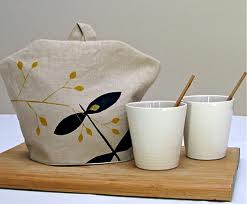
I’m making a tea cozy.  Or a tea cosy, as the Brits would say.  Its history begins when tea was first introduced to Britain in the 1660s.  I like the word cosy – it’s much more dignified than cozy.  This time last week I didn’t even know I needed a tea cosy and just a few years ago, I would’ve said, “A tea what?”

Now I’m a good Southern girl that grew up drinking iced tea – sweet, of course.  My Aunt Doris introduced me to a ‘spot’ of hot tea when I was a teenager.  And I’ve enjoyed afternoon tea at an upscale hotel restaurant.  But I didn’t expect that inviting my out-of-town college girlfriends to join me for afternoon tea would lead to searching through my stash of fabric and learning how to sew a tea cosy.

My friends responded eagerly by email and June agreed to serve as hostess  – she’s my tea party authority.  My friends insisted that they bring the food: cucumber sandwiches, asparagus roll-ups, ham tarts, cranberry scones, and stuffed strawberries.  Fine with me.  I’ll provide the tea and hot water.  But June said we must use good loose tea and she knows exactly where to buy it.  So it seems that hot water is my only contribution to my tea party.

I don’t have a fancy silver tea service, which includes a teapot for keeping water at perfect hot tea temperature.  But I do have teapots.  One that matches my very first set of china.  One that a family friend gave me when I was ten years old.  And one that my brother-in-law bought and brought to me all the way from China.  A real teapot with a loose-leaf strainer and four dainty teacups.  So I’m set or so I thought.

June agreed that the idea of several lovely teapots would be wonderful.  “But how will we keep the water hot?  I wish we had a tea cosy or two,” she wrote in an email.  I think my microwave heats water pretty fast, but since all I’m providing is hot water, I must follow tradition.

A tea cosy is a knitted or embroidered covering (I don’t have time to knit or embroider) or it’s made from heavy brocade or fabric with a lovely design, and it must be insulated and lined.  It fits right over a teapot.  Got it!  A piece of printed floral cotton material that I inherited from my mother’s scrap fabric box.  And for some reason I’ve saved an unused insulated fabric leg covering from when I had knee surgery.  And there’s plenty of solid colored material for lining.

How could I possibility serve hot tea without tea cosies?  One for each of my three teapots.   The tea cosy was invented not only to keep the contents of the teapot hot, but also to prolong social occasions.  And I want to keep my long-time friends sitting around my dining room table as long as possible.

One cosy made.  Two to go.

First Time Hostess

I lay in bed mentally checking my to-do lists.  Tables set.  Were the card table legs fastened?  Cut a lemon for tea.  Put the turkey in the oven at 5:00 a.m.  – just five hours from now.  Bake two pecan pies.  Wipe the bathroom sink.  Would the kids (ages 3 and 5) agree to wear the cute new outfits that my mother had made?

I’d written, checked, and rechecked lists for three days.  It was Husband’s and my firsttime to host a holiday dinner for my family.  And it wasn’t my idea.  Mother and her two sisters had rotated Thanksgiving and Christmas meals in their homes for 35 years, and they’d decided it was time for the younger generation to take over.

“We’ll help,” Mother had said.  “I’ll make the cornbread dressing and you know your Aunt Nell and Aunt Doris and I always make the gravy together.  Save the turkey drippings.  And everybody brings food.  You just put a turkey in the oven and make tea and coffee and maybe a dessert.  It’ll be fine.”  I told myself that these were the people – all 22 of them – who loved me best.  Grandparents, parents, aunts, uncles, brother, cousins.  If things weren’t perfect, they’d understand.

But I was determined that Husband and I could host the perfect Thanksgiving dinner.  I’d take pecan pies out of the oven just after everyone arrived.  Wouldn’t that make the house smell good?  By tradition, I had covered the tables with white tablecloths, and set them with my best china, crystal goblets, silver, and floral centerpieces.

Thanksgiving morning, 5:00 a.m., I shoved an 18-pound turkey into a 325* oven and climbed back into bed until daylight.  I rolled and turned, but didn’t sleep.  I got up.  The morning passed quickly.  How many times can one adjust plates and forks and napkins?  Our children were cuter than cute in their new clothes.  Bathroom sinks sparkled.  Husband promised that the card tables wouldn’t fall.  I rolled out piecrusts – no store bought crusts for this feast – and used the family recipe for pecan filling.  Turkey out of the oven and pie in, right on schedule.

Our guests arrived carrying sweet potato pudding, corn, asparagus casserole, green beans, pumpkin pies, and more.  Mother and my aunts filled my small kitchen as they stirred and tasted the giblet gravy.  Husband sliced the turkey.  We could’ve been models for Norman Rockwell’s November magazine cover.  The oven buzzer sounded.  “That’s the pecan pies,” I announced.

“You even made pies this morning?”  my cousin asked.  I opened the oven door, grabbed two potholders and carefully set the first pie on a cooling rack.  When I lifted the second one out of the oven, it was a slippery sliding disk.  The hot pie flipped out of hands and landed upside down on the floor and splattered onto my shoes.  Tears ran down my face, and everyone assumed that the hot pie filling had burned my feet.  Not so.  The pecan pie oozing under the refrigerator erased all pretense of a picture-perfect Thanksgiving.

Now, some thirty years later, I make short lists, check them once, and don’t bake pies.  And it’s just fine.  And I’m thinking maybe it’s time for the younger generation to take over.

Fall’s Biggest Social Events

How about the tailgating at TTU?  Lots of food and fun.  A bounce zone for the young and young at heart.  Fathers and sons playing football.  Corn hole games.  Frisbies.  Some folk bring their own food.  Some dine on the free food and beverages that are provided by local churches and businesses.  Tech cheerleaders pump us up for the game, and my favorite, the TTU Marching Band performs.

When did tailgating begin?  The American Tailgater Association, on its website, details the history of sharing food and drink before events and says the first documented tailgate probably took place in 1861 at the Battle of Bull Run.  It states, “At the battle’s start, civilians from the Union side arrived with baskets of food and shouting, ‘Go Big Blue!’  Their efforts were a form of support and were to help encourage their side to win the commencing battle.”  The Romans ate and drank outside the Coliseum before gladiator games.  Doesn’t that fall into the broad definition of tailgating?  Surely, they shared food and spirits and talked about the upcoming sports events.

In 1869, a group of Rutgers fans and players, wearing scarlet-colored scarves as turbans, paraded before the football game between Princeton and Rutgers.  This was one of the earliest recorded celebrations before a sporting event.

There are all styles and levels of tailgating.  Tailgating was simple when we drove a big wood panel station wagon.  We lowered the tailgate, spread out a plastic tablecloth and food.  Pimento cheese sandwiches, chips, and store bought cookies.  Then came vans.  We packed chairs, coolers with drinks, upscaled to ham rolls, fancy dips for chips, and cupcakes decorated with our team’s mascot.  Or we picked up a family-pack barbeque dinner on the way to the game.

For some folks, RV tailgating is the ultimate.  As good as life gets, I’ve been told, and an event that can go on for several days.  No need to go to the game.  RVers park close to the stadium and watch the game on big screen televisions.  They relax in their comfortable chairs, eat and drink all through the game, know there’s been a big play when they hear the roar of the crowd, and maybe even the game announcer, and celebrate when their team scores on the big screen.

Football fans on the Ole Miss campus take tailgating to the extreme.  And when I tailgated in The Grove, I made a check mark on my bucket list.  Ten acres in the center of a campus shaded by oak, elm, and magnolia trees.  Thousands of fans under a sea of red, white, and blue tents.  And the table settings and fare were fit for a southern girl’s wedding reception.  Elaborate centerpieces, silver candlesticks, tablecloths, fancy hor d’oeuvres, barbecue, fried chicken, shrimp, and all the fixings.

Tailgating isn’t just about the food.  It’s getting ready for the big game.  Food, friends, and fun —what’s not to like about one of fall’s biggest social events?

Who’s the Tomato Queen?

June declared that her mother is the Queen of Tomatoes. I really don’t like to argue with friends, but June didn’t know my mother when she and Dad grew a huge vegetable garden.
Mom served tomatoes every meal. Sliced, with eggs and bacon for breakfast, on a BLT sandwich for lunch, and chopped in coleslaw or quartered for supper.
Mom canned tomato juice, whole tomatoes, and tomato soup with vegetables. No tomato – not even a green one – went to waste. At the end of the growing season, green tomatoes were sliced, coated with cornmeal and fried. Fried green tomatoes. Delicious. And if there were too many green tomatoes to fry before the first killing frost in the fall, Mom picked them from the vines. Then she wrapped them, individually, in a torn piece of old newspaper and laid them in a single layer on a cardboard tray. The green tomatoes were stored, with hopes that they would ripen, in the darkest corner of the basement. The unused coal bin. And when those tomatoes turned light pink or red, she cooked them in spaghetti sauce or with Salisbury steak.
June said that her mother, Nell, buys home grown tomatoes from neighbors. “Searching for, talking about, and preserving tomatoes all loom large in my mom’s life each summer. She would never consider serving a meal of fresh summer vegetables and hot cornbread without luscious, fresh tomatoes.” Nell handles each tomato with special care. Wrapped in tissue paper. “Each Christmas she collects used tissue paper –all colors – and cuts perfect squares. She gently wraps all tomatoes, one by one, and places them on small trays and stores them on the floor under her bed.” There an air vent provides the perfect storage temperature. Nell’s tomatoes go straight from under her bed to the dinner table. (And all these years I thought my kitchen counter was the perfect storage place for ripe tomatoes.)
At the end of the season, Nell buys whatever tomatoes she can find. Red and green and all shades in between. She even travels fifty miles from her home in South Pittsburg to Pikeville to buy the best green tomatoes around. She wants to serve homegrown tomatoes as long as possible. It’s a sad moment when she announces, “These are the last of the home grown tomatoes.”
Nell’s goal is to serve tomatoes for her family’s Thanksgiving dinner. If she can keep them until November, that accomplishment comes with bragging rights. June said, “Although we are thankful for the turkey and fixings, we always talk about and wonder how long those tomatoes stayed under Mom’s bed. My mom truly is the Queen of Tomatoes.”
Does Nell’s wrapping each homegrown tomato in squares of Christmas tissue paper and sleeping with tomatoes under her bed trump my mother’s growing and canning and storing tomatoes? Maybe. How about this? June’s mother is the reigning Tomato Queen and my mother was the former queen.

Tomatoes – So Many Ways

I simply said, “I ate one of my favorite summer lunches today. Home grown tomatoes and cucumbers with cottage cheese.” You’d thought I’d violated a chiseled–in-stone code of ethics for eating summer’s reddest fruit. Didn’t I know that plain, with a little salt, is the best way to eat a tomato? That question made me curious so I asked a few friends, “What’s your favorite way to eat summer tomatoes?” Answers varied as much as the size and shape of garden tomatoes.
Janet likes the little ones, cherry tomatoes, like the kind she picked and ate while standing in her Grandpa’s garden. Jim wants a whole meal. “Peeled, sliced, and lightly salted tomatoes. With fried taters and cornbread, and a thin slice of Vidalia onion.” Linda’s choice is a grilled tomato. Rachel bakes tomatoes pies. Drew stuffs tomatoes with tuna salad. Karen goes German with a tomato and onion salad, topped with a vinegar and olive oil dressing.
Almost everyone told me to store tomatoes on the kitchen counter, never in the refrigerator. Except Leslie, she likes tomatoes, cold, peeled, and sliced. Kathy refused to be limited to one favorite way. She said, “I love a big thick slice of tomato on bread (I’m guessing soft, white sandwich bread) with mayo and bologna. I love tomatoes with meatloaf and green beans and new potatoes. I love tomato pie. I love tomatoes in a pasta salad with fresh basil. And more.”
And there are other sandwiches. My sister-in-law, Susan said, “I like a warm just-off-the-vine-tomato between a couple of slices of bread with just a bit of salt and mayo.” Angie choice is a cheese and tomato sandwich with Miracle Whip. Sara eats a BLT, heavy on the T. Allen makes a unique sandwich: peanut butter, Miracle Whip, tomato, lettuce and onion. Jane’s tomato sandwich is open-face sprinkled with mozzarella cheese and olive oil, with homegrown basil on the side,
Many think that a straight-off-the-vine tomato, eaten hand to mouth, is best. And maybe it’s because of our raising. Brenda said she did exactly what I did. “When I was a child, I’d pick a bright red tomato in the garden. And I’d stand right there beside the tomato plant and eat it and let the juice ran down my face and hands.” Now we slice or quarter a tomato, sprinkle it with salt, and use a fork.
As a kid, Tricia ate just-picked tomatoes like she’d eat an apple. “Now, that I know how to handle a knife, I go to the extra trouble to skin them, but I still love to stand at the sink (preferably without an audience) and go to town with the salt shaker, eating tomatoes until I get full or eat all of them.” Tricia added, “My favorite way is the most basic, humble, messy way there is.”
I agree that pulling a tomato from the vine and eating it like an apple is the best way to enjoy the its flavor. That’s a snack, not lunch. And since my neighbor Ozzie just delivered a few tomatoes picked from his garden twenty minutes ago, it’s snack time.

Next week: How to preserve garden tomatoes to serve for Thanksgiving dinner.