• Recent Posts

  • Archives

  • Categories

  • Meta

Never, Ever Walk Away

images

Ruth had spent the night with Husband and me.  She and I watched the birds at the birdfeeder as we ate Oatmeal Squares with green sprinkles, and we made our morning plans.  Swim.  Play with dolls.  Talk to cousin Dan and Aunt Lori on video chat.  Read.  And then, in my three-year-old Grand’s words, “Just play.”  But because I didn’t turn off the water, our plans exploded.

When Ruth and I returned home after playing in the YMCA pool, I filled the washing machine with towels and pushed start.  I threw our wet bathing suits in the laundry room sink, turned on the water faucet, and walked away.

In the playroom, Ruth dressed dolls and we had a tea party.  Then we snuggled close to see my laptop computer and video chat with Dan and his mother who live far away.  When we sang “Pat-a-Cake,” twenty-month-old Dan clapped his hands.  Ruth donned hats from the dress-up basket; Dan laughed at her silly faces.  We blew good-bye kisses and signed off.

“Gran, will you read me this book?”  Ruth put There is a Bird on Your Head! on my lap.

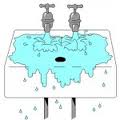
“Sure.  Let me put the towels in the dryer first,” I said.  When I saw water flowing under the closed laundry room door, I thought ‘Oh, no – what happened to the washer?’  I opened the door.  Water gushed like Niagara Falls over the edge of the sink.  The floor was flooded.  What I shouted can’t be printed.  I turned off the sink faucet.  The one I should have turned off an hour earlier.

I ran to our basement garage to get the wet vacuum.  The garage floor was wet, as if someone had washed my parked van.  Water dripped from 4’ x 8’ ceiling tiles and one was on the floor –soaked and crumbled.  Because Ruth stood right beside me, I calmly said, “Looks like Gran made a big mess.”

Ruth covered her ears with her hands to block out the roar of the wet vacuum as it sucked up water on the laundry room floor.  “Ruth,” I said, “why don’t you get some books and read in the kitchen?  I’ve got to use this loud machine for a while.”  She nodded and walked toward the kitchen.

About ten minutes later, I turned off the wet vac to check on Ruth.  She wasn’t in the kitchen.  She wasn’t in the living room or the garage or the playroom.  I called, “Ruth, where are you?”  Noticing that a bedroom door was closed, I opened it.  “Ruth, are you in here?”  I heard a whimper.  “Ruth, are you in the closet?”

She was.  Covered with thick white hand cream from fingertips to elbows and toes to knees.  She stood, crying.  This is not the first time she’d covered herself in some type of cream.  No doubt, she remembered the talks between her mother and her after previous cream events.  Her whimpers and tears turned into sobbing, and she collapsed in my arms.

All because I didn’t turn off the water.  Ruth and I lost our time to read and play.  My Grand cried.  I spent half a day cleaning up the laundry room.  Husband spent more time than that removing damaged ceiling tiles in the garage.  And I vowed to never walk away from a running water faucet.  Never, ever.

###

How to Stay Married for 50 Years

imagesGo into marriage with the thought, ‘This is forever.’  Take each day one day at a time and never go to sleep mad.  The days you don’t like each other stop and remember why you fell in love.  Did you read these words of advice from married couples in this newspaper’s supplement on Valentine’s Day?  Golden Anniversary – a celebration of local couples who have been married 50+ years.  Eighty- three couples married between 50 and 75 years and not a single one stated, “Our life together has been blissful.  We never had problems  – only happiness and each day filled with loving actions and thoughts.”  No, these couples shared real life stories.

A couple married 67 years stated, “We were too stubborn to give up.”  One couple compared marriage to a birthday cake.  “To enjoy it you need some cake (everyday living) and a little frosting (romance and passion.)  Too much cake without frosting is boring.  Too much frosting by itself will make you sick.  Find your perfect balance.”

I studied the couples’ stories and words of advice to create a Top Ten List  – How to Stay Married for 50 Years.

10. Threaten that whomever leaves has to take the kids.

9.  Don’t get mad at the same time.

8. Try hard to get along with both sides of the family.

7. Treat your man like a king and treat your woman like a queen.

6. Always keep God in your life.  Pray for your mate.

5. Be willing to put your wants (and sometimes needs) second.  Treat your mate as your best friend.  Be kind and considerate to each other.

4. Play childishly with each other frequently.  Have fun.

3. Learn to say you’re sorry.  You always need to give and take and forgive and forget.  Talk to each other and don’t just hear – really, really listen.

2. Hold hands, love each other always, kiss in the morning and before bedtime.  Tell each other often, “I love you.”

1. When you marry and say ‘till death do us part, mean it and stick with it.

I’m keeping this list and the newspaper supplement handy, in the top drawer of my bedside table.  I need be reminded that other married couples haven’t always slept on a bed of roses with no thorns.  And it makes me smile to read about the couple who’ve been married 62 years and said, “Love grows with the passing of years until one day you wake up and realize you don’t want to be with anyone else except your sweetheart of many years.”

In six short years, Husband and I will celebrate our 50th anniversary.  Maybe we’ll be featured in the 2019 Golden Anniversary Celebration and give advice.  But until then, we’re like the couple married 65 years who stated, “We’re not a perfect couple, but we never quit trying.”

###

            .


It’s a New Year……What to do?

images

I don’t know what to do or where to start.  It’s a new year.  And there are so many things that I want and need to do.  Knit a cap for my Colorado Grand?  Stitch pajama pants for my Grands who live across town?  Finish the quilt that Grandma Gladys started fifty years ago?  Bake bread to take to my sick friend?  Sort and throw away outdated medicines? Finish reading the book I started before Christmas?

I love new beginnings.  Mondays.  New calendars.  When I taught school, I liked the beginning of a Science unit and a new list of spelling words.  So I should welcome 2013.  But I’m frazzled with all the choices.  Clean out the kitchen cabinets?  I put clean dishes in those cabinets so where do all the crumbs come from?  Move the bed and vacuum the dust monsters?  They’re too big to be called bunnies.  If I hadn’t dropped my bookmark behind the bed, I’d never seen the monsters.  Ignorance was bliss.  Take pictures and write stories about the family heirlooms in my house?  I can’t expect my children to remember that five blue glasses belonged to Great-Grandmother Rich and that Daddy mailed the green wooden box to Mother while he was stationed in Germany during WWII.

Four years ago when I retired, I wrote a list of things to do, places to see, and people to spend time with.  I’m too big a coward to even look at that list.  But I remember that I thought I’d get back to playing the piano.  Why have a piano if no one plays it?  I’d sew dresses and rompers for my Grands; skirts for myself.  I’d exercise.  I’d throw dinner parties.  Explore the blue highways in the Upper Cumberland.  Eat lunch with friends.  Learn something new every day.

As I sit with my fingers on my computer, I create a new folder for this year’s columns.  Where We Are 2013.  Should I take time to trash and organize scattered documents in the 2012 folder?  Update my computer?  The loud buzzer on the dryer relieves my indecision.  I hang Husband’s and my shirts.  There’s the raccoon costume lying on the sewing machine by the ironing board.  Right after Halloween, I promised my Grand that I’d mend it.  It’ll only take ten minutes.  I could stitch it now.

Focus.  Make a plan, my brain says.  2013 – a chance to start new.  What should I do for the next 365 days.  Recently, I read a devotion that suggested choosing one word for a New Year’s resolution.  One word to guide each day’s choices.  Each day’s activities.   Suggested words:  courage, faith, patience, simplify, study, action, generous.  What about balance or love?

So here I am.  The beginning of a new year and I’m in a quandary.  Choices.  Lists.  Resolutions.  The phone rings.  “Gran?”  I hear the sweet voice of my seven-year-old Grand.  “Are you coming to see us today?”

Yes.

A Gift I’ll Never Forget

images

Angel trees.  Operation Christmas Child.  Food baskets.  Bicycles for Kids.  Rescue Mission.  It’s that time of year when we know about more opportunities to give than we have dollars in our pocket.  And oftentimes, we help people we never meet.

Mikey, I knew well.  His big brother, Steve, had been a student in my class.  Steve was Mikey’s caretaker, not only at school, but also at home if both brothers’ stories were true.

Steve was absent at least one day every two weeks.  Before the 8:00 morning bell rang, Mikey, a kindergartener, came to my 4th grade class door and stood quietly until I saw him.  I knew what he’d say before he said it.  “Grandma said to tell you that Steve is sick.”  The first few times I’d asked questions and determined that Steve’s sickness was a result of lack of sleep because he’d taken care of his sick father during the night or that Grandma needed Steve’s help at home.  “I’m suppose to take his work home after school,” Mikey said.  At 3:05, he’d wait beside my desk while I gathered Steve’s books and make-up work, and he always hugged my neck after I gave him a treat from my candy stash.

Steve and Mikey wore clean clothes.  Usually too big or too small.  Our school kept a closet stocked with children’s clothes for emergencies or anyone who needed something to wear.  Several times, the boys chose a pair of jeans and a shirt.

The next school year Mikey often detoured from his first grade classroom to my room after the 3:00 school bell rang.  He gave me a hug, and I gave him a candy treat.  Just before Christmas vacation break, I learned from his teacher while we were shopping together that Mikey wore two lightweight jackets on cold days.  Together she and I picked out the best looking, most in-style little boy’s blue coat in the store.  “Don’t tell Mikey where this came from,” I told his teacher as I handed my credit card to the clerk.

Two days later I sat at my school desk grading spelling papers while my students were in Music class.  Mikey marched into my classroom wearing his new coat, hood over his head.  “Look!” he said.  His grin showed every tooth and he stood six inches taller that he would’ve measured.  He held his arms high as if to catch a falling beach ball.

“Oh, Mikey.  What a good-looking coat!”  I said.  He walked close to me.

“Smell.  It’s new.  Nobody’s never wore it before.”  He turned his back to me.  I blabbered something, blinking tears away.  He looked me in the eye.  “Teacher said it’s just for me and blue is my favorite color.”

Of course, it was.  His teacher knew his favorite color and that a brand new coat would make a six-year-old boy walk taller and prouder.  Mikey probably did all his schoolwork better and quicker that day.  Because he wore a coat that no one else had even worn.

Trash or Treasure

photo[1]

My Christmas tree is decorated just the way I like it.  Lights, red bead roping, ornaments and an angel on top.  Ornaments handed down from my parents’ Christmas tree. Ornaments that were gifts from family and friends and school children.  Ornaments made or bought for a special memory.  I can tell the story of each one.  But there are more ornaments still in the storage box.  Some not hung for years.  Enough to decorate another tree, and one tree is all I want.

“Here,” I said to Daughter as I handed her a full plastic bag.  “Take these ornaments to your house, please.  And maybe you’ll hang some on your tree.”  She held the bag in her hands.  “Wait, let me look at those again.”  I took the bag from her.  “Maybe some should be thrown away.”

Who could trash Bert and Ernie?  Handmade, from yarn, and Bert is only missing one eye.  The white crocheted snowflake has just a few yellow spots.  The ceramic angel that I painted would look pretty if someone glued her wing back on.  I can’t trash a Nativity –even a miniature plastic one. A blue Smurf probably means something to one of my children.  The shiny red apple is still pretty.  Why do I have three wooden factory-made stockings?  There’s no name or date on the back of any of them, but they’re cute.

I can’t bring myself to throw away the dozens of calico ornaments that I made in the mid-1970s.  I stitched them at night after our children had gone to bed.  Five-inch stockings and candy canes and wreaths.  Cut from yellow and red and green calico.  Two pieces of fabric zigzagged together and stuffed with polyester pillow stuffing.  Unbreakable.  The only kind of ornament that hung from our tree for several Christmases.  The years when little hands took ornaments off the tree.  And those same hands hung them back on.

I wonder where the picture is of our children when they were 3 and 5.  They were standing beside the Christmas tree and pointing to the ornaments they’d just hung.  Twelve calico ornaments hung side-by-side on the electrical wire between two lights.  Calico really isn’t in style now, but there’s a cotton fabric candy cane and wreath hanging on my tree.

Red glittery plastic bells.  I’m not trashing those.  I bought them at the Dime Store and Husband and I hung them on our very first Christmas tree.  What if I tie a narrow green ribbon through the loop of each one and write “Pop and Gran’s tree, 1969” inside the bellI’ll attach one to the bow on each of our Grand’s gifts.

So the red glittery bells are on my gift-wrapping table and every other ornament that I thought I might cull is back in the plastic bag.  I’ll give them to Daughter.  Surely she won’t throw any away.

First Time Hostess

I lay in bed mentally checking my to-do lists.  Tables set.  Were the card table legs fastened?  Cut a lemon for tea.  Put the turkey in the oven at 5:00 a.m.  – just five hours from now.  Bake two pecan pies.  Wipe the bathroom sink.  Would the kids (ages 3 and 5) agree to wear the cute new outfits that my mother had made?

I’d written, checked, and rechecked lists for three days.  It was Husband’s and my firsttime to host a holiday dinner for my family.  And it wasn’t my idea.  Mother and her two sisters had rotated Thanksgiving and Christmas meals in their homes for 35 years, and they’d decided it was time for the younger generation to take over.

“We’ll help,” Mother had said.  “I’ll make the cornbread dressing and you know your Aunt Nell and Aunt Doris and I always make the gravy together.  Save the turkey drippings.  And everybody brings food.  You just put a turkey in the oven and make tea and coffee and maybe a dessert.  It’ll be fine.”  I told myself that these were the people – all 22 of them – who loved me best.  Grandparents, parents, aunts, uncles, brother, cousins.  If things weren’t perfect, they’d understand.

But I was determined that Husband and I could host the perfect Thanksgiving dinner.  I’d take pecan pies out of the oven just after everyone arrived.  Wouldn’t that make the house smell good?  By tradition, I had covered the tables with white tablecloths, and set them with my best china, crystal goblets, silver, and floral centerpieces.

Thanksgiving morning, 5:00 a.m., I shoved an 18-pound turkey into a 325* oven and climbed back into bed until daylight.  I rolled and turned, but didn’t sleep.  I got up.  The morning passed quickly.  How many times can one adjust plates and forks and napkins?  Our children were cuter than cute in their new clothes.  Bathroom sinks sparkled.  Husband promised that the card tables wouldn’t fall.  I rolled out piecrusts – no store bought crusts for this feast – and used the family recipe for pecan filling.  Turkey out of the oven and pie in, right on schedule.

Our guests arrived carrying sweet potato pudding, corn, asparagus casserole, green beans, pumpkin pies, and more.  Mother and my aunts filled my small kitchen as they stirred and tasted the giblet gravy.  Husband sliced the turkey.  We could’ve been models for Norman Rockwell’s November magazine cover.  The oven buzzer sounded.  “That’s the pecan pies,” I announced.

“You even made pies this morning?”  my cousin asked.  I opened the oven door, grabbed two potholders and carefully set the first pie on a cooling rack.  When I lifted the second one out of the oven, it was a slippery sliding disk.  The hot pie flipped out of hands and landed upside down on the floor and splattered onto my shoes.  Tears ran down my face, and everyone assumed that the hot pie filling had burned my feet.  Not so.  The pecan pie oozing under the refrigerator erased all pretense of a picture-perfect Thanksgiving.

Now, some thirty years later, I make short lists, check them once, and don’t bake pies.  And it’s just fine.  And I’m thinking maybe it’s time for the younger generation to take over.

Children Just Watch

My Grand was 4 1/2 years old and she beat me in a second game of UNO.  The first game, I’d played to her hand to make sure that she won.  The next game, I played my cards.  Lou had announced, “UNO.  Red,” and laid a Draw Four card on the table.  I drew four cards.  She played her last card and beamed.  “I won again.  Two for me.  None for you.”

“Lou, you’re a really good UNO player.  How did you learn?” I asked.

“I watched Mommy and Daddy and David (her older brother) play and I just learned how.  I just watched.  I do what they do.”  Her answer hit a nerve that’d been burned into my brain many years earlier when I taught fourth grade.

Melody was one of my best-dressed students.  Her mother curled her hair every morning and tied it with ribbons that matched her outfit.  No jeans and t-shirts for her.  Her infectious greeting, “Good morning, everybody!” lit our classroom.  She hurried to my side after hanging her red wool coat on a coat hook.  “Mrs. Ray, will you please roll up my sleeves?”

The long sleeves of her plaid blouse hung unbuttoned.  “Sure.  Didn’t your mom have time to do it this morning?’  I asked.

“She didn’t know how.  I want my sleeves just like yours and she didn’t do it right.”  Just like my button-cuff sleeves that I rolled up because they were three inches too short for my long arms.  What else did Melody do just like me?

My Grand, now 5 1/2, and I agreed last week that some things in her craft box needed replacing.  “Bring it with you when you spend the night and we’ll clean it out and then go shopping,” I told Lou.

She sorted trash and treasures, putting loose stickers in a zip lock plastic bag, while I put a pot of water on the stove to boil pasta.  “I’m ready to make my list.  How do you spell tape?”  Lou stood at the kitchen table, with pencil and paper in hand.  Ten minutes later, she had her list.  Tape, glue, stickers.

“This glue,” she said and put it in our shopping basket.  She laid her list on the store floor and drew a line through the word glue.  A dozen packages of stickers hung at her eye level.  “These two,” she said within ten seconds.  The tape was high, out of her reach.  “Can you get the one in the middle?”  She drew lines through two more words: stickers and tape.  I complimented her on being a fast and good shopper.  “That’s because I do it a lot,” she said.  Lou shops with her mother who writes a grocery list and crosses off items that she puts in her shopping cart.

A hand scribbled sign hangs over my writing desk.  “Children watch.  Children learn.”  A sign that I moved from my school desk to my home desk.


Back on Real Time

Papa would be happy.  Now we are back on real time as opposed to new time.  My grandfather, Paul Bertram, was a no nonsense man and somewhat set in his ways.  He was 31 in 1918 when Daylight Savings Time was first introduced in the United States, and now almost one hundred years later, I still think of him every time I move my clocks to spring forward or fall back.

I never heard Papa complain about Daylight Savings Time.  He made his statement by the clock that hung on the wall beside his and Grandma’s kitchen table.  It stayed on real time.  They ate on real time, and they went to bed and got up on real time.  Another clock hung on the living room wall close to the big console television.  Set on new time.

Papa was one of ­­­­six children and lived his whole live in Pickett County.  He built his and Grandma’s home within throwing distance of his parent’s home.  He was a carpenter and some say a self-taught engineer.  No problem was too great.  Solving a problem just took time and thought and work and patience.

Papa worked in Oak Ridge during the building boom, designed a water tank in Byrdstown in the 1950s to equip the new shirt factory with a sprinkler system, built houses to rent, and many by contract.  His houses were high quality, built to the owner’s specifications.  One house had electrical wall sockets three feet above the floor.  When he asked the homeowner where she wanted the plugs, she walked throughout her wood-framed home and pointed her finger at that level.  Papa penciled each place with an x and followed her directions.

One Christmas I didn’t understand why there was money in the pocket of the shirt that Papa and Grandma gave my daddy.  They had three daughters and three sons-in-law, and they treated each the same.  Dad’s shirt cost $2 less than the other two sons-in-law’s.  Papa expected everyone to be fair and honest, but sometimes he double-checked to be sure no one made a mistake.  More than one family member was embarrassed when he stood in the drugstore, poured the pills that the pharmacist has just put into a pill bottle into his hand, and counted.

Papa drove all over Pickett and the surrounding counties looking for good land.  Some he bought and later sold.  Whether his work for the day was building a house or trading land, he was always home by suppertime – five o’clock.  During the summer months, he ate fast so he could see the end of the evening news on TV.  When Daylight Savings Time ended, he could eat supper, take a little nap, and watch all of the 6:00 news.  And both clocks, the one in the kitchen and the one by the TV, were set on real time.

Halloween Costume, aka The Yellow Dress

When your doorbell rings tonight, expect to find Spiderman or Angry Bird or Izzy Pirate standing on your porch.  Halloween costumes have morphed into the big time.  When I was a kid I carried a bag, knocked on doors, and shouted, “Trick or treat,” every October 31st, but I remember only two costumes that I wore.  A ghost and a princess.

It was a classic ghost costume.  An old white sheet with cut out circles edged in black for eyes and a rope tied around my waist.  My princess dress wasn’t really a Halloween costume.  It was my spring piano recital dress when I was seven years old.  A beautiful dress – yellow satin, with a narrow covered binding at the waistline and spaghetti shoulder straps.  Mother sewed tiny iridescent and white sequins on the top and she gathered yellow net fabric to cover the floor length skirt.  A shawl, made from the same net, covered my bare shoulders and was tied through loops at my waistline.

I wore that same dress in my 3rd grade class play, entitled The Yellow Rose of Texas.  My classmates wore cowboy boots, blue jeans or long full shirts, and shirts with fringe, and they square danced around me while I stood in the middle of the stage, still and smiling.  The only reason I was the Yellow Rose was because I had a long yellow dress.

I don’t know whose idea it was that I dress as a princess for Halloween.  Probably Mother’s – after all, she’d spent many hours stitching my yellow dress and no doubt wanted it worn for every possible occasion.  We made a tiara and magic wand from cardboard covered with aluminum foil.

All the neighborhood kids walked together from house to house to Trick or Treat.  And we tricked, even when we’d been treated with good treats – popcorn balls, caramel apples, full size candy bars.  It was expected that goblins would soap windows.  With slivers of soap, saved just for the occasion, I drew circles and stick people and trees on windows, even at our own house.  Our huge living room picture window got cleaned twice a year – in the spring before Easter and the day after Halloween.  I had to help clean the big window so why not soap it?

Because we walked, the hemline of my long yellow dress got stained and worn –from dirt and the blacktop roads.  Mother must have let the tucks out of the skirt, cut off the hem, re-hemmed it, and let the seams out of the bodice because I wore a yellow dress for another piano recital.

Will a princess ring your doorbell tonight?  I hope so.  She’ll remember the Halloween that she was a princess and stood beside Spiderman and Angry Bird.  But I wonder if she’ll be wearing her handmade yellow piano recital dress.

Play or Work?

I’ve noticed that adults work and children play – even when they do the same activity.  Ask a child who’s putting together a jigsaw puzzle what he’s doing, and he’ll say, “Playing with a puzzle,” or “Putting a puzzle together.”  Ask an adult the same question and you’ll hear, “Working on a puzzle.”

Several years ago as a student in Leadership Putnam, I toured the Senior Citizen’s Center and observed an art class.  The teacher explained that everyone was working on paintings, using different types of media and different scenes.  “But we all work together here in the same room.”  My five-year-old Grand often asks to paint.  But she’s never worked on her paintings.  Why does she like to paint?  “It’s fun.  You can make anything you want,” she told me as she painted a bright red swirl across paper.  The art students at the Senior Citizen’s Center seemed to be having just as much fun.

Last week, I watched my three-year old Grand, at the Children’s Museum in the kitchen play area.  Her eyes wrinkled in concentration.  She filled a small shopping cart with plastic apples, celery, and green peppers.  She picked up a carrot, laid it down, and chose grapes.  Then she emptied the cart, placing her groceries in a small wooden refrigerator and in pots on a pretend stove.  When I said that we’d have to leave in about five minutes, she responded, “But, Gran, I’m not done playing.”  Somehow, I’ve never considered grocery shopping as play.

When my seven-year-old Grand wants to ride his bike in the woods beside our house, he clears a path.  He spends thirty minutes moving sticks and raking leaves to create a circular trail among the trees – all in the name of play – and another thirty minutes riding.  But he’s catching on.  When I suggest that he helps me pick up sticks in the yard, he’s quick to decide it’s time for him to go home.

Children play.  They arrange furniture, set a dinner table, and cook supper when they play house.  They ‘teach’ their dolls or pets or younger siblings how to say the alphabet.  They hammer and attach a bolt to a screw on kid-size workbenches.  They mold and create bowls and flowers with play dough and clay.  Using connecting blocks, they construct cars and airplanes and build fortresses and houses.

When does play become work?  When do we adults begin to describe what we do as work?  According to the Miriam-Webster dictionary, play is the state of being active or relevant and work is an activity in which one exerts strength to perform something.  Being active and exerting strength.  Being relevant and performing something.  Close enough to be the same for me.

I’d rather play than work.  So I’ll play when I cook supper and when I knit a scarf.  But I just don’t think I can play with an iron and ironing board.