• Recent Posts

  • Archives

  • Categories

  • Meta

My Take on the 3rd Grade Retention Law

I applaud Corby King, director of Putnam County Schools, for stating in this newspaper on May 26th. that retaining a student should not be determined by one test and should be a local decision.  I appreciate that the Putnam County School Board passed a resolution on September 1, 2022, opposing legislation that one test determines if third-grade students repeat third grade and/or attend summer camp and require a tutor.

            I’m a retired teacher and when I learned of the law that requires third graders who score less than “meeting” or “exceeding” expectations on the English language arts (ELA) TCAP test to attend summer reading camp (summer school) or tutoring programs or repeat the grade, I was angry. 

One test should never determine whether or not a child repeats a grade.  My generation called this failing.  Kids caught in this law are being treated unfairly.

Since 1988, the Tennessee Comprehensive Assessment Program has been the state’s testing program for math, English language arts, social studies, and science assessments.  The format is multiple choice and according to the Tennessee Department of Education website, the ELA test section includes 38-58 items (questions) and the time limit is 180 minutes, divided into four “subparts.”

The Tennessee Department of Education reports scores in four categories as related to expectations: exceeding, meeting, approaching, below.  It’s difficult to understand these categories because they do not correlate with the standards of typical grading (A, B, C, D, F.) 

As a classroom teacher, when I gave a test every student could make an A.  The score to make an A, or an F, didn’t change.  But with TCAP scoring, there are students in every category; a percentage of students will not score “exceeding” or “meeting,” no matter how well they did on the test.

Results are given by percentile based on the scores of all students. So, students who scored in the “approaching” and “below” categories are the students unfairly caught by this law.

Diana Wood, Putnam County PreK-4 Instructional Supervisor, confirmed my guess:  many kids scoring approaching or below expectations read on grade level and are typical B and C students, some even A students.

Dr. Wood stated, “Many kids in the approaching category can read on grade level.  This situation affects their self-confidence and their attitude toward learning, toward school.  We want to provide help for students who need it and we do. We’ve had programs in place to help every child be successful.”

 Academic assistance and retention should be determined by educators and parents – not lawmakers – based on a student’s progress throughout a school year, classroom assessments and performance, and many factors about the child that cannot be documented on paper or a computer.

As a 4th grade teacher, I taught many students whose TCAP scores did not reflect their ability and knowledge, and were, or became, accomplished readers, good academic students, and are now successful adults.

Lawmakers who really want to improve students’ reading skills could be school volunteers – listening to and assisting children read.  That would help students and teachers.

Celebrate Reading

To exercise your brain and keep it healthy, read. Just like you are doing now.

            This past Saturday, March 2, was National Read Across America Day, which has been celebrated on Dr. Seuss’s birthday since 1998. This day, created by the National Education Association, is intended for children and youth in every United States community to celebrate reading. Let’s stretch that celebration of reading through all of March for everyone, from children to adults.

Reading twenty minutes a day is the time that numerous research studies have proven makes a difference in a child’s learning. Generally, the more time we are exposed to something and the more time spent practicing it, the better we’ll become at performing it. This is true for reading. Reading exercises and stretches the brain; it connects the present with previous learning. Reading aloud to a child develops listening skills and prepares young children for learning. The single greatest factor in a child’s ability to read is being read to, even as a newborn.

When’s the last time you read to a child? It’s a gift, for the child and you. Snuggling a little one in your lap while reading aloud is a bonding time. Quiet, uninterrupted time. Once after I finished a book with Annabel, when she was 4, she said, “Gran, will you show me that again?” Show me again. Those words told me she had comprehended the story and transformed it to pictures. Don’t think a teen-ager is too old to be read to. They’ll not sit on your lap, but they’ll listen. Even adults like to hear someone read aloud. Years ago my Tennessee Tech professor, Dr. Eleanor Ross taught a class entitled Teaching of Reading and my favorite part of the class was the last few minutes when Dr. Ross read a children’s book aloud.

My love for reading goes back to childhood when Mom or Dad sat beside my bed and read from a Bible story book and whatever book I was reading at the time. When I was a fourth and fifth grade student, I read every biography that was in our school library. Do I remember the details of those people’s lives? No, but I read for fun and followed the example of everyone in my family who read newspapers, magazines, and books.

As an educator, mother, and grandmother, I’m convinced that children who are read to and have opportunities to read aloud and silently have a high probability of being successful students, and therefore, successful in their work. Research shows a strong correlation between a child’s ability to read and academic performance. You’ve probably heard that students first learn to read and then read to learn. It’s true.

We would all do well to follow the suggested 20 minutes daily reading habit. A well-known quote by Dr. Seuss sums up the importance of reading. “The more you read, the more you will know. The more you learn, the more places you’ll go.” Let’s share our reading, our learning, the places we go with someone else.

####

Family Vacation – Not as expected

Screen Shot 2016-07-14 at 7.05.03 AMRecently, I heard a friend lamenting that her grown children are so busy there’s no time for a family vacation. I suggested a weekend getaway, like the couple of nights Husband and I spent with our college-age children many years ago. But I warned that her vacation might not go exactly as she expected.

When Daughter and Son were college students, there was a narrow window of time between their summer jobs and the beginning of fall semester. I was happy that they would spend a weekend in Atlanta with Husband and me. We planned to go to a Braves game and eat good restaurant suppers, but I was most looking forward to family visiting time.

Returning to Atlanta brought back memories of two previous trips to Turner Field and the many nights we’d watched the Braves’ televised games. During a night baseball game, we reminisced about where we sat when Dale Murphy played first base and how Son had wanted to eat everything offered at the concession stand.

We stayed in a two-level condo with a kitchen and living room so we could eat breakfast in and have a place to gather. While watching Saturday Night Live, we agreed that we’d sleep in and make our own breakfasts.

I awoke first, made coffee, set out banana bread and fruit, and then curled up on the sofa to read a book until everyone else got up. Son came down the steps first, poured his morning Mountain Dew, and we talked a few minutes. Daughter joined us. She poured orange juice and sat on the couch beside me. This was perfect: my two children were all mine. I got up to freshen my coffee, and when I came back into the room, Daughter and Son both held paperback books in their hands.

I asked a question and got short responses. My attempts to start a conversation fell flat. My children kept their eyes and attention on their books while I talked. Then Son laid his book on his lap, looked at me, and said, “Mom, all our lives you wanted us to read and now we are.”

Daughter added her two cents worth. “Yeah, all those times you took us to the library to get books paid off.”

Son added, “Remember how we could keep a light on late at night as long as we read? Well, it worked, Mom. We just want to read our books now.”

My feelings were a hurt. I swallowed hard. I’d read aloud as I rocked my babies. How many times had I stopped whatever I was doing to read to them when they were toddlers? I read their school assignments with them. And those times we traveled all day in the car to the beach for family vacations, I read aloud or we listened to books on tape. I was determined my children would like to read.

I wiped a few sentimental tears. Together we shared reading time – each with our own books and that felt good. When Husband came downstairs, he was quiet and we continued to read. Eventually, the spell broke and then we talked about the books we were reading.

I don’t remember the book titles. But I realized grown-up children sometimes do exactly what we parents teach them, but maybe not at a time we’d choose. And family vacation time? Although what happens isn’t always as expected, it’s good to be together.

Little Free Library

Screen Shot 2014-05-22 at 7.58.10 AM

As Husband and I drove along a Cookeville street last week, he took his right hand off the steering wheel and pointed.  “Did you see that? It looked like a little house with books inside,” he said.  I quickly turned my head toward where he pointed, but I didn’t see any little house, just regular size houses, and I wondered how he could see through a window to see books inside a house.

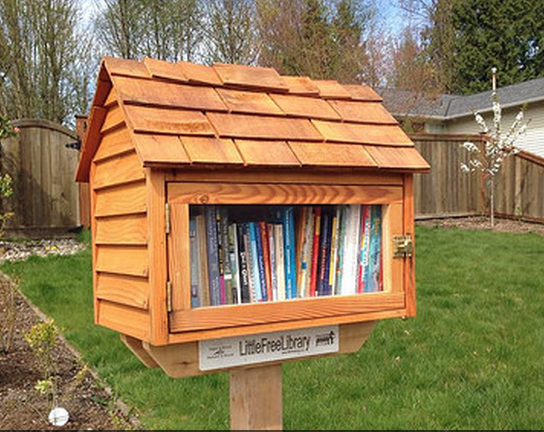
But Husband was right.  He did see a little house with books on shelves behind a glass door.  It’s mounted on a pole right beside the sidewalk. Under the little house is a sign that reads, “Take a book.  Leave a book. Or both.”

This Little Free Library was a Mother’s Day gift to a friend, a fellow retired teacher.  She had heard about the idea of free libraries a few years ago and when she mentioned it to her son, he not only built a library for her, but also installed it and planted flowers around it.  A Little Free Library, according to littlefreelibrary.org, is a  “take a book, return a book” gathering place where neighbors share their favorite literature and stories. In its most basic form, it is a box full of books where anyone may stop by and pick up a book or two and bring back another book to share.  The movement was started in 2009 by Todd Bol in Wisconsin.  He built a small schoolhouse, mounted it on a post, filled it with books, and posted a sign that read FREE BOOKS.  His neighbors and friends loved it.  Then he built more small libraries and gave them away.

The word spread from neighbor to neighbor, from local to regional to national to international media, and this one-person endeavor became an international happening.  A non-profit corporation was established in May 2012, and by the end of that year over 15,000 Little Free Libraries had been registered on the online site.  These libraries are now all over the world.  From Alaska to Hawaii, from Australia to Iceland, from Italy to Ghana.

I like everything about Little Free Libraries.  Books.  Free.  Bringing neighbors and friends and strangers together.  Encouraging children and adults to read.  Encouraging conversation about books and reading.  A project started by one man in his yard that has spread throughout the world.  I’ve seen them in a few big cities like Charleston, South Carolina, and Alexandria, Virginia, but my favorite one is right here in Cookeville.

Through Facebook, Jimmie announced that she’s in the library business and issued an invitation to “Take a book. Leave a book. Or both.”  My five-year-old Grand and I did both, and we quickly dubbed her library as Ms. Jimmie’s Little House Library.  A little house filled with books, just waiting for neighbors and friends to stop by.

I wonder how many more Little Free Libraries will spring up around here – in Cookeville, Putnam County, the Upper Cumberland.  I better put on my walking shoes and find a few more books to share.  And maybe, I’ll add something to my birthday wish list:  one library.

###