• Recent Posts

  • Archives

  • Categories

  • Meta

Dear Darling

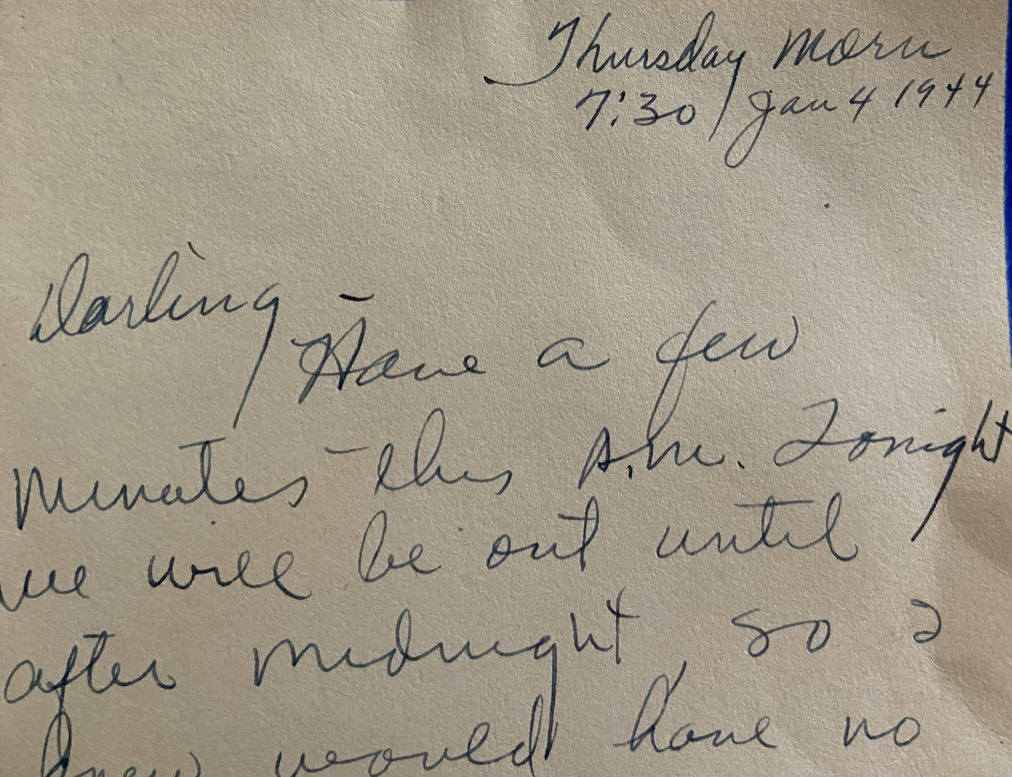
On Thursday, January 4, 1944, at 7:30 a.m. Dad wrote to Mom. “Didn’t get a letter yesterday.  Guess you didn’t have time since you are so busy canning meat.  It’s a little greasy and messy, isn’t it?” The letter’s return address is Camp Bowie, Texas. 

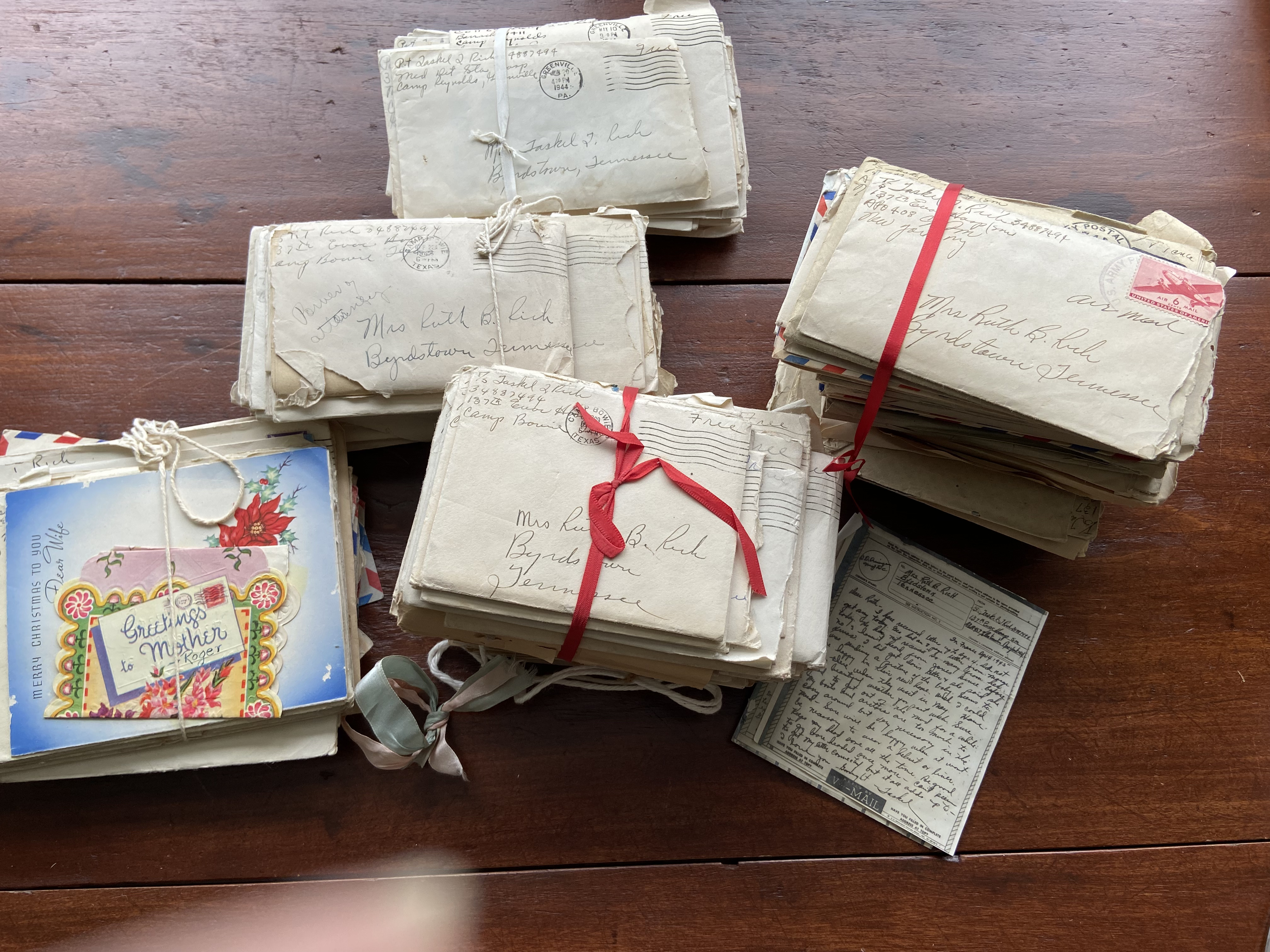
In last week’s column, I shared that Daughter and two Grands helped me sort the many letters that Dad wrote Mom while he served in the Army from October 1943 until April 1946.  These letters give glimpses of 2 ½ years. 

Dad wrote about daily life: food served, letters received from family and friends, fellow soldiers he met who had lived near his Byrdstown, Tennessee home town, weather, frustrations of letting the hem out of pants to make them long enough. And he always asked about Roger, my brother who was almost one when Dad enlisted.

In one January 1944 letter, Dad wrote that he hoped Mom was feeling fine after having ‘those old tonsils removed’ and that her headaches disappeared as a result.   For about two months, letters were rerouted from Byrdstown to Albany, Ky, and Akron, Ohio, where Mom’s two sisters lived.  So, Mom and Roger must have stayed with her sisters after her tonsillectomy.

From an October 1944 letter, I learned that Dad worked as a dentist assistant.  A job that was envied by others because he worked shorter hours and had time off. 

Dad wrote, “Do what you like with the roll top desk.  Paint it or anything.  Big job to sand it down tho and get it looking decent.”  Someone made it look decent.  It was Dad’s office desk at the service station he owned in the early 1950’s.  Without the roll top, it was Mom’s back porch office desk.  For many years, my brother and sister-in-law used it and two years ago, it was moved again – to my oldest Grand’s room.

February 1945, Dad mailed a signed Power of Attorney form. 

Letters written in March show an APO address: New York, NY.  He wrote, “I am still

very much in love with a certain beautiful young lady and this loneliness is only natural.”  One heading reads At Sea.  Another is Somewhere in France.

            Dad tells of travelling by truck convoy through several French towns and seeing some rather beautiful farm county.  People along the way were eager to get the cigarettes and candy thrown to them.

            April 1945, Dad wrote from Somewhere in Germany. He assured Mom that he wasn’t in danger, far from the front, and working as a carpenter.  An August letter reads, “We heard today about the new atomic bomb and our paper says something about a plant near Knoxville.”

            I’ve skimmed letters through March 1946, including those returned to Mom because Dad was on his way home. 

            My favorite parts are the greetings and closings.  Dear Darling.  Hi Sweetheart. 

Good night, Dearest I love you. I love you and always will.

            I share these glimpses to encourage others to get letters out of boxes.  Such writings make us who we are.

A Box Full of Letters

A tattered cardboard box filled with letters has been in a corner of a room at our house since 1992.  Not long after Mom’s death, Dad moved from his home in Byrdstown, Tennessee.

            Dad sold the house that he and Mom built in 1947, the house I grew up in, and he moved to an apartment here in Cookeville. My emotions were too raw to read those letters so soon after Mom’s death and after helping Dad clean out the only house I’d known as his and Mom’s home.

            The letters were tied with narrow satin ribbons.  Some red.  Some pink and blue – the soft hues that would be wrapped around a baby’s gift.  I looked at those ribbons and thought Mom tied those.

            At the time, Dad explained that most were letters he’d written to Mom while he was in the Army.  He served from October 1943 to April 1946, the last two years of World War II and seven months after the end of the war.  

Dad didn’t want to talk about his letters – only to tell me that the signatures on the bottom left-hand corner of envelopes that he’d mailed while stationed in Europe indicated that the letters had been approved by an examiner. 

Dad died in 1997, never looking at the letters. He did identify himself and friends in some black-and-white photos. He was a really good looking solider when he was stationed in Camp Barkley, Oklahoma for basic training.

            Through the years, I’ve read a few letters and every time I had to be careful that my teardrops didn’t smudge the ink.  And every time, I’d think that I needed to get the letters out of the box, but the task seemed overwhelming and I didn’t know how to best store them. 

            About two months ago, I gave up the excuse that I didn’t know how.  I met Megan Atkinson, Tennessee Tech University archivist, and told her about Dad’s letters.  “What should I do to save them?” I asked.

            Her response, while kind and gentle, was immediate and direct.  “Get them out of the envelopes and lay them flat.”  She explained that folded paper becomes weak and tears easily.  “Use a plastic paper clip to attach each letter and its envelope to a blank sheet of paper and store them in acid free folders.”

And I learned that I shouldn’t lay the folders on top of each other because weight weakens paper and to use acid-free storage boxes.   

I asked for help.  Following Megan’s directions, Daughter, two Grands, and I sorted and stored Dad’s 147 letters. We reminded ourselves to stay on task, but my two teen-age Grands found some treasures.  One is a picture of their great-grandfather standing in front of the Arc de Triomphe in Paris.

            Since Mom’s birthday is November 7 and Veteran’s Day is November 11, it’s a good time to honor Mom and Dad.  Time to read and share these letters with their grandchildren and great-grands.    

Let’s not Lose Letter Writing


screen-shot-2017-02-22-at-6-17-10-pmWhen Husband and I moved into our new house recently, I carried four boxes labeled “Letters” upstairs and stored them on the closet shelves in my writing-sewing-everything-room.

I glanced in one open cardboard box. Thin red ribbons tie together stacks of airmail letters. From Dad to Mom while he served in the Army during World War II and Mom was home in Byrdstown, Tennessee, caring for their toddler son and living with Dad’s mother. I’ve had this box since Mom’s death in 1991. Dad said, “You take those. Your mother kept them all these years.” And I’ve kept them for twenty-six years.

Although he was a teacher before being drafted, Dad served as a medic. One letter heading reads, “Somewhere in Germany. April 17,1945.” Dad wrote, “Notice the new APO number and address. I have seen three European countries: France, Belgium, and now Germany. We are in a group of buildings formerly occupied by a civilian hospital and we are certainly lucky to get such a set up. I can’t believe it is true after expecting to sleep in pup tents and have the hospital in tents. That could change anytime, but I’m keeping my fingers crossed. Sure is nice to write under the old light bulb once more.” He described the countryside of Belgium and Germany and then wrote words Mom must have cherished. “Darling, I am in no danger. Remember I love you very much and am just waiting for the day we can be together again.”

The envelope is stamped FREE. On the bottom left corner is a small rectangular black stamp with the words “Passed by Amy Examiner.” William G Healy, 1st Lt. scrawled his name to indicate that he approved Dad’s letter. So much history and love in one letter.

I’ve fill three legal-sized envelope boxes with letters I’ve received. Some newsy letters. Some love letters. Some required writings from my children when they were young and at camp. Some surprise letters. Some from former students.

Tommy was in my 6th grade class, 1991-92. In a letter he wrote on May 5, 1993, after his 7th grade, he wrote, “About school, the most important thing that happened was in math. My teacher Mrs. Holland said it was the most extraordinary change she had see in all her 23 years of teaching. I brought up my math grade 26 points, from 64 to 90.”

Until two months ago, I hadn’t seen Tommy since May 1992 as he walked out of my classroom. While visiting Daughter, I stood in the kitchen when a heating service man walked through. I nodded in greeting. He took three steps and stopped. “Mrs. Ray?” he said. He held out his arms and we hugged. A tight hug. Tommy had been a student I wished I could’ve brought home. A kid I often wondered about. Was he okay? He is. Better than okay.

Letter writing. Let’s not lose it. Who would like to receive a letter from you?


Why Write Letters?

screen-shot-2017-02-15-at-11-47-55-pmDavid, age 11, looked at me as if I’d asked him to run twenty miles and carry me on his back. “Really, Gran? I have to write a letter? Mom has me write thank you notes. That’s a letter.” David and I sat side-by-side for our once-a-week writing time.

I bit my tongue before saying, “Because everybody should know how to write a real letter and I’m the teacher.” Instead, I said, “Because some of my greatest treasures are real letters. My dad’s letters to Mom when he was in the Army in Germany during World War II. Some from my brother when he was in the Air Force in Spain and I was a high school student. From my mother’s aunt. From Pop to me before we married. ”

“Pop wrote you letters? What’d he say? Can I see them?” David asked. My Grand’s distraction tactic almost worked. I shook my head. Another time, maybe.

I said, “Writing letters was the way people who lived long distances from each other communicated before email and text. Even before phones. It’s a skill.” David’s attitude about this task lighten and he laughed when I acted out the five parts of a friendly letter. I pointed to my head for heading, mouth for greeting, body, leg for closing, and I kicked for signature.

Does anyone else have fond memories of receiving letters? Clutching a letter from Mom’s aunt, I ran from the mailbox to my house. In a kid-like way, I wanted to open the fat envelope immediately, but Mom made reading Aunt Anne’s letter an event. Time allotted to brew a cup of tea and enjoy the many handwritten pages, front and back. Mom first read silently, maybe to censor anything that shouldn’t be shared with me. Then she’d read aloud and then kept the letter on the hallway table until she responded. After Mom’s death, I discovered many letters in a shoebox.

I keep one of Aunt Anne’s letters, dated 1965, in a three-ring notebook of my favorite recipes. The letter includes a recipe for yeast biscuits and Aunt Anne explained how to roll the dough, spread half of it with melted butter, carefully fold the other half on top, press lightly, and then cut out biscuits. Those baked biscuits open perfectly. As much as I appreciate the recipe, I love that I still connect with Aunt Anne and Mom through this letter.

David wrote his other grandmother and questioned writing ‘Dear’ in the greeting. “Can’t I just write To Grandma?” He struggled with what to write and said, “We tell her everything on the phone.” Finally, he wrote about moving his bed and clothes and things to the basement of his home. He wrote the closing in capital letters. LOVE. After he’d addressed the envelope, stamped, and sealed it, he said, “I hope she writes me back.”

David might not store Grandma’s handwritten letter in a box, but he’ll always remember she wrote just to him.