• Recent Posts

  • Archives

  • Categories

  • Meta

Beach Heart Tugs

I promised myself to be mindful of Heart Tugs, times when heartstrings tighten.   I’ve shared other Heart Tugs columns and when I reread those, I relive memories.  While Daughter’s and Son’s families, Husband and I spent time together on a beach vacation, I made notes every day. 

One Grand’s flu diagnosis delayed his and Son2’s (aka son-in-law) arrival.  Strep throat kept another Grand isolated for two days.  So, when all fourteen of us finally sat or played near the water’s edge, I wanted to shout “Hallelujah!” but didn’t because our teen-age Grands would have run for cover.

I sent an early morning text:  Anyone want to walk on the beach with me?  About 7:30?  Son responded:  I’ll meet you there.  Only the two of us, a rare happening.

 “Hey Gran, can Micah and I spend the night with you and Pop in your condo?” nine-year-old Neil asked.  These cousins helped me make-up their bedtime Purple Cow story and the next morning they sat side-by-side at the kitchen counter asking each other riddles.  Their original riddles didn’t make sense, but they giggled like little boys do.

I burned the first batch of pancakes.  Neil said, “It’s okay, Gran.  You get a do-over.”

Son2 and two of his daughters, ages 14 and 16, walked together. His arms wrapped around his girls’ waists and both draped an arm across their dad’s shoulders.  It’s said that a dad is a girl’s first boyfriend; he teaches her the love and respect to expect in relationships.  Son2 is teaching his girls well.

Husband and I invited Dean out for lunch to celebrate his 12th birthday.  “You may invite anyone – parents, aunt, uncle, cousins, siblings,” we told him.  “Just me,” Dean said.  Pictures don’t capture the fun we three shared.

A picture did capture all of us together at the Gulfarium Marine Adventure Park entrance where a young woman held a camera and said, “Line up in front of that backdrop.  Tallest in the back.”   Seconds later she clicked her camera.

“Mom, that could be your Christmas card picture,” Daughter said.  Probably not.  The backdrop gave Son2 a sting ray growing out of his head and a dolphin kissed Son’s head.  My white cap disappeared in a white ocean wave.  One young Grand teased me: “Gran, you’re bald on top and have hair sticking way out by your ears.”

Elsie, age 16, stood beside an ocean kayak. “Who wants to ride with me?” she asked.  Her younger siblings and cousins lined up for turns. 

Husband, standing at the shoreline, announced, “Scavenger hurt!”  Paper trash, a feather, a shell.  In less than a minute, five Grands held those items in hand.

Eight-year-old Ann called, “Gran!”  after I’d kissed her goodnight, tucked her in, and almost closed her bedroom door.  I turned toward her.  She whispered, “I love you, Gran.”

Heart Tugs. However brief.  However rare.  However common. I catch all I can to relive and cherish.

Being 18 is a Big Deal

“Hey, Gran, do you remember your 18th birthday?” my oldest Grand asked.  While eating breakfast at my kitchen table, Samuel and I talked about his upcoming 18th birthday.

            I swallowed hard. Took a deep breath. I wanted to tell him that I remembered exactly how I had celebrated.  Who I was with and what I did. How my life changed.  I considered saying that my parents threw a big family party and I took a weekend trip with friends.

            But instead, I told the told the truth. “No, I don’t.  I know I was here in Cookeville because immediately after graduating from high school I started Tech that summer.”

            “Really, you don’t remember?  Being 18 is a pretty big deal,” Samuel said.

            I looked at my Grand.  He had let me learn to be a grandmother.

He grew from a babe I rocked to a toddler who hugged my knees, to a kid who asked to hear the same Choose Your Own Adventure book again and again so he could choose different adventures, to a teenager who wanted fried dill pickles for his birthday supper, to a basketball player who texted me the times of his games, to this young man who had asked for birthday money (to add to his) so he could buy a new speaker system for his red 1998 Ford pick-up truck.

That morning he was 17, a minor, as defined by state law.  The night before he’d sat close to me and asked me to scratch his back while we watched his favorite NBA team, the Boston Celtics win over the Miami Heat.  Next time I’d see Samuel, he’d be 18.

            As we ate bacon and eggs, we talked about his registering to vote and voting in the next presidential election, and Husband reminded Samuel that it is mandatory for him to register for the Selective Service. 

But I was surprised when I googled “What can an 18-year-old do?”

            Eighteen-year-olds are eligible for jury duty and can sign any legal document.  They can choose to legally change their names, file a lawsuit, and create a will.

            Financially, people who are 18 can open a bank account, apply for credit cards, rent an apartment, and file for bankruptcy.   They can buy fireworks, spray paint, a car, and cough suppressants, but not alcohol or tobacco.  Tennessee state law sets 21 as the minimum-age for alcohol and tobacco.   

            It’s good that during a school year an 18-year-old can work fulltime to support new freedoms without parental consent:  travel, skydive, bet on horse races, book a hotel room, and get married.  And some jobs are available that aren’t to a minor:  a cook, meat slicer, and taxi and truck drivers.

            Because Tennessee recognizes 18 as the age of adulthood, 18-year-olds are free of curfew restrictions and can move out of their parents’ homes.           

My Grand’s words have stuck with me: “Being 18 is a pretty big deal.”  He’s right, but, as I told him, I’m not done grandmothering him.  I’ll still scratch his back.

My Take on the 3rd Grade Retention Law

I applaud Corby King, director of Putnam County Schools, for stating in this newspaper on May 26th. that retaining a student should not be determined by one test and should be a local decision.  I appreciate that the Putnam County School Board passed a resolution on September 1, 2022, opposing legislation that one test determines if third-grade students repeat third grade and/or attend summer camp and require a tutor.

            I’m a retired teacher and when I learned of the law that requires third graders who score less than “meeting” or “exceeding” expectations on the English language arts (ELA) TCAP test to attend summer reading camp (summer school) or tutoring programs or repeat the grade, I was angry. 

One test should never determine whether or not a child repeats a grade.  My generation called this failing.  Kids caught in this law are being treated unfairly.

Since 1988, the Tennessee Comprehensive Assessment Program has been the state’s testing program for math, English language arts, social studies, and science assessments.  The format is multiple choice and according to the Tennessee Department of Education website, the ELA test section includes 38-58 items (questions) and the time limit is 180 minutes, divided into four “subparts.”

The Tennessee Department of Education reports scores in four categories as related to expectations: exceeding, meeting, approaching, below.  It’s difficult to understand these categories because they do not correlate with the standards of typical grading (A, B, C, D, F.) 

As a classroom teacher, when I gave a test every student could make an A.  The score to make an A, or an F, didn’t change.  But with TCAP scoring, there are students in every category; a percentage of students will not score “exceeding” or “meeting,” no matter how well they did on the test.

Results are given by percentile based on the scores of all students. So, students who scored in the “approaching” and “below” categories are the students unfairly caught by this law.

Diana Wood, Putnam County PreK-4 Instructional Supervisor, confirmed my guess:  many kids scoring approaching or below expectations read on grade level and are typical B and C students, some even A students.

Dr. Wood stated, “Many kids in the approaching category can read on grade level.  This situation affects their self-confidence and their attitude toward learning, toward school.  We want to provide help for students who need it and we do. We’ve had programs in place to help every child be successful.”

 Academic assistance and retention should be determined by educators and parents – not lawmakers – based on a student’s progress throughout a school year, classroom assessments and performance, and many factors about the child that cannot be documented on paper or a computer.

As a 4th grade teacher, I taught many students whose TCAP scores did not reflect their ability and knowledge, and were, or became, accomplished readers, good academic students, and are now successful adults.

Lawmakers who really want to improve students’ reading skills could be school volunteers – listening to and assisting children read.  That would help students and teachers.

Memorial Day is Any Day

Memorial Day, first known as Decoration Day, originated in the late 1860s as a time to show tribute to the soldiers who died during the Civil War.  Graves were decorated with flowers and prayers were recited.           

In 1971, the last Monday in May was declared a national holiday to remember all who have died, not just soldiers.  Communities hold Memorial Day parades, music programs, and ceremonies.  From the end of May until mid-June, many cemeteries offer worship services for people to gather together.  

            Following tradition, I visited the graves of my parents, grandparents, and great-grandparents, and placed silk flowers that will stay on the tombstones for a few months. But on one great-grandmother’s grave, I laid a small bouquet of red roses, cut from my backyard, because years ago I was told that Grandma Bertram had said, “If you can’t put fresh flowers on my grave, don’t put any.”

            My cousin Alan recently reminded me that we show honor by decorating graves anytime. Alan shared a story about the flowers his mother, my aunt Nell, treasured.

            In the spring of 1950, Wolf Creek Dam in Kentucky was almost complete and most of the homes along the Cumberland River had been removed, before the river would become Lake Cumberland. Aunt Nell, Uncle B, Uncle B’s brother and his wife took a picnic to a favorite spot along the river where Aunt Nell spotted blooming daffodils near where a home had been.

Alan wrote about his mom:  She instructed Dad and my uncle to get a shovel from the car – I guess shovels in trunks were necessary tools during periods of possible snowfalls then – and dig up the flowers so she could take them home and set them out in the yard of their new home built in 1949.

Being a good, young husband and a willing brother-in-law, they did as instructed. When they returned home, again they combined their efforts to set the daffodil bulbs out alongside a driveway that led to the back of the house and a basement garage door.

Those Cumberland River daffodils survived that transplanting, and still do to this day, pushing up through the ground each year as spring arrives and throwing out small, but brightly colored yellow blooms.

When Aunt Nell died in March 2006, Alan asked the florist to pick daffodils from his mother’s yard to make a casket spray.  It was a beautiful and a perfect, loving tribute to his mother. 

Mid-March, Alan wrote:  Last week I placed a few of those bright yellow daffodils on Mom’s grave – not too many – cutting too many at any one time was always frowned upon, although it seems there was always some in a small vase on the kitchen table each mid- March when we gathered to cut my birthday cake.

Memorial Day is celebrated any day we pay honor to those who gave their lives to make our lives better and any time we remember the people we’ve loved.

One Hour and Five DecadesTour

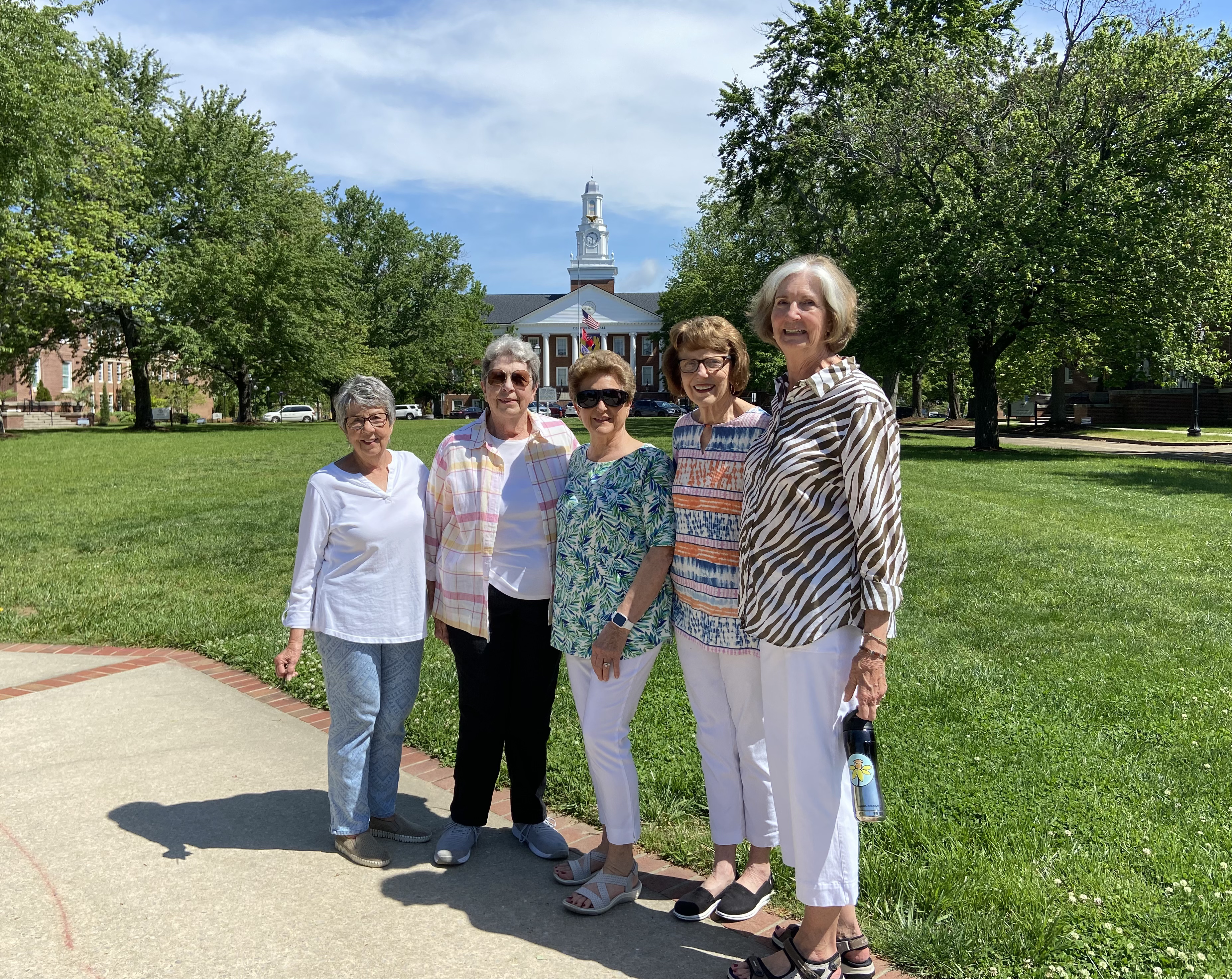
“You know what I remember most about this quad?” Kathy asked.  Last week, four college girlfriends and I stood in the middle of the Tennessee Tech quad, the grass rectangle in front of Derryberry Hall and surrounded by buildings built in the early to mid-1900s. 

            “Lines!” Kathy said. “Remember standing in lines to register for classes?”  We all laughed. 

When we were freshmen in 1965, to register for fall quarter classes we were given packets that included a list of class offerings, including time, location, and teacher, and our advisors ‘signed off’ on the classes we needed.  

            Then began the quest to get IBM cards for classes and that required walking from building to building and standing in line.  First, I chose non-major classes, especially English and History and the teachers determined my choice.  

            “But, remember when you’d have all the cards you needed for classes, except one, and that one required class was offered at a time you already had a class?”  JoAnn asked.  That meant walking across this quad, returning a class card, and hoping you could get into another class. 

            Registering for classes was like putting together a jigsaw puzzle and it usually rained on registration day.  A day of frustration.  “But just think, if Blondie and T. D. hadn’t stood in a registration line they might never had met,” said Kathy. That chance meeting led to a wedding in 1968, and as trite as it is, they have lived happily ever after.

            Ted McWilliams, assistant director of admissions and our tour guide, laughed at our stories.  “You probably remember going to basketball games in Memorial Gym right in front of us?”

            Yes, and because every seat would be filled, some of us went early to save seats for friends.  But, we most remember the gym as where we attended concerts and Public Programs and danced. Concerts by The Lettermen, Neil Diamond, Sam and Dave, Ray Charles, The Boxtops – big names in the 1960s. 

            Public Programs was a required underclassmen hour-long class in the gym on Wednesdays beginning at 10:00.  Students were assigned seats, by alphabetical order, and to earn an A for 0.5 credit hours, we sat while a student worker took roll, noting empty seats.  During Public Programs, school announcements were made and someone, a visiting dignitary or a faculty member, gave a short talk. 

            In the spring of 1967, Husband, then Boyfriend, invited me to the ROTC Ball, the Reserve Officers’ Training Corps formal dance.  He wore a rented tux and I wore a floor length blue satin dress and elbow-length white gloves as we slow danced under basketball goals.  

            “Let’s walk toward the new science building,” Ted said. My friends and I recalled chemistry lab classes in Foster Hall, which is no longer used, and English classes in Henderson Hall, where students still write papers and study Shakespeare. 

Ted led us on a one-mile tour, one-hour tour.  We five friends traveled more than five decades and didn’t stand in a single line.

College Friends are Lifelong Friends

As eighteen-year-olds from towns across Tennessee – Rockwood, Sparta, Nashville, Byrdstown, Jasper, Lawrenceburg – we came to Tennessee Technology University in 1965.  Seven coeds, two from one town.            

We lived on the top floor of Unit A dormitory.  Shared a hallway community bathroom, pink sponge hair rollers, poor boy sweaters, math homework, dictionaries, stories of the worst dates ever, and we swooned over Richard Burton’s pictures. 

            We practiced writing each other’s signatures, in case someone might be late returning to the dorm before it was locked each night: weeknight at 10:00 p.m., weekends at midnight. The sign-out and sign-in sheet was near the dorm front door, but one of us could distract the graduate student office worker while another signed the sheet. 

            We heated tomato soup in two-piece electric popcorn poppers – the only cooking appliances allowed.  But the bottom heating element heated a melted cheese sandwich when it was wrapped tightly in aluminumfoil.

We donned two-piece bathing suits, rubbed baby oil on our bodies, climbed out a dormer window, lay bedsheets on shingle roofing, and sunbathed.

            Typical dorm dress was baby doll pajamas.  Pajamas that could be hidden under knee length monogrammed London Fog rain coats, or knock-off London Fogs, and were acceptable attire to walk around the corner to the Midway Restaurant to get meat-and-three takeout suppers. This attire was also acceptable for an 8:00 Saturday morning class. 

            One of us dropped out of school to return home after her father’s death.  Two married while still students and lived across campus in married student housing; they brought home-baked cookies and cinnamon toast and stories of married life to the other four of us who lived in the dorm, two-by-two roommates. 

            We graduated. We hugged and promised to keep in touch. To write letters. To call, although phone calls were expensive and charged by the minute.  Within a few years, we’d all married, some living a short drive from each other, some in other countries.

            But we kept our promise.  We called to share news of jobs and babies and new homes.  For a time, we wrote a chain letter. When I received the seven-page letter, I read everyone else’s page, took out the page I’d written previously, wrote a new page, and mailed it to the friend who was to receive it next. 

            We wanted to celebrate our 40th birthdays together and five of us did.  To save money, we stayed in one hotel room that had a king bed and a pull-out couch bed and a commode that overflowed in the middle of the night.

            Since then, we’ve gathered most every year, usually all seven of us. One has told her children, “When I’m old and lose my mind, put me in a nursing home with my friends.  I’ll think I’m in the dorm and I’ll be happy.” 

            Last week five of us Sisterfriends spent three nights together here in Cookeville, and we toured the Tennessee Tech campus.  Memories flooded – fodder for another column.

May Brings Traditions

Just when life seems uncertain, May arrives and brings traditions, events that remind me that some things in life are certain.  I reach for the security of May traditions.

            I’ve written twelve Mother’s Day columns and have nothing new to share, but celebrating moms is a tradition to hold dear.  My mom made corsages of white flowers for both my grandmothers to wear in memory of their mothers, and Mom and I wore red flowers to honor our living moms when we went to church on the second Sunday in May. Because Mom honored her mom and mother-in-law, Dad made sure that my brother and I gave presents and showed Mom our appreciation and love. 

President Woodrow Wilson proclaimed the first Mother’s Day on May 9, 1914, and he asked Americans to give a public “thank you” to their mothers and all mothers.  For 110 years, we’ve celebrated Mother’s Day.

            Everyone knows someone who will don a cap and gown and be handed a diploma soon.  Across our country, 3.7 million high school students are expected to graduate.  Here in Putnam County’s public schools, more than 500 students will earn their diplomas – private schools and homeschool programs add to that number of graduates. 

            All graduates aren’t 18-years-old and attended school for thirteen years.  We honor kindergarteners and students who finish the highest grade in a school.  Many schools will hold 4th grade or 6th grade or 8th grade graduations, and academic programs, such as medical coding, hold spring graduations.  Colleges and universities, medical schools, and trade schools graduate students in May.

            The Boston Latin School, which opened in 1635, in Boston, Massachusetts was the first public high school that continues to graduate students.  Students have graduated for almost 400 years.

            The end of May brings Memorial Day.  Maybe only those of us who grew up in rural communities or who live near cemeteries where our ancestors are buried celebrate this day.          

As a child, I went with my grandparents and parents to place flowers on family members’ graves and I still do that – even leaving a silk rose for my great-grandparents, Elizabeth and David Rich, whom I never met, but heard Dad’s stories about them. 

The first Memorial Day was observed at Waterloo, New York, on May 30, 1868, to commemorate the sacrifices of Civil War soldiers.  Businesses closed and flags were flown at half-staff. During the late 1800s, communities across our country remembered those who had lost their lives during war.  After World War I, Memorial Day was established as a national holiday to honor those who had died in America’s wars.  

Some cemeteries set a day and time for decoration for families to gather and share ‘dinner on the ground.’ 

            According to Merriam-Webster, a tradition is an inherited, established, or customary pattern of thought, action or belief.  We need traditions because they connect generations and keep us moving forward.  Celebrating Mother’s Day, graduations, and Memorial Day are traditions to cherish, promises that there are certainties in life.

Golf is a Good Walk

When Husband and his friend invited me and his friend’s wife to join them while they played golf for a few days, we quickly accepted.

“Wanna’ ride along and watch for balls?” Husband said and I knew he meant when he and his friend teed off, hitting the first shots for each hole, maybe, just maybe, the ball wouldn’t go exactly they expected and we wives might see where the balls landed.

I also knew my friend and I could sometimes ride in golf carts and we could sometimes walk along the fairways (the mowed grass areas between tees where golfers hit the first shot for each hole) to the greens (the well-manicured areas where the holes are) and we’d get in our steps for the day.  And, golf courses are perfect environments to take in Florida flora and fauna. 

            Husband and I spotted a turtle before he hit the first golf ball.  Using her hind legs, the turtle threw soft dirt under a landscape shrub and buried her rump into the ground.  Her head and front feet were extended and she didn’t move for several minutes. Then she wiggled out of position and kicked dirt and landscaping pine needles to cover where her body had been. 

            Did the turtle lay eggs?  Probably not, because she wasn’t in position long enough, and turtles dig to hide parts of their bodies underground for comfort or when they are bored.  This turtle ambled across a sidewalk, onto grass, and, at my last sighting, across a fairway.

             A lost ball led us near a marsh area, the rough (tall grasses and weeds.) Two ducklings, with bright orange bills and black eyes, circled with white, stood perfectly still until we were within an arm’s reach, then they waddled toward water.  Later, I identified these as black-bellied whistling ducks.

            We spotted blue herons, red-wing blackbirds, geese, northern cardinals, blue birds, egrets, woodpeckers, and pelicans.  A utility pole provided a safe place for a bird nest and an osprey’s head appeared looking down toward us.

            When I saw a young turtle riding on the back of an adult sized turtle in a pond, I wondered if the five-foot long alligator close to it was lying in wait for lunch.  

            I mistook a saltmarsh mallow, a shrub-like wildflower with pink trumpet-like blooms, for a hibiscus.  Several fairways were bordered by water (a golf hazard) covered with water-lilies, and for a time I was mesmerized by their beauty, forgetting my responsibility to search for golf balls.

            I did forget why I’d been invited to ride along on the A. C. Read Golf Course, located at the Naval Air Station in Pensacola, because it was the Blue Angels practice day.  How could I watch golf balls while Boeing F/A 18 Super Hornets flew in tight formations overhead?

            It’s said that golf is a good walk spoiled, but golf is a good walk if you’re only watching for balls and take in all the outdoors has to offer.

Don’t Let Fear Make Life Small

When I read the book “In the Wild Light” by Jeff Zentner, I copied words Aunt Betsy said to her nephew Cash, “Fear tells you to make life small.  Don’t give it air to survive.”

            What encouraging words to a teenager to give up life in a small Appalachian town, and, with a close friend, accept the challenge to attend a big city elite prep school.  Cash lived with his grandparents who depended on him and while his friend excelled academically, Cash didn’t.

            Aunt Betsy continued, “You’ll never regret a decision more than one you make out of fear.”

Fear of a leaving the only home ever known.  Fear of leaving aging grandparents. Fear of being unsuccessful as a student.  Fear of moving to a completely different social and academic environment. Those are expected teen-age fears.

But the fear of being shot, and possibly dying, at school or a birthday party should never be children’s fears, nor should they fear that someone they love will be shot while at work. Yet, I think children are afraid because of recent mass shootings. They should never experience such fear.  Never.

As I write this column, the most recent mass shootings in our country were at a school, a bank, and a 16-year-old’s birthday party.

I know a young teenager who told her great-grandmother, “You know Mom (a teacher) and my sisters and I are at four different schools and Grandma works in a bank.  Now, I have to pray really hard every night for all of us.”

This child’s bedtime prayers are for her family members’ and her own safety, certainly not the prayers of a teenager a generation ago.

Last month, when the news broke of the deaths of three students and three adults at The Covenant School in Nashville, I felt great sadness and anger. Venting to a friend, I texted, “Why can just anyone buy an assault weapon? Will it take the death of a million innocent people, kids and adults, for laws to change?  Our state and country are a big mess.”

His response was that it’ll take changing politicians to change the laws, and it probably won’t happen in my generation’s lifetime.  I hope his timeline is wrong.

Has anyone else wondered where you’d take cover if shots were fired?  That thought went through my mind while enjoying a production of ‘Anastasia” at the Cookeville High School auditorium.  If I’m consciously squelching fear, what are our teen-agers feeling?

There must be change, not only laws for the sale of guns, but also in our understanding and treatment of mental illness.  I sympathize with the families of the shooters.  They must grieve and feel regret for not seeing warming signs to prevent tragedy.  I’m sad for them. 

Can we work together so that children and teenagers are safe?  I want their greatest fears to be the fears that the book character Cash felt when he struggled to make a decision. We can’t let fear make lives small.  

It’s Poetry Month!


Read any good poems lately?  April is National Poetry Month, first designated in 1996 by the Academy of American Poets, and is the largest world-wide literary celebration. 

            Some of us first studied poetry as high school students. We memorized lines from Robert Frost’s “The Road Not Taken” and Edgar Allan Poe’s “The Raven” and read Shakespeare’s “Romeo and Juliet” aloud in English class.

Memories of reciting, ‘Once upon a midnight dreary, while I pondered, weak and weary’ and reading ‘O Romeo, Romeo, wherefore art thou Romeo?’ might cause you to inhale quickly and deeply.

But you probably smile when you hear one of the most quoted poems:  Twinkle, twinkle little star, how I wonder what you are.  Jane Taylor’s lullaby was first published in 1806. One of my Grands was surprised when she learned that Twinkle, Twinkle is a five-stanza poem.  “Read it again, Gran,” she said.  “Is it really more than 200 hundred years old?”

            Years ago, I began reading poetry to our Grands while we ate breakfast after they spent the night with Husband and me.  We read the traditional Mother Goose poems, but the favorites are Shel Silverstein’s poems.

            Silverstein’s first book, Where the Side Walk Ends, was published in 1974 and the copy that belongs to Daughter is literally falling apart and is still on my kitchen bookshelf.  The back inside cover lists poems we read often.  My favorite is Hug O’ War.

I will not play at tug o’ war,

I’d rather play at hug o’war,

Where everyone hugs

Instead of tugs,

Where everyone giggles

And rolls on the rug,

Where everyone kisses,

And everyone grins,

And everyone cuddles,

And everyone wins.

Micah, age 8, said, “Will you read the one about the king?”  I didn’t know a poem about a king, but Micah’s older sister, Annabel, searched until she found an ink drawing of a king.  “It’s Peanut Butter Sandwich.”       

“And the king eats peanut butter sandwiches!” said Micah.  Annabel read that the king’s mouth stuck quite tight from a last bite of a peanut-butter sandwich.  Neither a wizard, a dentist, a doc, a plumber, a carpenter, nor a fireman could unlock the king’s jaws.  For twenty years, they toiled until finally every man, woman, girl, and boy pulled and then ‘kerack,’ they broke through that sandwich. 

“Wait!” said Micah, “I know what he said: I want a peanut butter sandwich!”

Annabel grinned, then continued.  “The first words that they heard him speak were how about a peanut-butter sandwich?” 

Micah laughed and asked, “What’s the one about the boy who didn’t know about money?” That one is Smart.

My dad gave me one dollar bill

            Cause I’m his smartest son,

            And I swapped it for two shiny quarters

            Cause two is more than one!

            Micah and Annabel giggled all the way to the end as Smart trades quarters, dimes, nickels, and finally shows his dad 5 pennies. 

 Celebrate Poetry. Find a book.  Search online.  Read a poem.  Not just now – anytime.