
• Recent Posts

  • Archives

  • Categories

  • Meta

Part 2: The Real Value of a Pump Organ

What is the value of a musical instrument if it can’t be played? If it takes up space and means something only to me? I wrestled with these questions about my huge pump organ. When the canvas binding connecting a pedal to the bellows broke and the organ wouldn’t play, it was time to do some soul searching, with a pinch of practicality.

My maternal grandfather and his siblings purchased the organ over a century ago. I played “Rock of Ages” on it for Papa as he sat beside me. Papa left it to his three daughters in his will with instructions, “One old organ that shall be kept in the family if possible and if it’s sold out of the family, the proceeds are to be divided equally among all my grandchildren.” It was moved from Papa and Grandma’s house to our home in 1985.

After Husband and I determined we couldn’t repair the broken binding, I researched the organ’s value and the cost of getting it repaired. It was made by the Estey Company, founded in 1850 and located in Brattleboro, Vermont. Something this old must be valuable, right? Not really. I found one on eBay priced $399. The only person who advertised online to repair pump organs didn’t service Tennessee and one contact who might look at it charged a minimum of $2500 to overhaul the complete instrument. That was too much.

But I wanted it repaired. Maybe because I have a picture of Mom and her two sisters when they were children standing beside the organ or maybe because I played it for Papa or maybe because Papa wanted it to stay in the family and mostly because I’m sentimental and believe that if family heirlooms are used, they are treasured.

A friend, known to his family as Builder Bob, offered to look at the organ. After he’d replaced the broken binding, I pumped the pedals and pressed the keyboard keys and nothing happened. Both of us were disappointed. Another day Bob took the back off the organ and although he knows nothing about keyboard instruments, he’s a self-taught carpenter and worked on the hydraulic machinery on nuclear submarines in the early 1960s and he likes a challenge.

Making this organ play would be a challenge. The brass reeds were black. The bellows cracked. The stops stuck. Dust, insect droppings, dead bugs filled the organ cavity. Bob and I agreed on a price and he hauled all the organ’s workings to his home workshop.

Last week, Bob put the shiny reeds, new leather bellows, heavy cotton dampening, and all the many parts of the organ in place. After he worked for two days making adjustments, I pumped the pedals and pressed the keys and played “Rock of Ages.” How I wished Papa had been beside me.

But even more I wished he’d heard my Grands say, “Can I play the organ next?” “It’s really hard to pump those pedal things!” “Listen, it sounds like the piano, but different.”

####
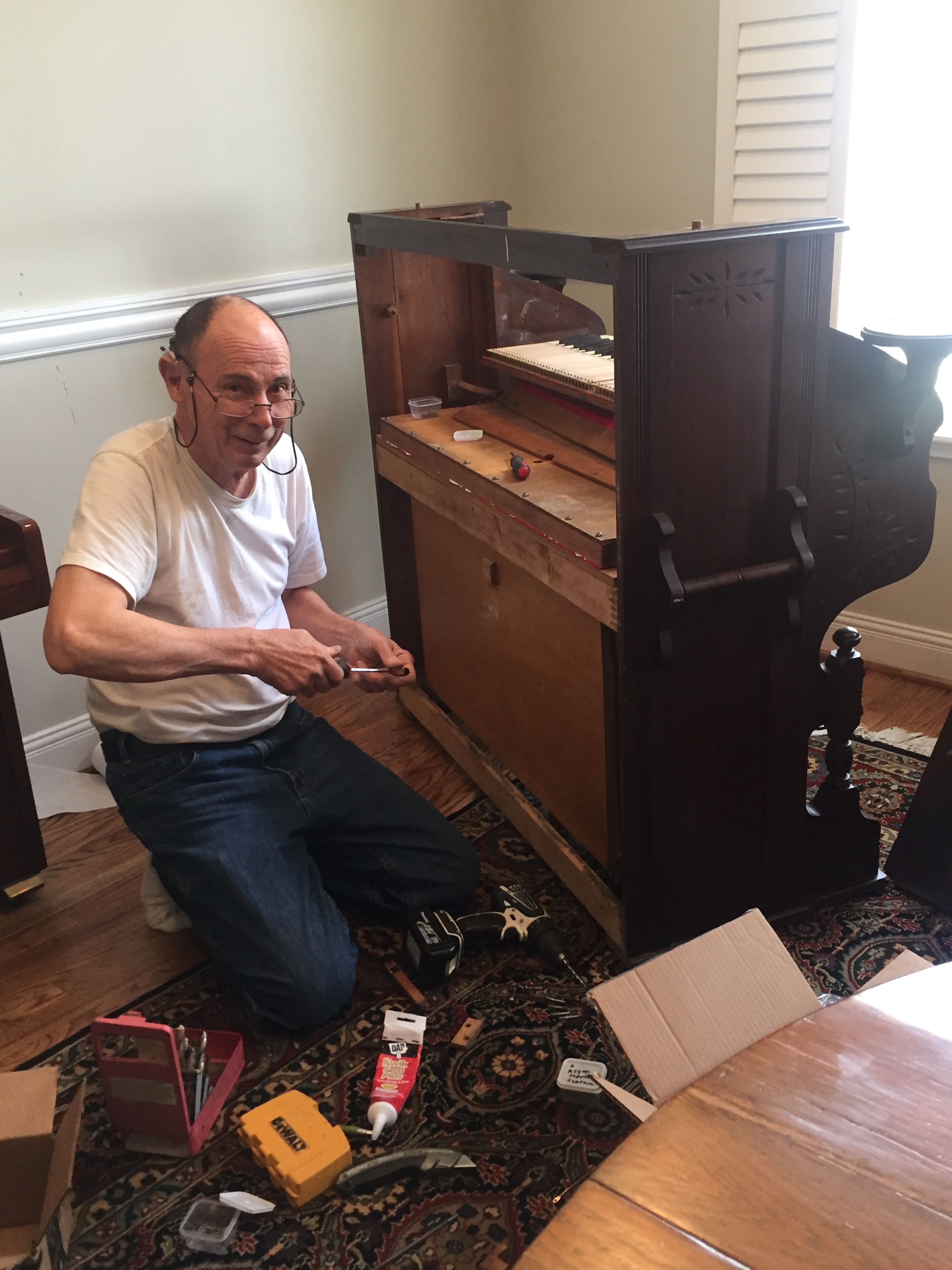
Post Script:  Thank you Builder Bob for your work!


Playing Papa’s Pump Organ

Papa sat in his easy chair beside me while I played “In the Garden” on his pump organ. My maternal grandfather, Paul Bertram, was a man of few words. When I finished the last note I knew he approved because he nodded, ever so slightly, and smiled. A closed mouth smile, his lips barely curved at the corners.

Papa’s approval was enough to encourage me to continue pumping the foot pedals to play “Rock of Ages.” After I played these two hymns, I opened the church hymnal and chose another. Papa sat as long as I played and I played as long as my twelve-year-old legs could pump the pedals.

I liked to pull out all the stop knobs to make the volume louder and it was fun to experiment by pushing some in. I didn’t know what Dulciana or Dolce or most of the other words printed on the nine other stops meant. I recognized the words Treble and Bass, but didn’t know what they meant when combined with Coupler and neither did Papa. He didn’t play any keyboard instrument, but he liked music and the organ was important to him.

Papa never talked about the days when he played musical instruments and I never saw him hold a fiddle, except in pictures, but I knew he had played one. Papa, his brother, and two sisters, Ervin, Mary and Martha, bought the organ about 1915 when they were all young adults, but not married so the organ sat in their parents’ parlor.   In the 1930s after their mother’s death, their father broke up housekeeping and lived with his daughter Mary and her husband. And the organ was moved to Papa and Grandma’s home.

During World War II, Papa and Grandma moved to Oak Ridge where he worked as a carpenter on war-related buildings. Upon their return home to Pickett County, Papa paid his siblings for their part of the organ and he took great pride in owning it. I wish I’d questioned him and taken notes. Who played it? Where did they buy it? Certainly not in the Bertram siblings’ hometown, Byrdstown, Tennessee. How much did it cost?

I continued to play for Papa every time I visited until his death in 1974 and about ten years later when it was time for Grandma to move from their home this dark stained, huge reed organ was moved to my house. Through the years I’ve played the organ occasionally and encouraged Daughter and our older Grands to play. Many notes stuck. The sounds were muffled. The pedals were stiff. But it played, until a few months ago when a pedal flopped because the binding connecting it to the bellows broke.

In his will, Papa excluded the organ from other property and left it to his three daughters with instructions, “One old organ shall be kept in the family if possible.” I believe family pieces are treasured only if they are used. So now what do I do with this family heirloom?

To be continued….

####


Decorating Easter Eggs

Screen Shot 2018-03-29 at 7.33.22 AMIt’s Easter and time to color eggs. Maybe this year we’ll decorate eggs some way other than a water dye solution. Before I could even explain different ways, my young Grand asked, “Why do we dye Easter eggs and can’t we just color them?”

The practice of giving Easter eggs began as a Christian tradition. A red dyed egg symbolized the blood of Christ and the hatching of an egg symbolized the resurrection.  The tradition carried through the years to different colors and processes.

Ukrainian etched eggs, especially those designs made using the scrimshaw method, intrigue me most. The inside of an egg is blown out (I’m not sure I can master that) and then the shells are lightly carved using a high-speed drill and a fine pointed knife. India ink is applied and the excess wiped away, showing intricate designs.

A design on a Ukrainian egg is created by applying wax to the egg before dying it. The wax protects the shell from the dye and layered designs are created. Usually detailed designs with many colors are used.

For a whimsical look, eggs can be decorated as heads of people or characters with painted faces, using permanent markers or brightly colored crayons. Yarn for hair and ribbon and felt fabric for collars can be attached with glue.

While researching methods, I came across the most valuable Easter eggs ever created. Around the late 1800s, jeweled Faberge eggs were crafted as Easter gifts for the families of Russian czars. Only 65 were known to be made. Today most are housed in museums and each egg is worth millions of dollars. A Faberge ‘style’ egg, for as little as $20 is available, but don’t expect real jewels.

I’ll fall back on the way I first colored eggs with my mom, then my children, and then my Grands. A PAAS dye kit. In the 1880s, the PAAS Dye Company began selling egg dying packets. William Townley worked in a drugstore in Newark, New Jersey and often concocted recipes for home use. He developed small colored tablets, in spring colors, to be mixed with water and white vinegar, and he sold the first packets of five colors for 5 cents. The word PAAS comes from Passen, the word for Easter that was used by Townley’s Pennsylvania Dutch neighbors.

Today’s basic PAAS kit is about $4 and for $20 deluxe kits are available. Neon colors. Emojis. Swirls. Marbled effect. Glitter. Spacemen. Crazy bird. Decals. Stickers. More choices than my Grands and I need. But we’ll improvise.

So we have a plan. I’ll boil a few dozen eggs, buy the basic PAAS kit, and collect a few other things. Markers and glue. Ribbon and yarn. Glitter and sequins. Wax crayons. My Grands and I won’t create valuable art like the Faberge eggs or priceless scrimshaw eggs. And we certainly won’t spend the hours required for a Ukrainian masterpiece. We’ll talk about the first red dyed eggs. We’ll have fun and make some memories.  That’s why we decorate Easter eggs.

March Madness Inside the Arena

When we bought tickets for Rounds 1 and 2 of the NCAA* Men’s Basketball Championship, Husband and I hoped to watch some of our favorite teams. At least one SEC* team and maybe the OVC* team would play in Nashville at Bridgestone Arena. And it’d be fun to watch Son’s favorite team, North Carolina. The sports analysts whetted our hopes. Tennessee, Kentucky, North Carolina, #1 Virginia were all mentioned as possibilities in Nashville. So when the bracket was announced, I was disappointed.

I knew nothing about the eight teams, except Missouri which is in the SEC. I stretched a connection that Husband and I ate supper at Shakespeare’s Pizza adjacent to the University of Missouri and then strolled across the university campus.

I like March Madness* so I’d go, pick teams, and have a good time. Watching sports on TV isn’t nearly as fun as seeing live games and all that goes on in the stands, on the sidelines, on the court that cameras can’t take in.

If there had been a wear-your-colors contest, the Cincinnati Bearcat fans decked out in red would’ve won. Also they, led by a small group seated behind the team bench, were the loudest, especially shouting DE-FENSE. And they appreciated great plays. Even when an opposing team player dunked for two points, they joined everyone in the stands and stood with arms stretched high.

The Florida State coach was the most entertaining. Dressed in a navy nylon sports sweatshirt and white tennis shoes, he paced the sideline and worked as hard as his players. He kicked his leg waist high and threw punches in the air.

Cincinnati also won the Battle of the Bands, in my opinion. During a timeout of every game, the arena announcer challenged the school’s bands to “do your best!” As Cincinnati played “Rolling Down the River,” fans clapped to keep time.

Mascots could take lessons from Texas Hook ‘Em. He danced Nevada’s Alfie off the floor during the Mascot Dance Off.   While Alfie swayed his wolf tail, Hook ‘Em moonwalked. Then he hit the floor with the Gator and next did the splits. Alfie threw up his paws in defeat.

The announced attendance was 17, 552 and the best Texas fan was seated right behind me. His continuous calm monologue entertained. “Take the easy lane – down the middle.   It was worth a try – you’ll hit it next time. Get down, you gotta’ get on the floor and dirty sometimes. The ball don’t lie – it’ll go where you shoot it.”  Even when his team lost in overtime, he was upbeat. “What a game! Somebody’s gotta’ lose.”

Up next are the Sweet Sixteen games and I’ll watch on TV and cheer for the two teams that won in Nashville. Nevada, a come-from-behind-team and Florida State that led only once over top-seeded Xavier.  And I’ll wish I were there. There’s more than basketball games to take in.

*NCAA – National Collegiate Athletic Association

*SEC – Southeastern Conference

*OVC – Ohio Valley Conference

*March Madness – the annual college basketball tournament

####


What’s in Your Wallet?

Elaine, age 6, watched as I searched inside my clutch wallet for money. I finally found $2.13 in bills and coins to pay the clerk. As we walked out of the store, Elaine asked, “What’s all that stuff in your wallet?”

I chuckled and said, “Stuff I need.” And my Grand asked, “For what?” For what, indeed.

Later I thought of Elaine’s questions and two other wallets came to mind. My mom’s and a college girlfriend’s. I stuck Mom’s billfold in my purse when she was admitted to the hospital April 1991. After her death a few days later, I kept it, just as she’d used it. Inside were the necessary things you find in everyone’s billfold: driver’s license, insurance cards, cash. And a few other things: her social security card, emergency contacts, and high school graduation pictures of my brother and me, although both photos had been made more than three decades earlier, and a picture of Mom and Dad. I cried sentimental tears that Mom had kept these pictures.

About ten years ago while travelling with a college girlfriend, I convinced her that her billfold was too big. No wonder she couldn’t find anything and her purse was so heavy. She didn’t need to carry every store discount card and notes from past shopping trips. Together we shopped for a smaller wallet and cleaned out her oversized one. Now, I laugh that my billfold looks like my friend’s did. Full of too much stuff.

So first, my apologies to you dear friend. What’s in my big 8” x 4” clutch organizer with its twelve card slots, zipper compartment, and three divided sections? The card slots are full. An expired museum membership card and insurance card dated 10/16 thru 10/17 to trash. Other cards that are used once a year go in a small zipper pouch in my car. Only two credit cards must stay.

Coins fill the zipper compartment. Pennies multiply. How I wish they’d transform into dollar bills. Just as sure as I clean out all the change, I will need a dime and three pennies to avoid getting back 87 cents in change.

One divided section for bills, one for receipts, and one for other important stuff. Important stuff like a dentist appointment card from 2016, expired restaurant coupons, and a scribbled grocery list – now trashed. And stuff I need: a band-aid, two postage stamps, emergency contact list, a copy of my passport (held over from when I marked the wrong box on my driver’s license renewal form and my driver’s license didn’t have a photo), a card listing a few passwords that regularly escape my mind. And a small plastic cardholder with three photos: one of Husband and two of our children when they were high school students, twenty plus years ago.

So Elaine the stuff in my wallet is important. It’s stuff to for identification, to buy more stuff, emergency stuff, and some sentimental stuff. Just like the stuff in most people’s wallets.

####

Lessons from Children

Screen Shot 2018-03-08 at 7.50.13 AMLast Friday, I was reminded of a lesson while celebrating Read Across America. This day isn’t on my calendar as it was when I was an elementary classroom teacher, but thankfully friends at Capshaw School invited me to read aloud. Although I often read with my Grands, sharing a book with a classroom of students is a different experience.
The calming atmosphere of the school where I taught for twenty years settled over me. I felt as if I were returning home, as a teacher in charge. The smells, the colors – all the same. The greeting, the smiles – different people, but the same.

Mrs. Rand introduced me and gave her second grade students a chance to ask questions. “What’s your favorite color?” Yellow, just like this questioner wore from head to toe. “Do you know my step-mom? She went to Capshaw.” I know step-mom’s parents. “What’s your favorite book?” Had this child been prompted to give me a lead-in to the book I’d brought to read?

These seven and eight year old students sat at my feet on the floor; I sat in a chair exactly like my former teacher desk chair.  I had practiced holding and reading a big picture book so that I could read sideways and upside down. “The book is Giraffes Can’t Dance by Giles Andreae,” I said and showed the cover picture of a bright yellow, orange-spotted giraffe turning a flip.

In the book, Gerald’s knees buckle when he tries to twirl at the Jungle Dance. The other animals cha-cha, waltz, rumba and laugh at Gerald. “Look at clumsy Gerald! Giraffes can’t dance, you silly fool,” they jeer. Sad and alone, Gerald creeps away. The song of a cricket and his encouraging words makes Gerald sway his body, shuffle his feet, and swish his tail. And then he throws his legs sideways and leaps into the air into a backward somersault. The other animals gather around and declared Gerald the best dancer ever.

As I read the last words of the book, the children leaned forward and a few clapped. “So what could be another title for this book?” I asked. The children’s answers told me they understood the story’s theme. Giraffes Can Dance! Giraffes Dance When They Hear Their Music. Gerald Had to Learn. Everybody was Wrong, Giraffes Dance.

And then one child said, “Everybody can do something. Giraffes don’t have to dance.” I wanted to hug him and I asked him to please say that again. “Everybody can do something,” he said.   I got my teacher fix: a reminder that children are teachers, too. We adults can listen to and watch children and learn from them.

Some people say, “I could never be a teacher.” If every minute of a teacher’s day was like the thirty minutes I spent with those young students, everybody could be a teacher and everybody would want to. But everybody doesn’t have to. Because everybody can do something. Different somethings.

A Young Grand’s Love

“GRAN!” Jesse screams as he jumps down the backdoor steps at his house. I spread my arms wide and my 3 year-old Grand runs to me. He jumps. I lift him and he wraps his legs around my waist and buries his head in my shoulder.

“Oh, Jesse, I’m so happy to hug you!” I say. Just as happy as I was the day before when he ran to me.

These are the times grandparents must never forget. Must cherish. Almost every time Husband or I see Jesse he asks, “Go to Pop and Gran’s house today?” And he accepts our frequent answer, “Not today, Jesse. Would you like to come another day?” He smiles and screams, “Yes!” Another day can be tomorrow or a day next week.

Jesse has a routine when he visits Husband’s and my house by himself. He climbs the steps to the upstairs playroom. “Come on!” he says. He sets the 1970s Fisher Price plastic garage on a low table and dumps the matchbox cars out of a basket. He parks each car in a blue or red space and counts them. “1, 2, 3, 4,” he says. Then he counts again, “1, 7, 5, 2.”

“Let’s read books now,” my Grand says as he runs to the kids’ bookshelf.   He chooses the same books every time: Look Out for Mater and Tales from the Track, both about the red car Lightening McQueen and his car friends. He throws the books onto the couch. “Sit here, Gran!” he says and slaps beside the books. I sit and he crawls onto my lap.

My Grand laughs aloud when Mater, a brown tow truck travels down a curvy road backwards. And whispers “Shhh” when Big Bull, a monster-sized bulldozer, sleeps. Before I finish reading the second book, Husband comes into the playroom. “Poppy!” Jesse shouts and crawls out of my lap, holds the book, and runs to Husband. Poppy, Jesse’s love name for Husband. Seven other Grands call him Pop, but Jesse coined Poppy, and now it’s his turn to read aloud.

No matter the time of day or how long the visit, Jesse wants a snack. “I’m hungry,” he says. He carries a booster seat to a kitchen chair and fastens its safety belt around his waist. He peels a tangerine, and like most toddlers, stuffs his mouth full and then talks. “Cookies! Can I have cookies?” he says. His snacks are always the same: a tangerine, cookies, and water. Water in a blue plastic cup and a blue straw.

When it’s time for me to take my Grand home, he runs to Husband. “Bye, Poppy,” and holds his arms up to be lifted. If Husband simply hugs, Jesse reminds him to kiss-hug and wiggles to the floor after each kisses the other’s cheek.

Jesse’s greetings and kiss-hugs won’t last much longer. Soon he’ll do as his older siblings who casually say, “Hi, Gran” or wave half-heartedly. But I remember, they too, ran to me when they were toddlers.

####


Goodbye to Baxter, a Loving Dog

It’s said that a mother is only as happy as her unhappiest child. Because Son and Daughter 2 (aka Daughter-in-law) and their three children said goodbye to Baxter, their 13-year-old Boxer, I’m sad. Baxter was family. My Grand, four year-old Neil would say, “There are four boys at our house. Me, Daniel, Daddy and Baxter.”

When Husband and I visited Son and Daughter 2’s home, Baxter welcomed us first. I braced myself for his full-force hug as he leaned against my legs. When I sat down, Baxter lay his head in my lap, his tongue licking my hands, my arms. It took a while for me to learn to say sternly, “Baxter, go away,” as Son suggested. That sounded cruel. Surely he’d understand, “Baxter, I love you, too and you are such a good dog and I’ll throw a ball with you later, but right now I want to hug my Grands.”

These three Grands, ages 6, 4, and 2, have only known life with Baxter. He’d be asleep, even snoring, on his mat in the corner of the family room and one of them would pet him or sit beside him or lay face to face with him. When Baxter awoke, he’d lie still or stand and walk to another room, another mat, or his crate. I wondered if he hid in his crate for peace and quiet.

Although all three Grands loved Baxter, two-year-old Ann turned to him for comfort. When we visited recently, Ann was unhappy that she couldn’t do what she wanted. She ran across the room and said, “I need my Baxter!” Baxter, sound asleep, didn’t flinch when Ann slung herself across his body.

It’s Daughter 2 I’m saddest for. Baxter was given to her as a young pup and he kept her company, especially when Son travelled on overnight business trips. She wrote the following tribute.

Baxter — my sweet, people-loving furry boy. My baby before I had a real baby.
He was a leaner, a licker, and a lover. As long as he was getting loved on, he was happy (even at the vet). You could see it in his short, wagging tail and feel it as his entire body weight leaned against your legs, and he licked whatever he could reach.
His ears were velvety soft, and he had a small white spot on the back of his neck. He had one black toenail, and his paws smelled a bit like corn chips. (One learns these things when an 85-pound furry boy shares your bed, occasionally). He loved peanut butter and would eat almost anything, including small stinky socks.
He lived a long, happy life. I’m grateful to have had him by my side for so long – in four different states and numerous homes, along for the ride in life’s big and small moments. His absence has left an almost tangible void in our house.

So Son, Daughter 2, and Grands, know that others are sad with you. Baxter was one loving dog.


Roses, Violets, Sugar, and Cards

Screen Shot 2018-02-15 at 7.54.23 AMIt’s Valentine’s Day. A day to send greetings to those we love. A day that the Greeting Card Association says that over a billion cards are sent, and it’s estimated that almost two hundred million roses are produced for this holiday. That’s about 17,000,000 bouquets of a dozen roses.

When I think of Valentine’s Day cards, I think of a two-line poem I first heard Dad quote when I was a child, and it was printed on some of the first mass produced cards in the mid-1800s.

Roses are red, violets are blue

Sugar is sweet and so are you.

But that’s not how the poem was first written. These lines were adapted from a rhyme published in 1784 in a collection of English nursery rhymes and read as follows:

The rose is red, the violet’s blue,

The honey’s sweet, and so are you.

Thou are my love and I am thine;

I drew thee to my Valentine.

The origins of these words can be traced back all the way to the 16th century, 1590, and were written by Sir Edmund Spenser in his epic The Faerie Queene. To describd a fair lady, he wrote, ‘She bath’d with roses red, and violets blew.’ All these years later, cards are printed with variations of the two lines about roses and violets and honey.

By the time you read this, I’m sure everyone has given and received Valentine cards. But what if you haven’t? It’s not too late. All you need is a pen or keyboard, a little time, and a willingness to put your feelings in words.

Husband and I have celebrated more that fifty Valentine’s Days. Yes, fifty! Three as college sweethearts and forty-eight as husband and wife. The cards we’ve given each other chronicle our time together. From lovey-dovey courtship days. Busyness of early marriage, each holding a job. Appreciation of love and care given to children and family. To funny verses about love lasting through the years. And we’ve exchanged gifts of flowers and candy.

I do appreciate every card, every gift, but I most remember one gift and one card. When Husband and I were college students, I was the only girl in my dormitory who received a dozen long- stemmed yellow roses. Yellow, not red, roses. No doubt the florist tried to convince Husband that red roses signify love and romance and were the perfect Valentine flower. Yellow roses represent joy and friendship. Husband knew yellow roses were my favorite flowers.

And my best-loved card didn’t cost one penny, except Husband’s time and the expense of printer ink. Not a store-bought card, but a personal card. I read this just-for-me card every Valentine’s Day and sometimes in between.

So write a card for your sweetheart. Begin with ‘Roses are red and violets are blue. Sugar is sweet and so are you.’ You can’t go wrong with those words. They’ve been around a long time.

Collecting: A good hobby?

Screen Shot 2018-02-08 at 7.45.11 AM‘Surely, collecting is a good hobby.’ With those words I ended a column two weeks ago that was inspired by the current Collecting Cookeville exhibit at the Cookeville History Museum. Friends have told me their adult children don’t appreciate their collections. One daughter refused her mother’s offer of a few of her Hummel figurines. “Mom,” the daughter said, “you like those more that I do. You keep them.” This mother knows a time will come when her only child will donate her treasured collection to a non-profit organization or sell them to add dollars to her son’s college education fund.

I know no one else in my family is particularly fond of clowns. I really like my twenty or so clowns arranged in small groups, which sit among the books on our living room bookshelves. Clowns with notes on the bottom telling who gave them to me and when. A clown depicting an adult reading a book to a child. One holding brightly colored birthday balloons. A clay clown, with a broken foot, that Daughter made.

According to psychologists, we humans are unique in the way we collect items just for the satisfaction of seeking and owning. We’ve done it for thousands of years, since earliest man gave up nomadic life and settled in one place.

Somehow I feel compelled to defend the importance of collecting and I found a blog that gives 8 reasons why collecting things you love is good for your brain. Now who can argue with anything that is good for our brains?

Collecting builds observation skills and organizational skills. We collectors search for details to make choices and look for common characteristics. Collections call for sorting into categories and that can transfer into other tasks, i.e. presenting school assignments and work projects.

Collecting builds knowledge and may lead to a career. A bird collection could inspire the study of habitats, the many species, and the distinct differences among birds. It’s possible a child could become an ornithologist because her mother collected wooden bird carvings. And think about children who collect rocks and are budding geologists. Charles Darwin collected beetles when he was a child and developed a curiosity for all living things. We know him best for his theory of evolution through natural selection presented in 1859.

Collections inspire creativity. Artists often collect things that influence their work. And social connections are made through collections. At model train shows and swaps, people from all walks of life and all ages meet to exhibit and trade train cars. And there are worldwide clubs for philatelists, people who collect postage stamps.

I knew it. Collecting is a good hobby. But I know collections are often valued only by the owner. I don’t expect my children to ever want all my clowns on their bookshelves, but someday they may want one or two. Ones with their names and “Happy Birthday, Mom” on the bottom. Just as a keepsake of something that made me smile and was good for my brain.

####