• Recent Posts

  • Archives

  • Categories

  • Meta

Surprise Christmas Gifts!

If ever there was a Christmas to give surprise gifts, it’s this one.  Unexpected gifts that bring smiles and laughs and memories. 

            Neither Husband’s nor my family pulled pranks often, but we remember a few surprises, like the year Uncle B played a trick on his father-in-law, my grandfather.  Papa was one of the most honest and fair and no-nonsense people I’ve ever known.  When Mom shopped for shirts for his three sons-in-laws’ Christmas presents and then told Papa the cost of each, he would give her money, even as little as a dollar, to put in the pocket if a shirt cost less than the others. 

            Every Christmas Papa gave one-pound boxes of Paul’s Stick Candy, soft stick candy of many different flavors, and as a kid I thought he owned the candy company because his name was Paul.  Papa tucked a $20 bill under the top flap of the white cardboard box – fifty years ago that amount bought a brown paper bag full of groceries.

            Uncle B told everyone except Papa his plan.  When Uncle B opened his and Aunt Nell’s box of candy, he swapped the $20 bill for a $100 bill.  He waved that bill above his head and said, “Thank you, Paul!”  Papa’s chin dropped, his eyes grew big and he reached into his back pocket, pulled out his billfold and looked inside it. How could he have made such a mistake!  Everyone, even us young grandchildren, laughed.

            Papa’s look of astonishment changed to confusion, when Uncle B drew a breath and held up Papa’s $20 bill.  Now, decades later, we grandchildren still laugh about the look on Papa’s face.

            Husband’s dad, aka Grandfather, was shocked by a gift he received one Christmas.  He had no hint of what was inside a beautifully wrapped package, but he was prepared for a surprise because no name was written on the gift tag to show who gave it.  Grandfather’s children, in-laws, and grandchildren sat gathered in his and Grandmother’s living room, and only the giver knew what was in the package.  Young grandchildren sat close on the floor by Grandfather’s feet, and he took his own sweet time to open the mystery package.

            Grandfather laughed aloud when only he saw the gift:  an xx-large white cotton bra embellished with sequins and red ribbons.  Holding both straps, Grandfather held his gift high for all to see.  Little ones covered their faces; grown ones laughed until tears rolled.  And for many years, we laughed again because that decorated bra was often among the gifts under the Ray family Christmas tree.

            Have you ever gotten a pig’s tail for Christmas?  When Husband was young, his maternal grandfather and uncles traditionally killed hogs the week of Christmas so a fresh pig’s tale was often wrapped and under the Christmas tree for the Powell family Christmas gathering.

            I don’t have a pig’s tail, but there are some things around our house that will be surprise gifts. As we celebrate this holy day, let’s bring laughter to Christmas 2020.

Shop at Home – Chapter 2

After reading my recent column about shopping at home, friends shared stories and agreed that I could share them here. 

 Five years ago, Jo found a newspaper from 1989 that had four-leaf clovers dried between its pages.  She remembered a day when her son Eli, then age 10, and his grandpa walked across the field between their homes.  Eli found 82 four-leaf clovers that day, and Jo had dried some of them in the newspaper that had been stored on a top closet shelf.  Jo cut an 8” x 10” section that showed the date from the paper.  She glued clovers around the paper’s edges and wrote a poem about that day when Eli and his grandpa were together.  Eli was 35 when he received the framed newspaper and poem, and he cried, as did all who watched him open his Christmas gift.  To make it an even more sentimental gift, Eli’s grandpa died in 1989.

            Delores shared that her mother writes a poem for her children’s birthdays and those saved poems are some of Delores’s most cherished gifts.  Recently, I found a picture of my granny holding my son when he was only six weeks old.  Jo’s and Delores’s gift ideasprompted me to write a short memory of Granny and mail it along with the picture to Son.  His immediate response and thank you give me the idea that a single picture with a short writing might be inside a few Christmas packages.

            Linda’s mother asked her brother and Linda to walk through her home and pick out the family pieces of antique furniture that they would like to have.  Last week, my friend Carol invited her only granddaughter to look through her jewelry and choose what she wanted.  I’m reminded of the day that my aunt took a ring off her finger and put it on mine. It was my grandma’s birthstone ring that had five stones:  one for each of my grandparents, my mother, and my two aunts.  Being the only surviving daughter, Aunt Doris wore the ring often.  That day she said, “It’s your turn to wear this ring.” 

            Friends also chimed in about regifting.  Nell said that her late step-mother thought she was the master re-gifter, but her gifts proved otherwise.  She gave a car vacuum with dirt inside the bag and a casserole dish with food stuck under the rim of the lid.  Her clothing gifts weren’t well received either:  a sweater with a speck of dried food on the front and a silk blouse with wrinkles where it had been tucked into a skirt waistline.

            One of the most legendary gifts that Nell’s step-mother gave was an evening clutch with theater stubs inside – not tickets, stubs.  This idea can be refined:  tickets or green folding money inside a new purse or wallet could be a really good gift.

            There are a at least two advantages of shopping at home:  you can wear pajamas and you’ll save money. Have fun shopping!  Only eight more days.

Why not shop at home?

            Is anyone Christmas shopping at home this year?  Not from home – at home?  My mom and Husband’s mom gave gifts that were theirs and that have become more valuable, sentimentally and, maybe, monetarily over the years.   

            I remember a Christmas in the late 1980s when I opened a lightweight package from under Mom and Dad’s tree and found a note inside.  I don’t remember exactly what Mom wrote, but my gift was a to choose a framed art print of a painting by Ralph McDonald from those that hung on Mom and Dad’s living room and dining room walls.  Mom had collected McDonald prints and now they were Christmas gifts for us children and spouses and grandchildren, who were teen-agers. 

            I was a surprised.  Mom and Dad liked these prints of wildlife in their natural settings, of frontier men and American Indians, and I couldn’t imagine how their house would look without these pictures.  And I wondered what if more than one of us chose the same print.  Mom explained the plan.  We were each to write the name of one or two favorite prints on a piece of paper and give it to her.  And while our chosen prints would be ours, she and Dad wanted to keep them hanging on their walls for a few more years.

            Mom knew us well – we didn’t choose the same prints.  After her death, when Dad sold their home and moved to a smaller place, Mom’s Ralph McDonald print collection had already been divided.  The Statesman, a picture a mockingbird, has hung on my living room wall since 1992.    

            Husband’s mother often shopped at home. When we celebrated our 50th wedding anniversary, she gave us a set of glasses, Princess House Heritage pattern juice glasses.  Ann explained that they were really old, may fifty-years old, and she’d bought them at a ‘home party.’  I was always amused when Ann would say, “That’s really old,” a way of saying that’s something valuable and keep it.  I treasure these hand-blown etched crystal glasses and they fit my young Grands’ hands perfectly.  One of my favorite Christmas gifts from Ann was a plain heavy glass butter dish with a domed top that had been her mother’s.  It’s got a few scratches and a chip which reminds me that it set on the family kitchen table when Ann was a child. 

            Not all shop-at-home gifts are sentimental.  I have a gift stash:  Christmas hand towels, fancy napkins, notecards, pens with pom-pom tops, scented candles, magnifying glasses, copies of a favorite devotional book, and even a small decorative pillow.  These are items purchased at discount prices or gifts I’ve received and someone else will enjoy more than me.  (I’m careful not to re-gift to the one who gave the gift!)

            Shopping at home would be a good choice this year, but I’m not sure what’s here for our Grands.  What if I wrapped home things in Christmas packages, and we play a good old-fashion game of Grab Bag?  It could be a new tradition.

Breaking Thanksgiving Traditions

Thanksgiving is about traditions and I cherish traditions. Even before I was born, Mom, her two sisters, and their parents celebrated together on Thanksgiving Day at noon.  The number of place settings at the table has changed over the past 75 years (yes, 75!). Card tables were set up for us children and grandchildren, and then the passing of grandparents and parents meant we children moved to the dining room table.  Thankfully, in-laws graciously gave us this day, and we’ve welcomed parents-in-law, in-law siblings, boyfriends, and girlfriends.

            Now, we who were born into this tradition are grandparents, and although none of us carry our maternal grandparents’ last name, we gather for the Bertram Family Thanksgiving.  But not this year.  On Thanksgiving Day, we might be with a son’s or daughter’s family. Maybe with a few people that we’ve claimed into our COVID-safe bubble. Maybe alone. 

            I wince when I hear someone say that rules are made to be broken, meaning it’s acceptable, or even good, to break a rule. Rules keep us safe and provide peace and order.  But, we all know instances when rules were broken for good at that moment.

            I take that stance with traditions.  Traditions are made to be broken. It’s the safest and best for my family to not be together this Thanksgiving.  I’ll miss my cousins and their families.  The hugs.  The laughing over the re-telling of stories about our parents and grandparents.  The first time to see a cousin’s six-month-old granddaughter.  The dividing of leftovers. The kitchen clean-up with my sister-in-law and cousins because the best conversations are over the kitchen sink, not at the dinner table. 

            Several weeks ago, I came to terms with our decision and pondered how to make this Thanksgiving a celebration with only Husband and Daughter’s family.  It’s the food.  As Daughter said, “The best meal of the year!” We pared the menu to turkey, cornbread dressing, a few sides, bread, and pies.

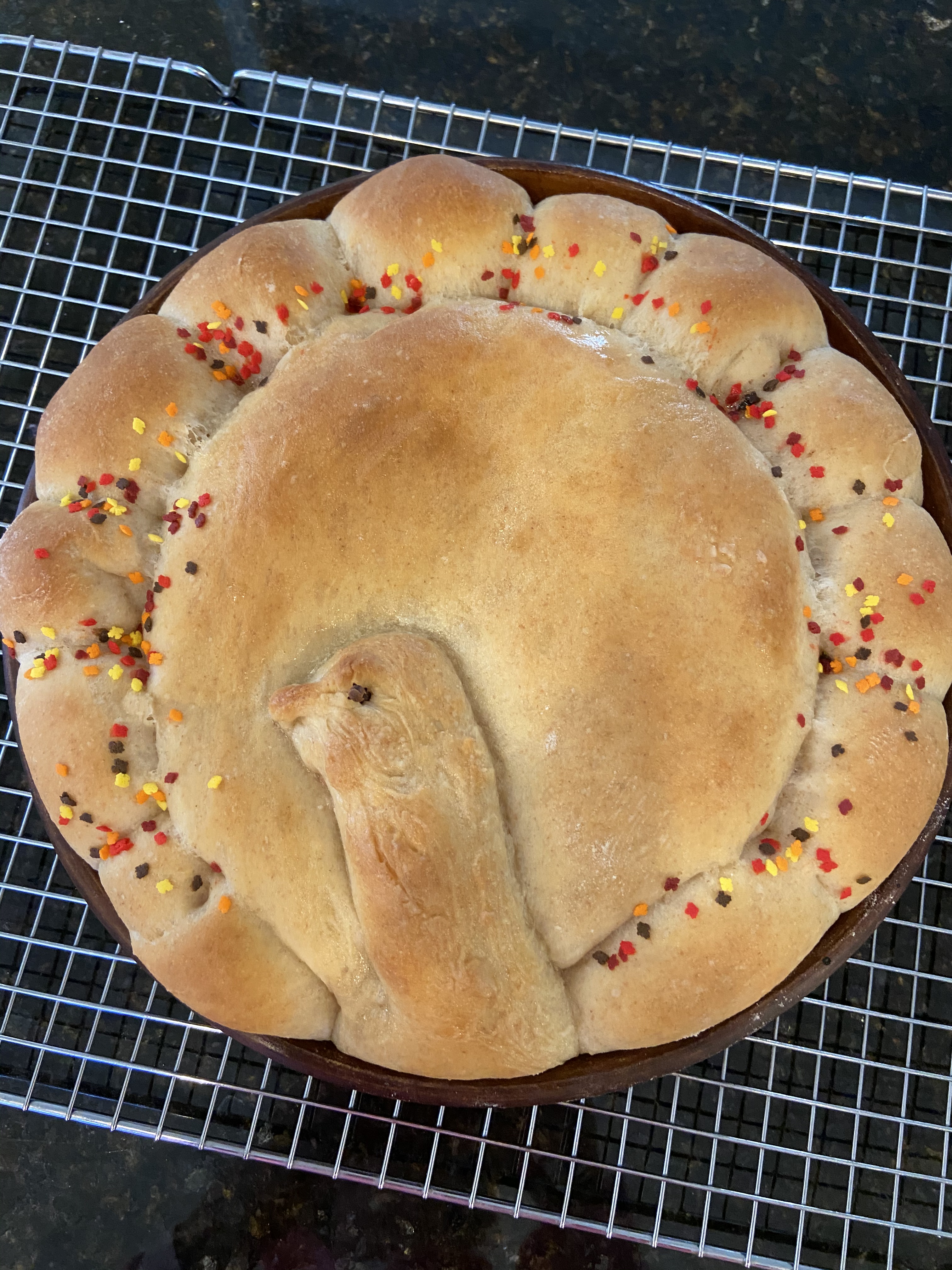
            And I thought of two things to make our Thanksgiving unique: turkey bread and a tablecloth.  I hope our Grands and their parents look back on Thanksgiving 2020 and remember that’s when I baked bread that looked kinda’ like a turkey, and we drew and wrote on the table cloth. 

            Neither idea is original. The bread is baked in a round cake pan with one big round roll in the middle (the turkey body) surrounded by smaller rolls (feathers), and a bread dough turkey neck and head draped over the body.  A whole clove marks the turkey’s eye and yellow and brown and orange sprinkles decorate the feathers.  We’ll draw and write on the heavy flannel-backed white table cloth that’s been around for years.

            Sometimes breaking traditions is good.  We Bertram cousins will be together next Thanksgiving and I have a feeling we’ll have a couple of new traditions.  Thanksgiving dinner won’t be complete without turkey bread and the tablecloth from 2020.

            May everyone stay well and enjoy a Happy Thanksgiving.

When Clothes Talk

“Hi, Gran, you look like Dad!”  Micah said.  I’d walked up behind my six-year-old Grand while he played with Matchbox cars on a track he’d made in the dirt.  He turned quickly and looked up to greet me.

             “Micah,” I said, “why do you think I look like your Dad?”  Son2, aka son-in-law, and I are about the same height, and he could wear my t-shirts, but his would be a bit tight for me.

            “What you’ve got on,” my Grand answered. “Doesn’t Dad have a shirt like that?” My t-shirt had a bicycle on it and because Son2 has ridden in many biking events, he often wears t-shirts with a picture of a bicycle.  I shook my head to answer Micah, and realized I was wearing blue jeans and tennis shoes, like Son2 wears most days since he’s been working at home during these months of the pandemic.

            Now, I love Son2, but Micah’s words that I look like him made me think about the clothes I wear. What other time in history would a child’s father and grandmother wear the same type of clothing?  I can think back one generation when my mom wore pants, but not jeans.  Her pants often had elastic waistlines and were made of stretchy fabric, and Mom wore long Bermuda shorts in the summer.  I never saw either of my grandmothers wear pants; even when Granny hoed the beans and pulled weeds from her flowerbeds, she wore a cotton shirtwaist dress. 

            History tells us that in the mid-1800s, women wore bloomers under dresses. By the early 1900s, women’s trousers appeared on high-fashion runways. During World War II, when more women entered the workplace, they wore pants for comfort. It wasn’t until the 1960s that pants became fashionable and popular for women.  And even then, we college students in the late 60s remember that pants weren’t allowed in classes.  I often wore my lightweight knee-length raincoat over shorts or pants to class.  

            By the early 1970s, pants suits, made of matching or coordinating fabrics, were poplar and comfortable.  The long tops were several inches above the knees and covered loose wide-leg pants.  And then the hippy revolution hit, with bell-bottom pant legs and jeans, and women began to wear pants everywhere.

My favorite jeans were bell-bottoms, wide legs that dragged so long that I almost tripped.  Now, like most women, I have several pair of jeans and I’ll keep wearing them.

            Who doesn’t have a collection of comfortable t-shirts?  We wear them to support sports teams, state our beliefs, and show where we have travelled.  But Micah made me think that I’ll wear other shirts when I’m out and about.            

The day I wore a t-shirt without writing or a picture and visited Micah’s house, his mother said, “You’re dressed up.  Going somewhere special?”  I didn’t tell Daughter that I was wearing a plain pink t-shirt because of something her son said, instead I said, “Yes, to visit with all of you!”

Finding Joy in a Plant

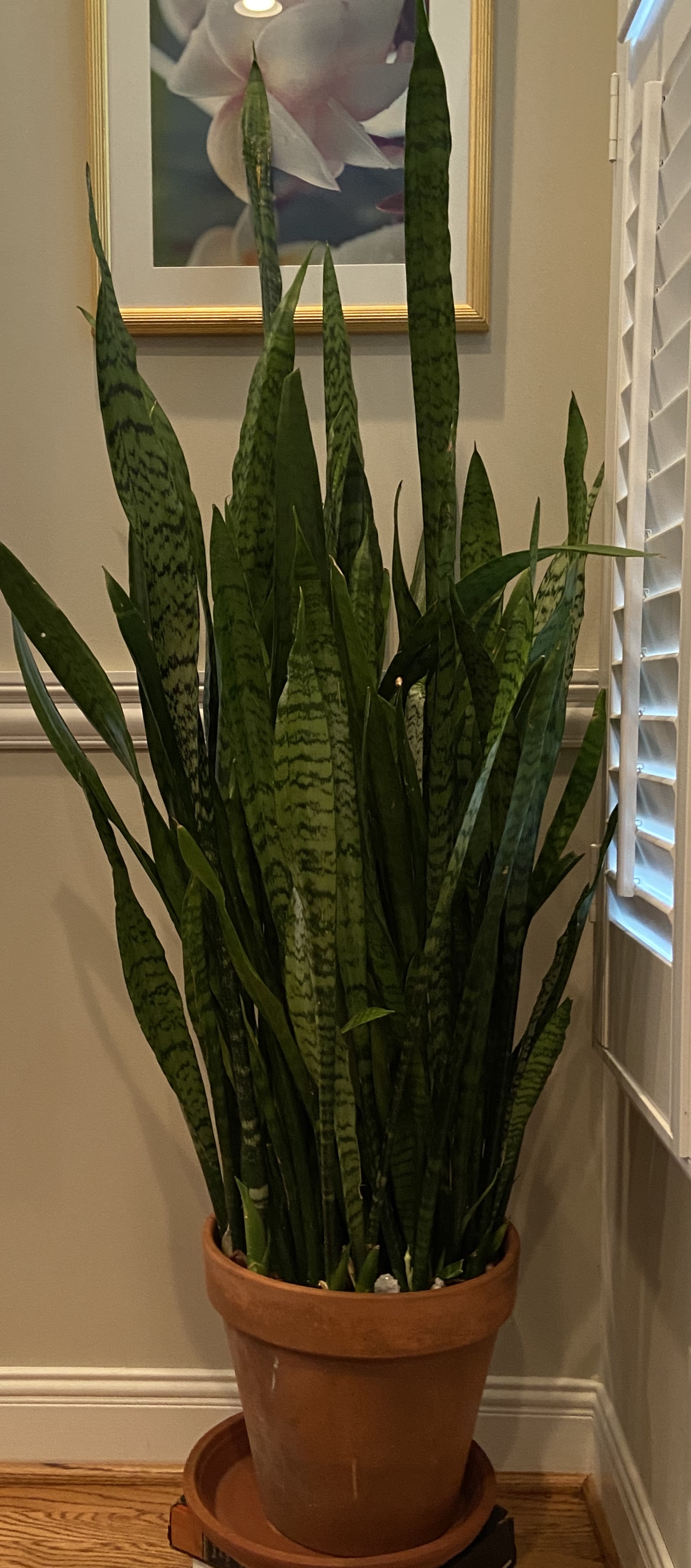
A tall snake plant sits in the corner of our dining room, and that simple plant makes me happy.  Recent weather forecast for frost signaled the time to bring potted plants indoors.  It felt good, almost soothing, to wipe the dust and grime off the long, narrow, strong leaves.  Partly because when I clean, I want to see a difference and this plant was dirty. But mostly, because it once belonged to my grandmother.

             A tall snake plant in a white pot always set on Grandma and Papa’s front porch.   She called it a mothers-in-law tongue, and her mother gave it to her.  As a kid, I didn’t really like it. The pointed, sharp leaves hurt when I brushed by arm or leg against them and I didn’t think it was pretty.  After Grandma’s death about thirty years ago, my aunt moved the plant to her house and shared two starter plants with me.  Grandma had few material things to pass on so I was really glad to have something that was hers; something she had nurtured.

            Snake plants require little care.  In fact, leave them alone and they grow well.  In the summer, I sat the pots outside and prided myself that the leaves were green and healthy.  When frost threatened, I moved the plants into a garage corner for the winter.  After many weeks, I noticed the tall leaves were limp. So, I set the pots in a bucket and poured water around the soil and left the plants in water all day. In fact, I left them for several days, and the leaves began to turn yellow.  I’d broken the #1 rule about care for snake plants: don’t overwater.

            Root rot killed one plant. Aunt Doris gave me detailed instructions to save the other one and she offered new starter plants, but I was determined to bring my small plant back to life. And I did, and now truly appreciate it as Grandma did hers.  

            The long, narrow, strong leaves earned this plant the name snake plant and prompted other names. Mothers-in-law because we mothers sometimes struggle to hold our tongues.  In Spain, it’s known as Saint George’s sword.  It’s also called viper’s bowstring because the stiff fiber in the leaves are strong. 

            Snake plants are succulent plants and their leaves retain water, similar to a cactus. I finally learned to water mine only when the top few inches of its soil are completely dry and to never pour water on the leaves.  I just learned that snake plants clean the air better than most plants because not only do they give off oxygen, they absorb high amounts of carbon monoxide and filter toxins in the air.  I’m sure Grandma didn’t know her plant helped to keep her healthy. 

            Now, the tallest leaf on my snake plant is about 40”and there are dozens of leaves, so many that it must be divided.  Next spring, I’ll give starter plants to my children.  Who knows how many generations might enjoy a simple snake plant?

It’s About Time

It’s that time again when I have to adjust to ‘old time,’ the term Papa, my grandfather, used for standard time, and he called Daylight Savings Time ‘new time.’  It takes a while to get used to sunset at 4:50 p.m. and the sun shining brightly at 6:15 a.m. My body and brain don’t immediately adapt, but the most difficult change is when I travel across time zones. 

            Drive across the United States from Maine to California and you’ll go through four standard time zones.  Travel to Alaska takes you to another one and Hawaii covers two more, except Hawaii and Arizona don’t observe Daylight Savings Time, but the Navajo Nation, in northeastern Arizona, does observe Daylight Saving Time.

            This thinking about time sent me on a search to remember when and how time zones were established and to learn other exceptions.  The need for a standard time became necessary with the beginning of railroad travel.  Prior to 1883 there were over 300 local times across the United States.

            Greenwich Mean Time (GMT) was adopted universally in 1884. The world is divided into zones by longitude, with each hour 15 degrees apart.  The starting point is the Prime Meridian, 0° longitude, that runs from the North Pole to the South Pole and passes through the Old Royal Observatory, in Greenwich, England, near London. Here in middle Tennessee we are in the GMT-6 (hours) Standard Time Zone so when it’s 4:00 p.m. in Greenwich, it’s 10:00 a.m., six hours earlier here. Counting around the world an hour difference for each fifteen degrees would mean there are twenty-four time zones. 

            Except, it doesn’t exactly work that way because some time zones are determined by political and geographical boundaries and some by choice.  So, there are forty time zones and all aren’t based on an hour.  India, Iran, Afghanistan, Burma, Newfoundland, Venezuela, and parts of Australia use half-hour differences from standard time.  I would be really confused traveling in Australia because there are three time zones: GMT+8, GMT+9½, and GMT+10. When it’s 4:00 p.m. on the west coast, it’s 5:30 p.m. in central Australia, and 6:00 p.m. on the east coast. 

            Time in some places is even more unusual. Nepal, a small country in the Himalayas and bordered by China and India, adopted GMT+5¾ in 1956, and the Chatham Islands in New Zealand is GMT+12¾ so those are 45 minutes past the hour. China is also unique; geographically it covers five time zones, but in 1949 the country established one time zone, Beijing time which is GMT+8.

            I imagine that the scientists from around the world who created Greenwich Mean Time in 1884 thought they’d set the world straight. But the lines for worldwide time zones are more crooked than the Caney Fork River. 

            Everybody just doesn’t go along with a plan.  Like Papa who never changed his clock that hung above the kitchen table to ‘new time’ because dinner was always eaten at 12:00 noon on ‘old time.’  

A Fun Halloween Surprise

What’s the most unusual thing you’ve received in the mail?  When Daughter was a college student, she sent a shoebox filled with leaves.  Colorful fall leaves from Berry College in Georgia.  Why would she send this when our yard and driveway were completely covered with leaves? 

            As teenagers, Daughter and Son teased me about my Leaf Reports.  Beginning when they were very young, I talked about leaves.  “Look, the trees have big buds.  In a few days, we’ll see leaves,” I said in the spring.  During summers, we identified trees by their leaves.  My children said I gave daily Fall reports: the changing colors, falling leaves, and the crunch of dried leaves.  Daughter’s box of leaves was a happy surprise, and I kept that love gift for years, stacked with other shoe boxes in my closet.

            Last week the mail carrier delivered an even more unusual gift.  Our 15-year old Grand was visiting and said, “Look what you got in the mail, Gran.”  He pointed to a small pumpkin, about seven inches tall and six inches in diameter.  It has a jagged-tooth smile, a triangle nose, and smiling half circle eyes drawn with a black marker.   

            “What?” I said, “This was in the mailbox?”  My Grand explained that the pumpkin was delivered to front porch.  “Where’s the box it came in?” I asked.

            “There wasn’t a box.  Look, your name is on it,” he said. There’s a hand-written address label secured with clear packing tape and a United States postage label showing the mailing cost, $8.70.  Another postal service label gives the tracking number. 

            “You mean it came through the mail like this?” He looked at me with the look that only a teenager can give.  I’m glad he didn’t say, “Duh, Gran.” 

            There was no return address so the person who sent Happy Jack wanted to remain anonymous.  The only clues were the hand writing looked familiar and “Mailed from zip code 38501” was on the label.  But who’d spend $8.70 to mail a pumpkin?  Why not just deliver it? 

            Maybe it was the person I’d talked with a few days before and she and I agreed that we love a good mystery and love solving it.  Maybe it was the friend who left a foot-tall yellow rubber duck on my front porch a few years ago.  Maybe it was the friend who likes to play jokes and knew I needed a good laugh.  All three of them responded to my text inquiries, “No, not me.” 

            I sent pictures of Happy Jack to Daughter and Son and they shared them with their families so we all laughed about this surprise and tried to figure out the sender.  After many guesses and sending many texts of inquiry, I received this reply: “Yes! I thought it’d be a fun thing to show all those Grands!”  

            Happy Jack sits on my back door step, and he is fun for all of my family.  But I’ll not tell who sent him because, after all, he was sent anonymously.             Happy Halloween!

So Many Putnam Counties

In this column last week, after praising Library Friends for its support to our public library and encouraging everyone to become a Friends member, I provided a link to Library Friends for Putnam County, Indiana.  The correct URL for our Putnam County Library Friends is https://pclibrary.org/PCL%20Friends.html.  I hope many of you join.

Ten years ago, when my friend Jennie encouraged me to write for publication, she said, “Just look around. Observe. There’s an idea for a story or column in almost everything you see and do.”  She’s right. In fact, my mistake provides two ideas: Putnam County and mistakes.

Do you know nine states have a county named Putnam? Counties in Tennessee, Georgia, Illinois, Indiana, Missouri, New York, and West Virginia are named for Israel Putnam.  It’s not certain if Putnam County, Ohio is named for Israel or his cousin Rufus, and Putnam County, Florida could be named for Benjamin Putnam, an officer in the first Seminole War and a Florida politician.  And two states, Connecticut and New York, have cities named after Israel Putnam.

What do you know about Israel Putnam?  He was born in 1715 in Massachusetts and died in 1790 in Connecticut.  As a young man he moved to Pomfret, Connecticut, where he became a prosperous farmer.  He served in the French and Indian War (1754 -63), was captured, and gained the rank of lieutenant colonel in 1759.  Putnam most distinguished himself as a major general in the Continental Army when he fought at the Battle of Bunker Hill during the American Revolution in 1775.   He deserved recognition across our country.

The next time you go the Putnam County Courthouse stop and read the tall silver sign about Israel Putnam to learn what year our county was established.  All nine Putnam Counties were named between 1807 and 1849.  Tennessee’s wasn’t the first or last.

So, there are nine Putnam Counties and nine Putnam County public libraries and most have a Library Friends webpage.  On my last revision of last week’s column, I cut words to rewrite the last paragraph because I wanted space to include the Friends group webpage link and that’s when I goofed.           

No excuses, just facts, I was tired and wanted to finish quickly.  When I first googled Putnam County Friends, I noticed the headline banner read Florida so I tried again, and I didn’t notice Indiana on the second one.  I copied and pasted and said to myself, “Done!” 

Isn’t that often what happens when we make a mistake?  We’re in a hurry or tired or both.  Then we have choices: fix it, if possible, or hope no one notices.  My mistake was fixed on the Herald-Citizen online edition and corrected in the next printed issue, but I wanted to ‘fix it myself’ as my young Grand says.  Winston Churchill said, “All men make mistakes, but only wise men learn from their mistakes.”   It’s true that everyone makes mistakes, and yes, I learned from mine.  And now I’m collecting more stories about mistakes for another column.

Be A Library Friend

Are you a friend of the library?  Not just someone who likes the library, but a member of the Putnam County Library Friends organization?

            Library Friends is a large group of people, some who generously give their time and money and many whose only support is through membership dues.  Its purposes include connecting people who are interested in libraries and raising public awareness of libraries.  It works with the library staff to provide programs and services.

            October 18-24 is National Friends of Library Week, a time for public libraries to show appreciation to Library Friends, a time to make more people aware of this organization, and to encourage membership.  When I received the recent bi-annual copy of Book reMarks, published by Putnam County Library Friends, I put it aside until I could sit a bit, with a cup of hot tea, and read this eight-page newsletter. 

            This edition tells about the current library services, some are limited due to COVID-19.  It includes pictures and articles about recent library renovations and the success of the summer reading program for children, teens, and adults.  The article that most interested me told about Open Books, Open Doors, a partnership between Putnam County Schools and the library. Librarians are visiting 7th grade Language Arts classes in all four Putnam County Schools to enrich the students’ experiences in oral storytelling, comic arts, and virtual book borrowing.  Last year through this program, many students received their first library cards.

            I reread that sentence.  These 7th graders, who are 12 years old, got their first library cards.  I thought of my young Grands and how proud they were when they were 5 years old and showed me their cards.  “Look, I can get my own books!” Micah said last year.  Having their own library cards, children are likely to choose more books and want to hear and read those books.  I’m glad our community’s school system and public library work together to encourage middle-school students to use the library.  

            Perhaps Library Friends is best known for its monthly used book sale, and unfortunately, it has not been open during recent months.  I have a stack of books to donate when the sale re-opens, and every time I have gone to the sale I leave with an armload of books for just a few dollars. 

            By being a member of Library Friends, I put my money where my mouth is.  Children, and adults, learn by reading.  It’s true that children learn to read, and then they read to learn, as well as for enjoyment.  I want public libraries to be around forever.  The library offers more than printed books, such as public computer use, online printed and audio books, and meeting rooms.  Check out the Putnam County Library website and Face Book page.

            The Friends’ mission is to promote literacy in all its forms, to facilitate equitable access to information, and to encourage lifelong learning and a love for reading. Membership is available to any person, corporation, or organization that shares this mission. You can join online at https://pclibrary.org/membership%20form%202016.pdf.