• Recent Posts

  • Archives

  • Categories

  • Meta

Celebrate Thanksgiving and Christmas

Tis’ the day before Thanksgiving and all through the town Christmas lights shine brightly – much to some people’s dismay.

Don’t skip Thanksgiving.  Don’t let Christmas lights and glitter and tinsel push Thanksgiving aside.   Thanksgiving is the time to be thankful.  Enjoy the last days of fall while a few golden and rusty orange leaves hang on tree branches. 

Celebrate Thanksgiving Day with family, friends, food and football.  And take in the Macy’s Thanksgiving parade while the cornbread dressing and pumpkin pies are in the oven.  Let the Thanksgiving spirit carry you through the weekend as you eat turkey sandwiches, watch more football and gather with family and friends. 

People who say that Thanksgiving is their favorite holiday have good reasons.  Little decorating.  No gifts.  The dinner menu is set – some would say it’s the best meal of the year.

Those same people are annoyed, almost angry, that rooftop lights on their neighbors’ homes cast shadows on their yards.  They scoff that anyone would put up Christmas trees before Thanksgiving.  How dare anyone skip Thanksgiving.  

Let the lights shine say others. A friend who decorates with Christmas lights and green garlands before Thanksgiving said she wanted to wrap herself in the Christmas spirit as long as possible.  (She might have strung Christmas lights atop her house on July 4th if everyone who lives in her house had agreed.) 

Pro-before-Thanksgiving decorators say, consider the expense and work putting up Christmas lights. Why not enjoy them as long as possible?

“The lights make me happy and I can still eat turkey and dressing,” a friend told me. Her Christmas tree, decorated only with white lights, has stood in the corner of her living room since early November.  The day after Thanksgiving, she’ll add the ornaments.

For years, I’ve said, “Don’t skip Thanksgiving!” And I hate Christmas television commercials before Thanksgiving.  My childhood traditions tell me that Christmas begins after the 4th Thursday in November. That’s an unspoken rule.

Maybe it was when I heard my friend say that the lights make her happy that I began to mellow. I thought of Thanksgivings and Christmases past.  We gathered with family and friends, and Mom and her sisters served turkey and cornbread dressing for both holiday dinners. 

So, when my family gathers around our dining room table, they’ll see a centerpiece of pumpkins, gourds and bittersweet.  Small blocks, the kind that toddlers like to stack and knock down, spell Happy Thanksgiving and ceramic pilgrims and turkeys stand on a living room table.

Nearby a two-foot wire Christmas tree is decorated with ornaments, depicting well-known local places, that I’ve bought from Cityscape through the years.  And framed family Christmas cards that Husband and I have mailed for the past eighteen years set atop the piano.  And my Grands helped me put carolers and a gingerbread house near the pilgrims.

I’ll never skip Thanksgiving, but I can be thankful and celebrate the birth of Jesus at the same time.

Both Thanksgiving and Christmas bring joy and hope.

It’s Poetry Month!


Read any good poems lately?  April is National Poetry Month, first designated in 1996 by the Academy of American Poets, and is the largest world-wide literary celebration. 

            Some of us first studied poetry as high school students. We memorized lines from Robert Frost’s “The Road Not Taken” and Edgar Allan Poe’s “The Raven” and read Shakespeare’s “Romeo and Juliet” aloud in English class.

Memories of reciting, ‘Once upon a midnight dreary, while I pondered, weak and weary’ and reading ‘O Romeo, Romeo, wherefore art thou Romeo?’ might cause you to inhale quickly and deeply.

But you probably smile when you hear one of the most quoted poems:  Twinkle, twinkle little star, how I wonder what you are.  Jane Taylor’s lullaby was first published in 1806. One of my Grands was surprised when she learned that Twinkle, Twinkle is a five-stanza poem.  “Read it again, Gran,” she said.  “Is it really more than 200 hundred years old?”

            Years ago, I began reading poetry to our Grands while we ate breakfast after they spent the night with Husband and me.  We read the traditional Mother Goose poems, but the favorites are Shel Silverstein’s poems.

            Silverstein’s first book, Where the Side Walk Ends, was published in 1974 and the copy that belongs to Daughter is literally falling apart and is still on my kitchen bookshelf.  The back inside cover lists poems we read often.  My favorite is Hug O’ War.

I will not play at tug o’ war,

I’d rather play at hug o’war,

Where everyone hugs

Instead of tugs,

Where everyone giggles

And rolls on the rug,

Where everyone kisses,

And everyone grins,

And everyone cuddles,

And everyone wins.

Micah, age 8, said, “Will you read the one about the king?”  I didn’t know a poem about a king, but Micah’s older sister, Annabel, searched until she found an ink drawing of a king.  “It’s Peanut Butter Sandwich.”       

“And the king eats peanut butter sandwiches!” said Micah.  Annabel read that the king’s mouth stuck quite tight from a last bite of a peanut-butter sandwich.  Neither a wizard, a dentist, a doc, a plumber, a carpenter, nor a fireman could unlock the king’s jaws.  For twenty years, they toiled until finally every man, woman, girl, and boy pulled and then ‘kerack,’ they broke through that sandwich. 

“Wait!” said Micah, “I know what he said: I want a peanut butter sandwich!”

Annabel grinned, then continued.  “The first words that they heard him speak were how about a peanut-butter sandwich?” 

Micah laughed and asked, “What’s the one about the boy who didn’t know about money?” That one is Smart.

My dad gave me one dollar bill

            Cause I’m his smartest son,

            And I swapped it for two shiny quarters

            Cause two is more than one!

            Micah and Annabel giggled all the way to the end as Smart trades quarters, dimes, nickels, and finally shows his dad 5 pennies. 

 Celebrate Poetry. Find a book.  Search online.  Read a poem.  Not just now – anytime.

The Happy Little Helper is a Joyful Giver

There is always one gift or one story to make every Christmas unique. My thirteen-year-old Grand is this year’s story.

            Annabel is Daughter’s middle child with an older brother and sister and a younger sister and brother.  Ten days before Christmas she set up business – an in-home business – to earn money for gifts.

            “Mom, come in and see what Annabel is doing,” Daughter said when I stopped by her home to leave a borrowed waffle maker.  Annabel stood on her knees behind her work desk, a piano stool, that displayed a handmade poster:  The Happy Little Helper is IN.  In smaller letters I read ‘Handy man work and house cleaning service.’

            Three of Annabel’s siblings sat nearby on the floor when she saw me. “Hi, Gran!  How can I help you?”  She grinned waiting for my reply. 

            “Can you clean my house?”  I asked. 

            “Probably later, but Lucy and Elsie (her sisters) have some things they need done first.”

            Annabel worked; she vacuumed her sisters’ rooms and cleaned the interior of her family’s van and Husband’s car.  She didn’t clean my house because she had enough money, she told me.

            I was her shopping chauffeur and assistant.  I packed my patience and blocked out the morning.  I’ve stood in front of chewing gum displays for fifteen minutes while Annabel chose one pack – there are so many choices.

            “I can get everything at Wal Mart,” my Grand said as she buckled her seat belt. She held a small spiral notebook with only four lines written.  “I know where everything is.” 

             “Let’s go to Aisle I-17 first.”  Annabel led the way and immediately picked up a Gatorade water bottle.  I suggested that another one would be a better buy.  “No, this is the one Samuel (17-year- old brother) will like.”  I wondered how she knew which aisle.  “There’s a search and map on the store website,” my Grand explained and headed to toys where she chose Hot Wheels tracks and a Hot Wheels Lego truck for her younger brother. 

            As she stood looking at the many card and board games, I offered help.  My Grand repeated the name of the card game twice:  Taco Cat Goat Cheese Pizza.  “Yes!  There’s only one and it was hidden behind another game. Lucy will love this!” Annabel pumped her fist.

            The hanging space for Rubic cube key chains was empty and we couldn’t find a hidden one.  With a gleam in her eye Annabel said, “I’ll get it online. It’ll be here on the 28th, and I’ll make Elsie a paper one.  She’ll be happy to get her gift later.”  Fifteen minutes after walking toward Aisle I-17, Annabel practically skipped to the self-checkout lane. 

            In my van, we searched Amazon for the key chain, ordered it, and Annabel handed me money to pay for it.  “I’ve got $3.00 left!” she said.

            Christmas 2022 will always be the year of The Happy Little Helper, the fastest shopping ever, and the happiest giver who should be on a billboard with the caption The Joy of Giving.

Marvel at All Living Creatures

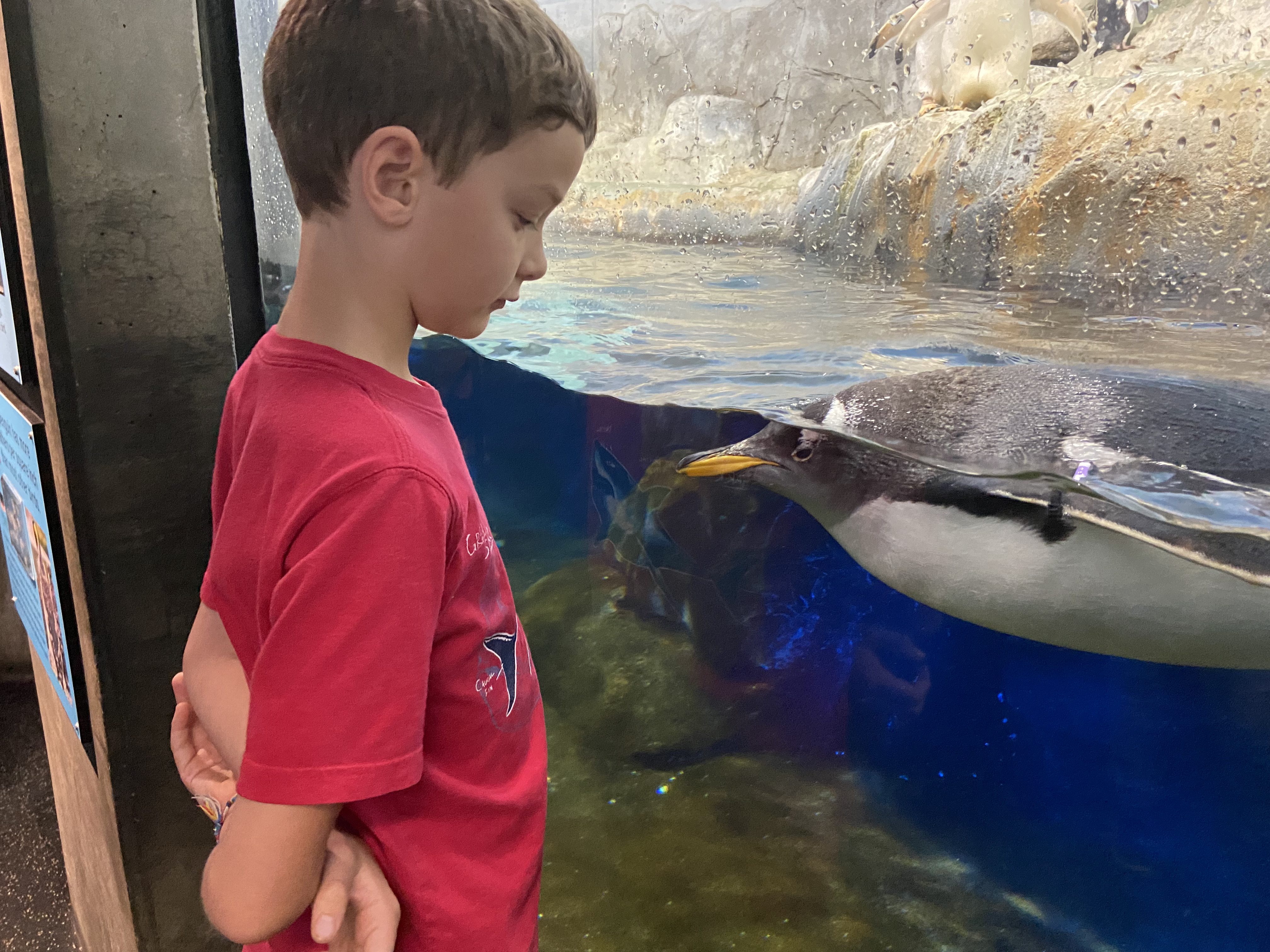
            Their noses were inches apart.  What was my Grand thinking as he looked into the eyes of a penguin at the Tennessee Aquarium?  Harrison, a juvenile Macroni penguin, seemed as mesmerized as Micah, age 8.  Where they were playing a game of Blink through the Penguin Rock exhibit’s thick glass. Who would blink first and move?

Finally, Harrison swam away.  My Grand turned toward me and said, “He liked me.”  

            Micah’s body touched the glass of the tank that holds the largest aquarium animals.  A Sand Tiger Shark swam toward Micah and he backed up.  After the shark’s nose skimmed across the glass, Micah stepped forward to meet a Whiptail Stingray.  It’s underside white body was wider than Micah’s outstretched arms and it flapped its fins to swim away.  Micah stood at attention waiting for the next animal to come close.  

            During a two-mile hike with five Grands, Daughter, and Daughter2 along a Colorado park trail, we stopped often.  “Look, Gran,” said Charlotte, age 7.  “It’s a lady bug.”  Charlotte had squatted low and she placed her hand on the ground.  The beetle crawled into her palm and we all marveled at its beauty, its brilliant red back with black spots. 

            As we walked, some of us ducked to avoid black and yellow swallowtails and all eight of us stopped to count how many small yellow butterflies flew above a stream.

Lucy and Annabel, ages 11 and 13 respectively, were in no rush at the Nashville Zoo at Grassmere.  The meercats scampered on the ground and some into holes; one stood at attention, as if posing.  These were the animals both girls wanted to watch first.

At the cougar exhibit, we saw these large cats stretched out perfectly still on rocks.  Husband, Lucy, and I were ready to move on so I said, “Annabel, I think they’re sleeping.” 

            “I know,” my Grand answered and didn’t move. When we finally walked away, I wondered how long Annabel would’ve watched these big cats sleep. 

            On that hot day last week we talked about how hot we were, how hot the zoo animals must be, and we understood why most hid underground or in the shade. “Except him and he might be dead,” I said and pointed to an earthworm on the stone path. Lucy carefully picked him up; he wiggled slowly in her hand.  She carried him to the grass covered ground and gently turned her hand so that he fell off.

            “You saved a life today, Lucy!” Annabel said.

            Just a few days before Annabel and I had read poems from Great Poems for Grandchildren.   “Like the poem we read last week.” I said.  “Hurt no living thing.”  I wish I could’ve quoted the next six lines, especially the last: ‘Nor harmless worms that creep.’

            “Nothing, Gran?” Lucy said with a smile.  She knows I swat flies and mosquitoes.

            One of my grandparent joys is watching my Grands marvel at all living creatures.  I do it every chance I get.

Happy to Celebrate!

Most times when I put my fingers on my keyboard to write the first draft of a column I have the topic and most of the 500 words, in somewhat logical order, in mind.  Today only the topic is firm: this week I’ll celebrate a milestone birthday.  But the words are like shooting stars – fast and random.

             I think of my grandmothers and Mom and of my other significant birthdays and my life at age 25 and how the next fifty years unfolded.  If given a second chance, what would I have done differently?  I count blessings.  I reflect on how I got to be this age and what’s next.

            Granny and Grandma Gladys looked old when they were 75. Both had short wavy gray hair and wore dresses – I never saw either in a pair of pants.  Neither ever drove a car.  Granny worked in her garden and hand stitched quilts and watched soap operas and wrestling on TV.  Grandma cooked three meals a day for herself and Papa and welcomed their three daughters’ visits.

            In her seventies, Mom played golf and Scrabble, preserved vegetables and fruits that she and Dad raised, sewed clothes for herself, machine stitched quilts, grew flowers, watched baseball and basketball games.   These memories make me wonder how my children and Grands will describe me at 75?

            At 25, I hoped for children and five years later, Husband and I had two toddlers, Daughter and Son. And many years later, they blessed us with grandchildren.  At 25, or even 50, I never expected eight Grands!

            Oh, the things I would have done differently.  Fewer chores and more play with my children.  Laughed at spilled milk. Rocked until babies slept and then kept rocking. Allowed desserts even if all the vegetables weren’t eaten.

I wish I’d listened more carefully and made notes when Mom and Dad told stories of their childhoods and when they dated as young adults and their early marriage.  Why didn’t I ask my grandparents about their lives?  Why didn’t I write their memories?

As an elementary school teacher, I’d be less strict and structured.  I would learn more about my students’ home lives and send home more positive notes. 

            At this point in life, counting blessings comes easy.  Several years ago, I began listing people, things, and events for which I’m thankful.  This morning as I drank coffee on my front porch at 6:30 a.m., I wrote number 5983A hummingbird chattered and drank from our feeder. 

            If someone asked “Who are you?”, I’d start with relationships.  Christian. Wife. Mother. Grandmother. Cousin. Friend.  I’m most thankful for God and people.             

I’m thankful to live when we grandmothers color our hair and wear shorts and drive grandchildren to practices and play in swimming pools with them.  I’m thankful to sleep under Granny’s quilts and make Mom’s sweet pickles. And I appreciate a computer that lets me cut and copy and delete.

I’m really happy to celebrate this birthday.  I’ll eat cake first.

Roots and Wings

‘There are only two lasting bequests we can give our children.  One is roots.  The other, wings.’  When I researched to learn who wrote or said these inspiring words, I learned many people have used them:  Henry Ward Beecher, Jonas Salk, Ronald Reagan, and others. But I didn’t find out who first gave this sage advice.

            As 865 Putnam County high school students graduate this week, parents wonder if their children are ready.  Ready to move out of their homes.  Ready to take on the responsibilities of living with peers.  Ready for a full-time job.  Ready to study to attain the next degree.  Ready to measure up to the rigorous training in the armed forces.  Ready to manage their time, their money, eat healthy, even ready to wash their own clothes. 

            Yes, they are.  Because you gave them roots.  Roots that go all the way back to when your children were swaddled in small blankets and you attended to their every physical and emotional need.  When they fell on their bottoms as they stumbled to take steps and you clapped to encourage them to stand and try again.  When they started kindergarten and you threw an air kiss.

            Roots grew thicker and stronger when children learned to socialize with classmates and team mates.   Learned to adapt to teachers’ and coaches’ expectations that were different than at home.   Learned rules and consequences, and probably experienced consequences that taught life lessons.   Learned to compromise, to lead, and to follow.

            You parents encouraged wings to develop through root experiences.  When toddlers fell, they picked themselves up and wings fluttered.  When children felt unsure and scared, you encouraged.  When the world’s values didn’t match home values, you helped your children sort, discard, and keep what was necessary to be successful.

            And when children felt rejected or defeated, they knew a safe, secure place. At home, their wings could wave frantically and then rest to rejuvenate and grow.

            Roots and wings continue to develop even after most people think children are old enough to be on their own. When my children were young, Mom told me about giving roots and wings and years later she chuckled when Son showed both.  He was working his first full time job after college graduation and lived a four-hour drive from Husband’s and my home.  We planned to visit him for the weekend and Son asked, “Will you bring my camo coat? The one that’s hanging on the coat rack in the mudroom.” 

            Son’s wings had taken him to independent living.  His roots told him that home was the same. That his coat he’d hung on a coat rack when he was a high school student, years earlier, was still there.  The coat had been moved to a closet and we took it to him.

The greatest gifts parents give their children truly are roots and wings.  Gifts we continue to give, even after children wear caps and gowns and think they are all grown up.

More Than a Cheese Tray

It’s more than a cheese tray.  More than pepperoni and salami on a platter.  More than a fruit plate.  More than a basket of crackers and a bowl of nuts.  It’s cheese, fruit, crackers, nuts, and cured meats on a flat board, any size and any shape.  It’s a charcuterie board.

            When I first heard charcuterie, I asked, “A char what?”  I looked up the word in my online dictionary: cold cooked meats.  It wasn’t in my trusty paperback Webster’s New Dictionary, copyright 2002.  What’s the origin of the word?  When and how did charcuterie boards become the rage for entertaining? 

            According to online sources, charcuterie is from two French words: ‘chair,’ meaning flesh and ‘cuit,’ meaning cooked.  It was a way to preserve meat, before refrigeration was available, and to prepare meat products.  During the first century in Rome, meat was salted and cured, and centuries later charcutiers in 15th century France produced and sold bacon, sausages, head cheese – any pork that could be preserved. 

            Corkdining.com states that charcuterie is rooted in the belief that nothing from the animal should be wasted; not even the heart, lungs, kidneys, fat, or brain.  This takes me back to hog-killing day on the Friday after Thanksgiving when I was a kid when Dad and Granny certainly didn’t know cured meats were called such a fancy word as charcuterie.

             According to most sources, a charcuterie board must include meat, so add cured meat to a simple cheese tray and voila!  During the past few years, charcuterie boards have evolved into meals, party themes, works of art, and almost anything goes. 

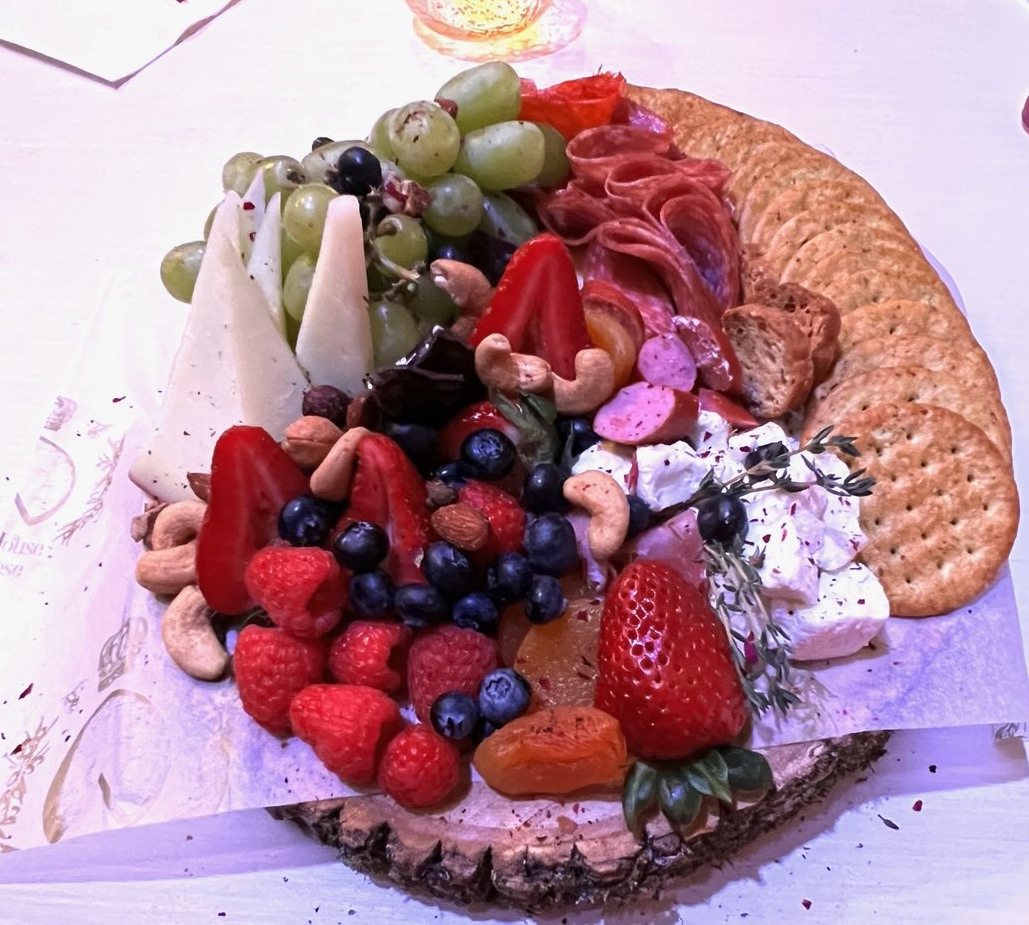
            Wanting to learn to create a board from a master, I recently took a class taught by Diego Alvarez, the owner of the Royal House of Cheese.  On my working space, he placed a two-inch thick, eleven-inch diameter wooden disc and enough food to feed a family of six.  Grapes. Strawberries and raspberries.  Three kinds of cheese.  Salami, polish sausage, and prosciutto. Dried apricots and cranberries.  A sleeve of round crackers. Handfuls of bagel chips and nuts.

            Was it possible to balance all of that on something with no sides? And what went where?

Diego patiently explained the circle as a clock face and suggested the placement of foods.  As crackers slid, he expertly fanned them into a crescent.  He suggested food arrangements based on flavors that complement each other and said to vary textures and colors.

            Diego is an excellent teacher, as well as entertaining, and I created a charcuterie board that I proudly served to guests the next day.  Only one raspberry rolled onto the floor.  And Diego taught me how to confidently say charcuterie: char- like to blacken meat, cu- like cu when saying a cute baby, and erie rolls off the tongue to rhyme with rotisserie.

            Now that I can put together charcuterie boards, will they go the way of fondue?  Remember fondue parties in the 1970’s?  By the time I hosted one, they were going out of style.

Bridgette and Rogd

I first saw her black afro and its red highlights. “You all want to go on the next tram tour?” How did she talk and grin at the same time? Her dark eyes sparkled against her dark skin. “Hop on. We leave again in ten minutes,” she said and then walked toward the welcome center at the Fairchild Tropical Botanic Garden.

He stood ramrod straight, about 6″ 2″ tall.  His grey-rimmed glasses matched his eyes and hair; his fair complexion could burn under the Florida sun, even on this winter day.  “I like to get to know people. Where are you from?”  he asked in a controlled monotone.

At 12:00 noon, tram driver Bridgette took her seat and helped Rodg untangle the wires on his headset microphone. Then we twenty or so guests set off for a one-hour, two-mile tour of the eighty-three-acre park.

First impressions. She was short, feisty, middle age.  He was tall, serious, retirement age. The driver and the guide couldn’t seem more opposite.

The tram travelled slowly as Rodg pointed to and named trees, shrubs, flowering plants; he included scientific names that I can’t spell or pronounce. “That’s a royal palm.  There’s a clonal palm – it’s leaves are used on thatched roofs. And there’s a…….,” Rodg hestitated.  He looked at Bridgette; she said names that he repeated and then he said, “I taught her everything she knows and now tells me.”  He chuckled quietly.

“Stop at the lipstick tree and let’s see who wants red lips,” he said. After the tram stopped, he slowly walked toward a branch loaded with ping-pong size red fruits.  He stretched his arm overhead and touched a fruit with his fingertips, but didn’t grasp it. Bridgette stepped off the tram and jumped to pull down the branch with one hand, and grabbed a fruit with her other hand. 

Rodg explained the origin of the tree and opened the fruit filled tiny balloon-like seeds.  Red liquid squirted when he squeezed the seeds. “Anyone want red lips?  Or maybe stripes on your cheeks or forehead?  It’ll wear off in a week or so.”  

The next stop Rodg suggested everyone get off the tram and look up for football-size yellow pods. He asked, “Does anybody like chocolate?” and he talked about the tropical evergreen cocoa tree.  I stood apart from the group, near Bridgette. “You and Rodg have a good time together, don’t you?” I said. 

Bridgette’s face softened. “I love that man. He’s in the beginning phase of Parkinson’s, and they (the park management) thought he should quit.  But he’s so kind and knowledgeable and I said I’d be his driver.  Now we do just three tours a day, only two days a week, and we have fun.”

At the Fairchild Garden, I saw beautiful trees and plants and a butterfly conservatory.  Birds, iguanas, and lizards scattered quickly from sight. But my take-away at this botanical garden was the respect and friendship between two people who are so very different. 

She saw only the best in him.

Valentine’s Day Cards – Then and Now

Every February, I open the large brown envelope that a friend gave me for a few years ago.  Inside are four cards, all fragile and yellowed with age.

            A flat cardboard card opens to a red faded tissue paper accordion greeting.  Only the words ‘Valentine Thoughts’ convey the message of the bright-eyed smiling children shown.  This 10 x 8-inch card was probably made in the early 1900s when honeycomb paper and fold-out valentines were popular.  I wonder if the person who first received this card appreciated its simplicity, its beauty as I do.

            A postcard-sized rectangle folds out to stand. Tiny colorful flowers and an outdoor fountain provide the backdrop for a little boy dressed in short pants looking toward a little girl wearing a dress, short enough to show her white bloomers. The only words are To My Valentine.  Nothing more is needed.

            Two other cards are much more wordy.  One shows a man dressed in pants and jacket fitting for his top hat and bow tie.  The verse title is ‘Don’t Say I’m No Bargain.’

            I know that you love bargains

            Confess Now! Ain’t it true?

            Ain’t I a bargain, Honey?

            Please take me home with you!

            Be My Valentine!

            The man wears a placard that reads, “Take me home for Nothing.”  A shopper might like his offer.

            Red hearts decorate the corners of another vintage card.  A man and a woman look toward each other.  She’s wearing a green dress that falls at mid-calf and is seated, her fingers on a manual typewriter.  He’s dressed in a white shirt, a red tie, a black jacket, and green pants, and stands, leaning toward her.   

            The verse is titled ‘Take This Down!’

            You’re just my type, and do we click?      

            I’ll say we do – but gee!

            Now get this straight, and get it quick,

            You can’t dictate to ME!

            When I first saw this card, my heart softened.  Ah, an old-fashioned sweetheart card.  Then I read the message and was brought up short.  Well, it is old-fashioned, for sure.

            The couple’s clothing and the typewriter are clues to when it was printed.  The best clue is the artist, Dudley T. Fisher, Jr.  If Wikipedia is correct, Fisher lived from 1890 – 1951 and was a syndicated newspaper cartoonist beginning in 1937.  So, maybe someone gave this card to his sweetheart in the 1940s. 

            Today Valentine cards are printed for everyone, not just sweethearts.  There are cards for parents, children, teachers, friends, grandchildren.  To avoid doing what my friend did, read the verses.  He thought he’d chosen the perfect card for his wife.  The front had flowers and hearts and a simple Happy Valentine’s Day greeting.  But he overlooked the inside of the card:  To my favorite teacher. 

            His wife is a teacher who has a sense of humor so she laughed. Maybe I should loan him my honey-comb fold out card.  He couldn’t go wrong with Valentine Thoughts. 

            And we can’t go wrong with a simple Valentine greeting to tell someone we care. 

Some Things Don’t Wait

Monday, January 3, 2022.  Chores and tasks lay ahead.  Laundry.  Respond to emails.  Make plans for a club meeting.  Submit a column to the newspaper. 

            The column, a letter addressed to 2022, was written and ready for one more read-aloud. Then Husband’s edits:  insert words I omitted or maybe add an s to a word I meant to write plural.

            But Mother Nature gave us snow and Monday tasks and that column, fell to the wayside. I sat where I begin most days to drink coffee, list blessings, read a devotion, write notes, and watch a few birds.  But Monday, I munched on grapes and drank coffee and stared outside for a long time.

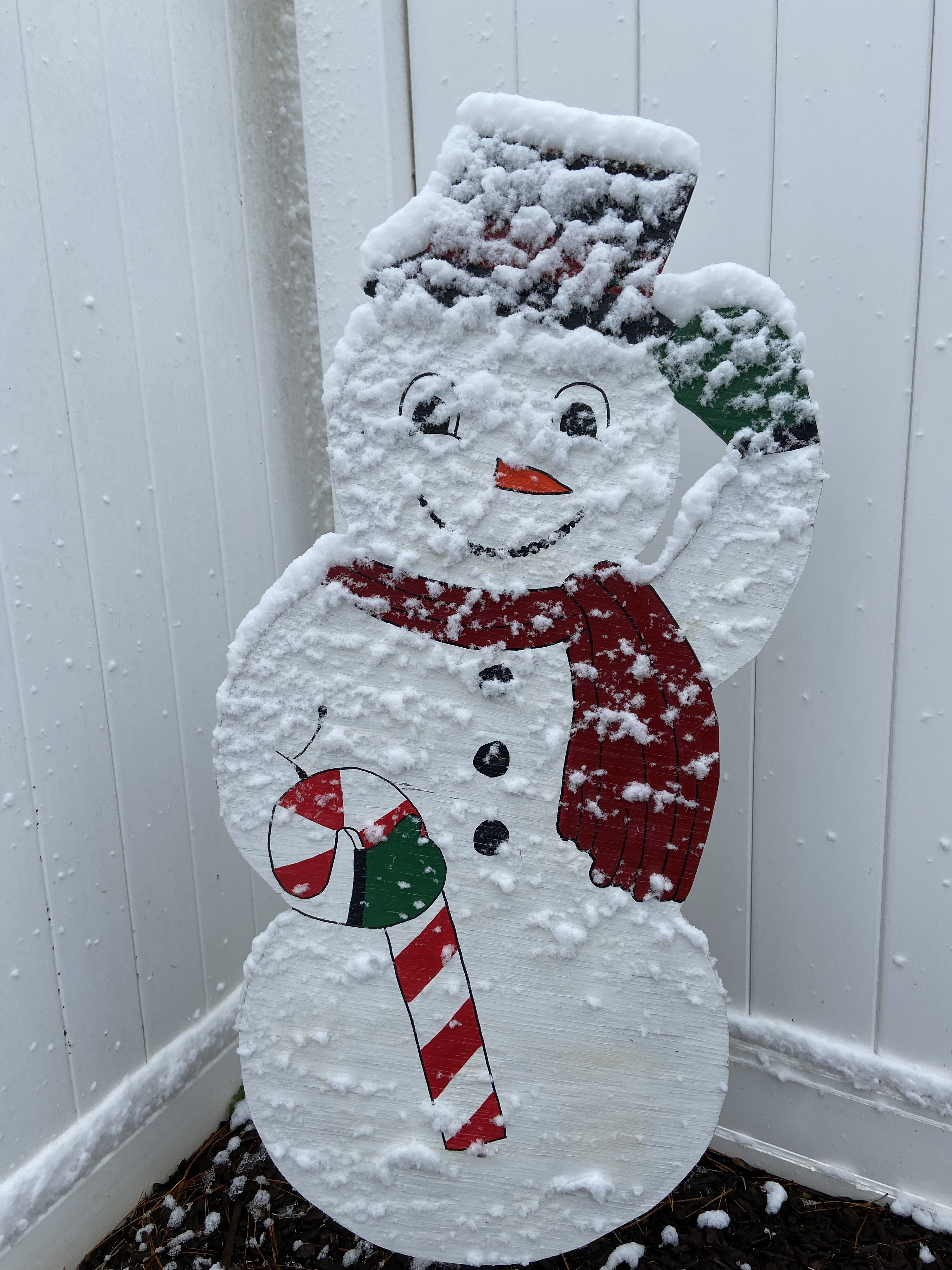
            Except for driveways and streets, everything was white – clean, brilliant, beautiful.  Every branch, every twig, were laden with snow and many more birds came to our birdfeeder that is about 18” from my window. 

            Brown house finches ate quickly and flew.  A downy woodpecker pecked into an open feeder hole as he would into a dead tree.  A red Northern cardinal perched, but didn’t eat until a female cardinal sat beside him.  Both held seeds in their beaks and turned their heads side to side before flying away. 

            A Carolina chickadee, smaller than the other birds, perched at the feeder’s top as if claiming ownership before he chose a perch and stayed a while.  A tufted titmouse joined the chickadee, not giving up his perch quickly.

            I didn’t immediately identify several birds about the size of house finches.  Their dark charcoal -colored backs and tailfeathers set off their white bellies and orange beaks.  Looking through my bird field guide, I found the junco, a sparrow that winters in the southeastern states.  And I found a date I’d written when I’d spotted juncos another time: February, 2021.

            Doves strutted slowly on the ground and picked up seeds that had been dropped by other birds.   I admired their patience.

            Then I learned my Grands across town were playing outside. “I’m coming over,” I texted Daughter.  She responded, “Come quickly. After two hours outside, it’s almost time for hot chocolate.”

            “Want to ride down the hill, Gran?” Lucy asked.  While I considered how steep the hill was and the many trees, my Grand jumped onto her sled and flew down the hill.  I didn’t sled or roll like a log down the hill or throw fistfuls of snow down anyone’s coat, but I did make the biggest snow angel and stomp a giant S while my Grand stomped all the letters to spell her name.

            I lost miserably playing a game of UNO that went on and on because nobody, my four Grands nor I, wanted it to end.  What’s better than sitting inside a warm house, wrapped in a blanket, and drinking hot chocolate after playing outside on winter’s first snow day?

            Chores and tasks wait.  Playing with Grands and watching birds do not.   

            And that previously written column?  Maybe it’ll keep until next week.