• Recent Posts

  • Archives

  • Categories

  • Meta

Acknowledge, Regroup and Plan

Post-it notes with topic ideas litter the 2023 desk calendar where I’ve written column titles on the Wednesday spaces.  A manila folder labeled Where We Are Topics bulges with scraps of paper. Hastily written notes and people’s contact information and newspaper clippings and printed programs and more.

            There’s a folder on my computer labeled Possible Columns.  Seems there’s always something to write about.  Since I write only one column a week, I have time to think through what seems pertinent for readers and what’s happening now.  And sometimes, a topic nags until it’s written. 

             Months ago, I wrote “Last Column?” on a post-it note. That idea wouldn’t go away, even after I threw the note in the trash.  It’s time to write it.  So, this is my last weekly Where We Are column. 

            Like book authors who write acknowledgements, I’m thankful to many people.  First, to you readers – especially those who have told me your stories that relate to mine.  I’ve appreciated all topic suggestions – especially those from one older friend who often said, “You haven’t written about your Grands lately.”  You grandparents know I could’ve written about my Grands every week.

            One person gave me the confidence to ask for pay.  After reading one of my writings, my friend, (later fellow columnist) Jennie Ivey said, “Go talk to Buddy at the newspaper about a regular column! You should get paid for your writing.”  Without her encouragement, I’d never picked up the phone and made an appointment with Buddy Pearson, former Herald-Citizen editor.  Jennie, thank you for your encouragement that day and many times since.

            I was surprised when Buddy offered a dollar amount and then said, “How about Wednesdays?” I’d thought maybe a monthly column.  We comprised and two columns a month were published until six months later when I agreed to every week. 

To all the past and current newspaper staff members, thank you.  From that first column, published May 19, 2020, you’ve given me freedom to choose topics and never once refused a Monday morning submission.

            Each week’s column is edited by my in-house editor. Husband Allen catches every typo, incorrect subject-verb agreement, extra space – anything and everything.  Thank you.  And thank you for accepting the title Husband and letting me write about you.

            I appreciate Daughter Alicia and Son Eric who have let me write about their children.  And to you eight Grands, someday you might find, and read, the more than 700 printed columns that are saved in plastic sleeves and stored in three-ring notebooks.  Thank you, Children and Grands, for providing the very best writing fodder.

            Sometimes I’ve been asked why my column is titled Where We Are. Almost twenty years ago, while visiting my aunt and uncle, I said that I was sad for them, both in their 80’s, because three of their friends had passed away during one week.  Aunt Doris smiled and said, “It’s okay.  It’s where we are in life.”   

            I hold Aunt Doris’s words as a mantra. It’s where we are in life that determines what we do and accepting each life stage with its blessings, its trials, its activities make each day okay.  

            Recently I discovered a poem my dad, Taskel Rich, wrote in the 1980’s, shortly after he retired as Byrdstown, Tennessee postmaster.  Maybe it was his words that confirmed that I should dig that post-it note out of the trash and write this column.

Night falls swiftly

And the day is over

The day that had dragged its feet

And seemed to hover with darkness.

Today can never be yesterday

And allow us to change decisions,

Correct errors or make up lost times.

Neither, today cannot be tomorrow

And allow changes in actions

That will guarantee success.

We must regard today

As the most important one.

A time to assess our successes

And failures of yesterday

And a time to regroup and plan

To make tomorrow the best

And most successful day of our life.

            I’m not finished writing.  I’ll continue to post writings and recipes and stories and whatever comes to mind on my blog page and social media, but not on a regular schedule.  (I won’t throw away all those possible topics and notes.)

Find future writings at  https://susanrray.com/ and https://www.facebook.com/susan.ray.357.  And most past columns on my blog page.

I’m grateful to every reader and every person who has contributed to Where We Are.  And I intend to make tomorrow the best and most successful day of life.

The Stuff of Nightmares

I walk down the school hallway to my 4th grade classroom, open the door, and my students aren’t there – even though I’d left the room only minutes earlier.  What happened?  Where are they?  Maybe they’re in the gym or the music classroom or the library.  They aren’t.  I checked the cafeteria, but no one is there.

            As I hurry to the outside playground, I meet my principal in the hallway.  I can’t let her know I’m looking for twenty-five kids.  A teacher doesn’t lose her students.  So, I smile, walk past her, run to get outside.  But nobody is on the playground. 

            That’s my stress nightmare.  Although I’ve been retired for fourteen years, I still sometimes awake in a panic.  During my twenty-six years teaching, I never lost my students so why does this dream still haunt me?

            When I read Ty Kernea’s Facebook posts and the many comments that followed, I laughed and at the same time felt compassion for each person who wrote.  Ty, former Herald-Citizen photographer extraordinaire, shared his nightmare.  He positions people for a group photo, turns around to walk to the shooting spot, turns back around, and everyone is leaving.  Ty runs to stop them and repeatedly yells, “I haven’t taken the photo yet!” 

            Kimberly shared The Actor’s Nightmare.  After being cast in a play and nearing opening night, she is ready to walk on stage and doesn’t know her lines or the play. 

            Former caterer Diana dreams that she is to prepare food and serve a large group of people at a banquet.  The meat is frozen and the people are walking through the doors of the banquet hall.

            Fellow Herald-Citizen columnist Drucilla dreams take her to the days when she owned a beauty shop.  She gets behind doing her work and many women are sitting with permanent rollers in their hair. 

            Donnie, a truck driver, pulls his tractor trailer to the side of the road and gets out to walk around his truck.  When his foot falls, he sees a huge void underneath.  Sometimes the void is a cliff; sometimes it’s burning like a volcano.  He gets back into his truck to drive it onto the road, but the truck falls.  All he can see is the sky above.  He braces for impact, but the fall never ends.

            Most of us can relate to Sharon’s dream.  She is driving to work and her car breaks down so she’s   going to be late. No matter what she does, she can’t get to work. Even when she runs, she’s held back.

Sharon also shared a student or teacher nightmare.  She’s locked in the English building in the dark at TTU and the building is haunted.

            Thanks to all who let me share your nightmares.  I laugh at these impossible situations, and, at the same time, I take comfort knowing that others occasionally awake in a panic, a cold sweat. 

            Diana commented under Ty’s Facebook post that maybe he could start a therapy group.  I think he did.

Catching Up with Slang

I asked a Grand if he’d like more milk and he answered, “I’m good.” I didn’t immediately understand.  I knew he was good.  A good kid.  A good eater. But what did that have to do with my offer to pour milk into his empty glass while we ate supper?

            “I know you’re good.  Do you want more milk?” I asked.

            He shook his head.  “No, I’m good.”  I understood that answer.  No more milk.  Why didn’t he say so?   Later, after listening for this phrase as people talked, I realized that my Grand responded as many others do.

            Maybe you’ve heard the phrase I’m good to answer questions and refuse offers.  Would you like to go to the movies with me tomorrow afternoon?  Are you cold?

I tried a new recipe for pecan pie.  Would you like a piece?  

I’m going for a walk.  Want to go with me?

It seems that I’m good can be the response to all of these questions.

            What happened to direct, simple answers?  No, I can’t go to the movies.  I’m not cold – I’m comfortable.  No, thank you seems like a polite answer for a pie offer or to go for a walk.

            Now, I interpret I’m good as no, but when I hear those two words, I sometimes think of my dad, a high school English teacher sixty years ago.  He taught me a lesson I’ve never forgotten.  I’m well refers to physical well-being and I’m good to mood.

I ask friends, “Are you okay?” When they say I’m well, I know they feel physically healthy.   When they say I’m good, I know my friends are happy and having a good day.  

            When did people start saying I’m good not to describe their mood, but instead as a refusal?  The online Urban Dictionary listed I’m good as slang to mean rejection or ridicule in its 2008 edition.  

            Sidenote: The Urban Dictionary, according to its site, was created in 1999 by a then-college freshman who was a computer science major at California Polytechnic State University as a mockery of Dictionary.com.  The Urban Dictionary is like Wikipedia in that anyone can edit, revise and submit text so I take information on both websites with a grain of salt, as Granny used to say, when she doubted something she’d been told.

            But I have confidence in the online Oxford English Dictionary and I’m surprised to read that I’m good was first listed in 1966.  The phrase is used in response to a question or request to mean no thank you or I’m not in need of anything.

            So, I’m way behind the times.  However, Dad’s grammar lesson has stuck with me and I’ll continue to say what my parents taught me when I’m offered something I don’t want: No, thank you.

But I do understand my Grand when he says I’m good.  And I always think he’s a really good kid.

Said Like a True Southerner

You look really good for your age.  I’ve never forgotten that comment made by a young college co-ed.  I was thirty years older than she, but not even 50 yet.

When her friends glared at her and simultaneously inhaled, she grinned.  When one said that she liked the food I’d brought for the gathering and asked for the recipe, no doubt an effort to fill the silence in the small kitchen, she nodded. 

This child probably thought she’d paid me a compliment.  I wish I’d known her well enough to take her aside and washed her mouth out with soap.  Borax would’ve been appropriate to remove the words ‘for your age.’

Maybe you’ve heard similar comments.  He has a thick hair for his age.  She dresses nicely for her age.

Recently, I read an article stating that we Southerners, especially women, are masters of backhanded compliments.  Phrases that are less-than-gracious flow like warm molasses.  I regret to say that we women are known for tossing around words that should have been stifled.  Just last week, I cringed when I heard, “Is that a new haircut?  It looks so much better.”   

            And unfortunately, while listening to our aunts and mothers and their friends, we learned, and later repeated, a few subtle phrases to interject before changing the topic of a conversation.  I love how you say what you think.  Well, that’s one way to look at it.  That’s different and maybe it works for you.  Well, aren’t you sweet? 

            But one less-than-gracious phrase outranks all others and we Southern women keep it on the tip of our tongues.  We roll it with sugar and honey.  It oozes from our lips no matter where we are or who is with us. 

We say it anywhere, anytime.  During Sunday afternoon concerts and Saturday morning kid’s soccer games.  Summer, winter, spring, and fall.  About young and old. 

            I remember a winter school day when a few of us teachers were hurriedly eating lunch while sitting knee-to-knee, shoulder-to-shoulder around tables in the faculty lounge.  Conversations darted from how cold our classrooms were to how to get the best deal on a new phone to a guaranteed weight-loss diet to complaints about one more form to fill out.

            Mrs. W stood, walked toward the lounge door, and looked down at her feet.  With a loud shocked voice, she said, “Oh, no!” 

            The room went silent and every eye followed Mrs. W’s gaze.  She wore almost matching shoes – both flats.  Both slip-ons.  One with a small bow; the other plain.  One brown; one navy blue. 

            When Mrs. W laughed, we laughed too.

 She left the room and we dear teacher friends shook our heads and let those sugar-coated words roll:  Bless her heart. 

We Southern women have been accused of saying whatever comes to mind about whomever and adding heart blessings to cover our words.  Maybe it’s too late, but here goes.  To that young woman who is now the age that I was:  You didn’t know better. Bless your heart. 

Being Bored is Okay

It’s okay to be bored.  Really, really bored with nothing to do.  Not reading or listening or moving.  Being quiet and still.

            For months, I’ve had a note to write a column about it’s okay for children to be bored, but after research, I realize being bored is for everyone – young and old.

            Boredom is usually thought of as a negative, as defined in Webster’s dictionary:  feeling weary because one is unoccupied or lacks interest in a current activity. 

            But, think of boredom as a positive: giving the brain a rest.  We know our bodies need rest to function well. Brains need rest, too.  Professionals who study the brain encourage making time to sit and avoid all external stimuli.  Time to think or to clear all thoughts. 

            Don’t expect boredom to be easy.  We have daily to-do lists and we usually plan what to do next.  For me, there are cookies to bake, books to read, words to write, stitches to sew, cards to play, people to visit, and adventures with Grands. 

            Last week, I sat in my van in an empty school parking lot for twenty minutes while one of my Grands practiced soccer – a perfect time to rest my brain.  But I didn’t.  I picked up my phone, checked text messages, read the headline news, and scrolled Facebook.  Another waiting time, I walked the perimeter of the school building while listening to a podcast. 

            And we don’t appreciate children being bored.  ‘There’s nothing to do’ was a signal for my mom to list chores:  dust furniture, take out the trash, pull weeds, clean windows. 

             I read an article by a child psychologist who recommends that parents keep a box of creative materials, such as markers, colorful paper, small boxes, glue, and card games, for when children say they’re bored. Yet, in the same article, she recommended that children be allowed time to do nothing.

My response to my children’s boredom was simple:  Go outside.  If a small shovel is available, most children dig.  If there’s a tree, they climb.  If there’s a ball, they play.  But when my kids lay spread-eagle on our trampoline looking at the sky, I didn’t realize they were resting their brains, I just thought it was good down time. 

There is a cultural stigma to boredom.  Maybe that’s why parents fill every minute of their children’s day with activities.  It’s important that kids be bored to simply think or to mindlessly do nothing.  Owning one’s thoughts builds confidence and self-esteem. 

Give kids and yourself permission to be bored. Boredom fosters creativity and problem solving.  One authority suggested that we often come up with good ideas while taking a shower – while alone and our minds tend to wander. 

An article from https://www.mayoclinichealthsystem.org/ states ‘Don’t be afraid of boredom. It’s a normal part of life. Try not to dismiss or dislike it. Instead, try to view is as an opportunity to restore your brain and develop solutions to problems.’

Welcome boredom.  Rest your brain.

Swollen Lug Nuts: Part 2

In last week’s column I wrote about taking my van to be serviced and the tires rotated. I was told that the tires couldn’t be rotated because the wheels had swollen lug nuts.  The service technician explained that if the lug nuts were taken off, they probably wouldn’t go back on.  New lug nuts were needed. 

            I’ve never studied the workings of motor vehicles, but I knew lug nuts are made of metal and fasten the wheels on my van.  How could metal swell?

            When I repeated the service tech’s explanation to Husband, he grinned and raised his eyebrows and thought I’d misunderstood the problem.   

             I posted last week’s column on Facebook and it turns out Husband and I weren’t the only ones bumfuzzled by swollen lug nuts.  Friends wrote, “Well, I never!” and “I’d think they (the service department employees) were taking advantage of me,” and “That’s a first for me!”       

            One wrote, “Maybe because we’re a medical family, it sounds more like a physical diagnosis!” 

“That’s hilarious!  Never hear of them,” another said.

Laughter was the immediate response when Husband and I told the story to friends, except one who thought he knew all about cars and declared that lug nuts are made of steel and one-piece and can’t swell and never need replacing.  He was sure I was being hoodwinked. I was happy to share what Husband and I had learned.

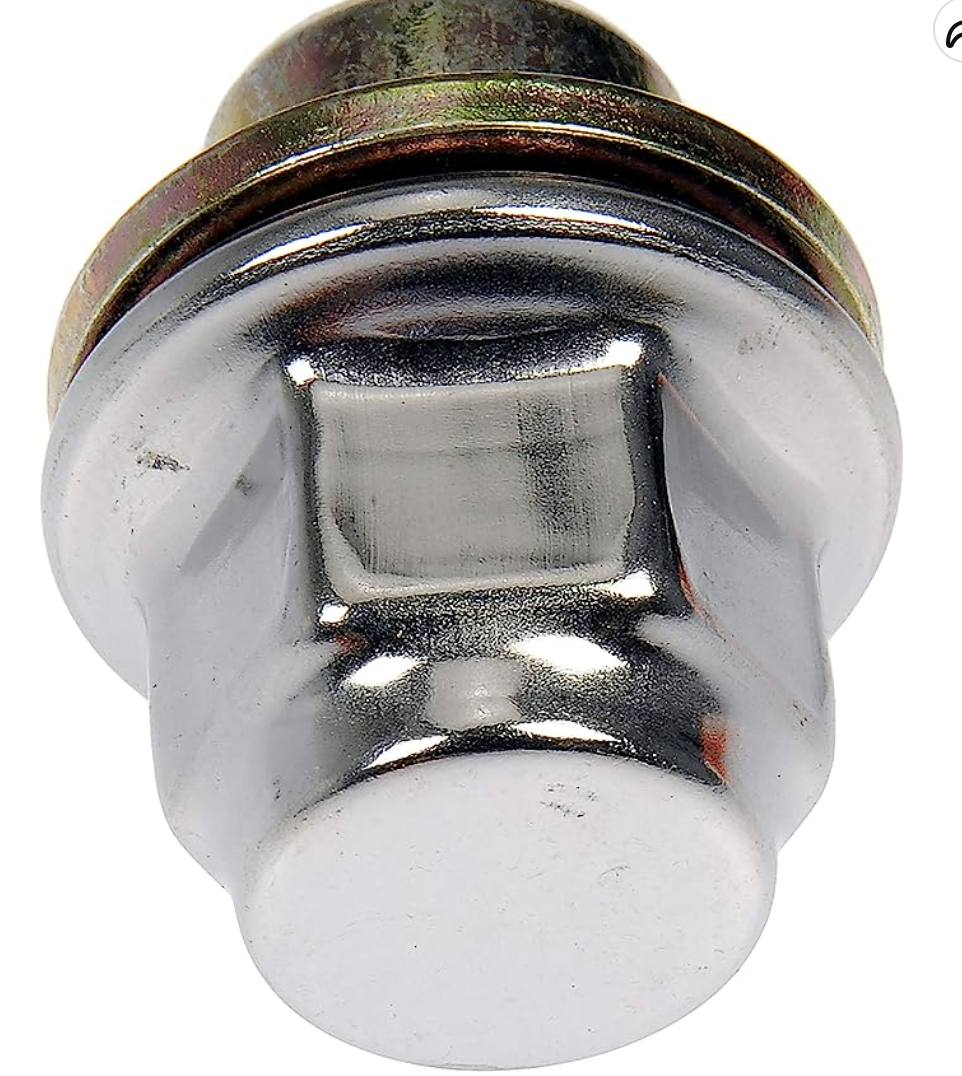
In the 1980s some vehicle manufacturesswitched from one to two-piece lug nuts.  According to online experts, two-piece wheel nuts, a chrome decorative cap and a steel nut, help prevent wheel runoff crashes and customers like the look of shiny chrome better than dull gray steel.

Moisture can get between the between the cap and nut and the steel begins to rust. The rust pushes against the chrome covers and enlarges them.  The Toyota service manager told me another reason for swollen lug nuts is that after many years of removing and tightening lug nuts to rotate the tires, the chrome coverings can become deformed.  “It’s not a good design,” he said.

It’s safe to drive with swollen lug nuts.  The problem is getting a lug wrench on a swollen nut to loosen and tighten it.  My Facebook friend Karen wrote that during a rainstorm, her daughter hit a curb and popped a tire.  But the flat tire couldn’t be taken off because the lug wrench wouldn’t fit on the swollen lug nuts.  The car was towed and the lug nuts were replaced.  “Not an inexpensive endeavor,” Karen wrote.

Another friend shared: “Being in the tire business, I can tell you that this is a fairly common occurrence.  Lug nuts, like everything else, are not made like they used to be.  Replacing them can be expensive.”

Thanks to the good folks at our local Toyota service department, the wheels on my van are now secure with new lug nuts. And the cost?  The story and laughing made the cost worth every cent.

A Swollen What?

During the twelve years that I’ve taken my van to be serviced, I’ve learned the routine.  Tell the service technician the current mileage and explain any problems, and that I’ll wait.

            I look for a quiet place to read a book, make a phone call, watch people, and sometimes write notes for a column. Maybe because my dad owned a service station when I was a kid, I like the smells and feel of a car garage and dealership.

And I like the uninterrupted hour – unless there’s a repair needed and then the service tech explains what needs to be done.  I’m not completely ignorant of vehicle terms. Dad allowed me to drive alone only after I could change a tire and check the oil, and he told me about anti-freeze, belts, hoses, brake pads, filters, and windshield wipers. 

            Recently while getting my van serviced, Bryan, the service tech, found me in a corner of the sales department.  He noticed air pods in my ears and spoke quietly: “Don’t get off the phone. This’ll just take a minute.”  Bryan moved a chair close to mine, sat down, leaned forward, and put his elbows on his knees.

“We can’t rotate your tires today because you’ve got swollen lug nuts.”

Rotate tires, I understood. 

Swollen lug nuts, I didn’t.   

I told my friend on the phone that I’d call back.  I frowned and said, “Okay.”

“So, your lug nuts are swollen and if we take then off, we probably can’t get them back on the wheels.”

When Dad taught me to change a tire, I’m sure he told me to use a lug wrench to remove the lug nuts, and that’s probably the last time I’ve heard the words lug nuts. 

“Okay,” I said.

“So, all four tires have swollen lug nuts. We don’t have that many. I’ll have to order them.” 

“Okay.” I tried to get a mental picture of a swollen lug nut. 

“That’s the cost to order them.” Bryan circled a dollar amount on a paper clipped to his clipboard.

“Okay,” I said for the fourth time.

“Well, you might check the cost somewhere or discuss it with someone. Driving with swollen lug nuts for a while isn’t a problem.”

 “So, you’re saying I might want to discuss with my husband about ordering lug nuts somewhere?”  I asked.  Bryan nodded.

Husband was leaving our house just as I got home.  “Wait,” I said. “I didn’t get the tires rotated because the van has swollen lug nuts.”  He raised his eyebrows, grinned, but didn’t laugh out loud.   

The next day Husband told me that he and our 18-year-old Grand, a car guy, had laughed and that he’d said, “Surely your gran didn’t hear right and misunderstood.” 

            But Husband googled swollen lug nuts and then called Bryan to ask, “What’s the problem with

the tires?”  Husband admitted that I’d heard correctly.

No matter the cost to replace my van’s lug nuts, it’s worth every penny.  Who else has a story about swollen lug nuts?

For Children’s Sake, Drive Slowly


As I drove past Capshaw Elementary School, I glanced at the clock in my van:  2:14.  It wasn’t near 3:00, school dismissal time, so I wasn’t concerned about the lower speed limit that is enforced immediately before and the end of school days.

Children played on the playground and teachers gathered near a wooden bench.  As a former teacher, I have happy memories of those teacher conversations; recess is one of the few times during a school day that teachers can visit.  Four teachers stood in a circle, facing different directions to see the whole playground and monitor students, to be sure children were safe.  I recognized two friends.

            A city police car was parked in a street parking place, ready, I thought, for school dismissal. During my teacher days, I appreciated when police officers were present at the times when students were dropped off and picked up.  Just seeing a police car reminded drivers to slow down.  I waved to the policeman as I drove past.

            He waved back and turned on the blue lights on top of his car. I slowed for him to pass me, but he didn’t.  His car was on my bumper. 

            As I stopped in a parking place off the road, I wondered if there was something wrong with my van.  The policeman greeted me kindly, “Good afternoon, Ma’am. May I see your driver’s license?” 

            “Sure,” I said and handed it to him. “I hope your day is going well.”  He nodded and, holding my license, walked to his car.    

            I was surprised by his next words: “Mrs. Ray, you were going 28 in a school zone.  The posted limit is 15 MPH.”

            And then my experience as a teacher hit me.  Kindergarten students are dismissed at 2:00 p.m. so the school speed limit is enforced beginning at 1:45 p.m. My words rushed out.  “I’m so sorry.  I looked at my clock and because it wasn’t near 3:00, I didn’t think about the speed limit being lower now.  It’s because kindergarten students get out at 2:00, isn’t it?”

            The policemen repeated the posted speed limit, noted on a sign by a flashing yellow light, and he didn’t know about kindergarten students.  He looked stern.

             I knew exactly where that light was and I didn’t see it that day because I’d turned onto the street a half block after it. I wanted to whine, but I knew that wouldn’t help.  I said. “You know what makes this really embarrassing?  I taught at this school for more than twenty years.  I should’ve remembered.  I drive past here almost every day.  I’m so sorry I was going too fast and promise to be more careful.”

            I got no pity for being a teacher, but maybe it was my repeated regrets and promise that warranted only a verbal warning.  “Ma’am, you do that.  Be careful and slow down.”   

             Let my experience be you warning:  obey the speed limit and drive carefully. Especially near schools.

Searching and Hoping

“Well,” I said to Husband, “at least I got column fodder out of our lost stuff.”  We shook our heads and laughed at ourselves.           

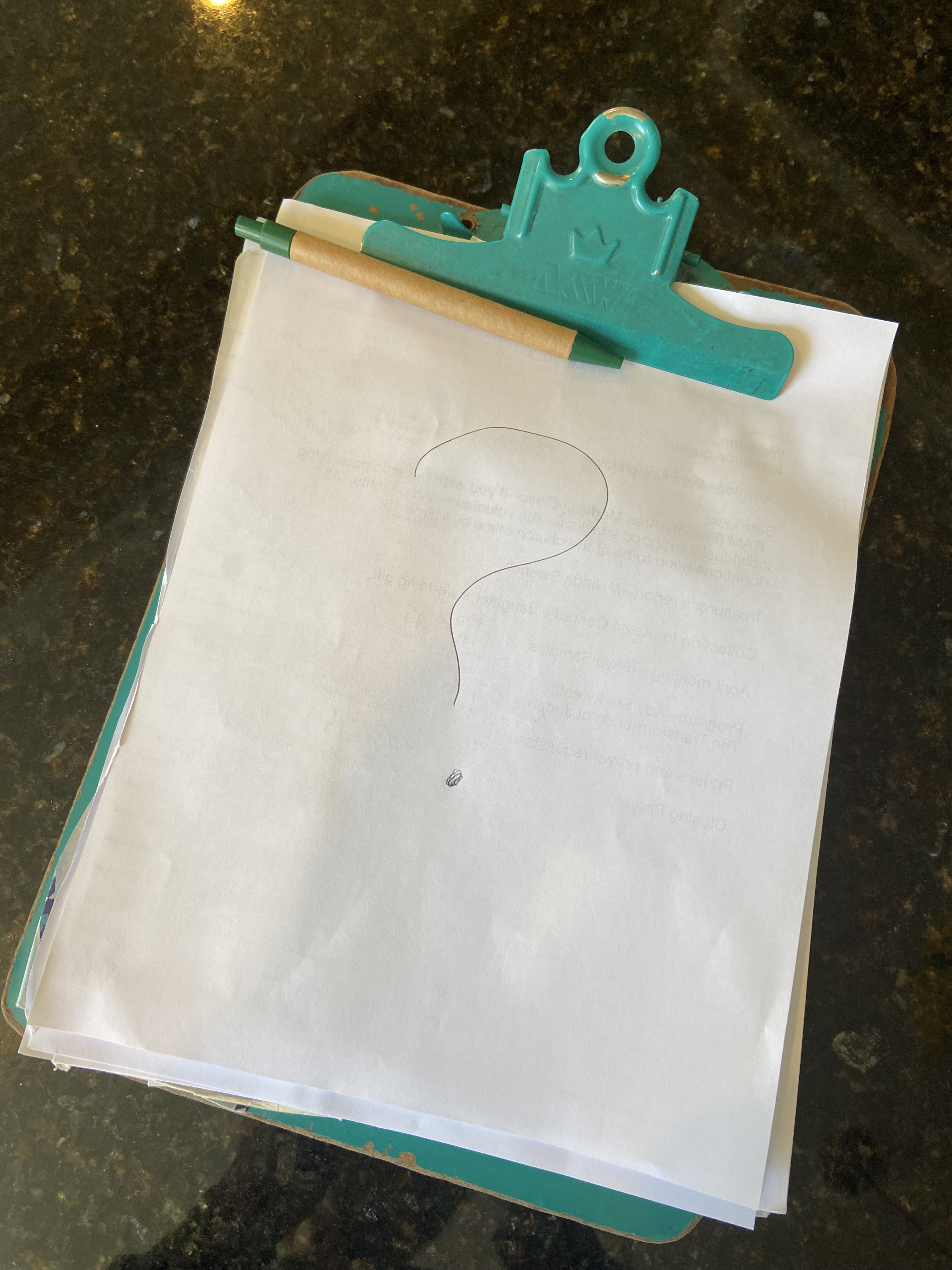
It’s just a clipboard, an aqua-colored clipboard that I’ve carried to grocery stores for at least 30 years.  I’m old school and I write shopping lists on paper – 8½” x 11” paper that could be trashed.  When I taught school, it was usually a piece of notebook paper that might have had a student’s first draft of writing.  Now, it’s most often the back of a document I didn’t print correctly or a junk mailing.

            But I digress, it’s the clipboard that’s important.  When not used, its place is in the kitchen drawer under the oven with baking pans, but one day it wasn’t there. Remembering that I’d use it a few days earlier, I searched my van, even the third row back seat thinking one of my Grands probably moved it out the way. 

            “Maybe you left it in the grocery cart,” Husband said so I called the grocery store and was happy to know that they often find and always keep items left in carts.  I listened to pleasant instrumental music while the store employee searched Lost and Found and I thought of what was on my clipboard besides blank pages:  an inspirational writing by Rick Bragg, a keepsake drawing by one of my Grands, a list of heart-healthy foods.  

            “I’m sorry.  I didn’t find a clipboard.”  That wasn’t what I wanted to hear.  My next stop that shopping day was at the Dollar General Store so I called and a pleasant, cheerful sounding employee searched Lost and Found, but didn’t find a clipboard. 

            Two days later, I searched that drawer again.  I took out everything and at the bottom of the drawer, under three cookie sheets and two pizza pans, I found that old, much used clipboard.

            While on a weekend trip to watch our oldest Grand play basketball, Husband couldn’t find his favorite black cap and I was sure I’d packed it in the corner of our suitcase.  Two Grands thought he’d worn it to Chick-fil-A the night before so on the way to the next game, we stopped there. The employees searched in all the places they put lost items, but didn’t find it. 

            Back at the Hampton Inn, we went through all the drawers, although both of us were certain we hadn’t put anything in them.  We searched our stack of dirty clothes on the top closet shelf.  Thinking he might have worn it to breakfast and left it at a table or in a chair, we asked the hotel clerk if anyone had turned in a black cap.  No one had.

            When we began packing to come home, Husband found his cap.  Tucked tightly in the corner of the black-lined suitcase – right where I put it and where neither of us saw black against black.

            That’s how we sometimes spend our days.  Searching and hoping.

More Than Just Waiting

I give my college roommate a hug, tell her I love her, and then watch as she walks, leaning on a cane and limping, beside a nurse.  When they’re out of sight, I rush from the surgery waiting room to the nearest elevator, down to the hospital cafeteria. 

            It’s 6:00 a.m. and I’d awakened at 3:45 at Roomie’s home where I’d spent the night.  Since she couldn’t eat or drink anything before hip replacement surgery, I didn’t have the heart to drink coffee at her house.  She likes morning coffee more than I do.

            As I swallow the first sip of hot breakfast blend, I smell bacon.  It’s a large cafeteria in a large hospital in a large city and there were many breakfast choices.  A hot bar offers bacon, sausage, eggs, biscuits, white gravy, and hashbrowns. There are bars for pastries, cereal, yogurt, fruit, and bagels.

            The only other diners, all wearing blue scrubs, stand at the griddle station. I get in line behind them. 

            “Hello. What can I get for you, sweetie? How about an omelet or egg sandwich?” Although I normally don’t like strangers’ affectionate terms thrown my way, I appreciate this young woman’s greeting – she practically sings.  Her eyes, over a bright red mask, sparkle.

            She puts the ham, spinach, and mushrooms for my omelet on the griddle.  She serves egg and bacon sandwiches to two people in front of me. She breaks and whips three eggs and pours them on the griddle and nods to the man who stands behind me.  

            “How’ya doing, Ted? What do you want in today’s omelet?”  Ted, who wears a security uniform, orders.

            “That’s just like yesterday’s,” she says as she folds my omelet into a perfectly tight rectangle. Looking my way, she asks, “You got family here, sweetie?”

            I say that my college roommate is getting a new hip.  “Oh, and you get to be here with her. I pray she does well.”  This young woman serves more than egg sandwiches and omelets.

            In the surgery waiting room, I spot one chair beside a small table in a corner and make my nest for the next few hours. 

            A family sits nearby, within hearing distance.  Two daughters assure their mother that their dad will be just fine.  A man sitting across from them, tells about his older brother, who is at that moment having heart surgery, falling out of a tree.  Another brother doesn’t agree that he wasn’t hurt and talks about an arm cast.  I eavesdrop on a lively family conversation.  Two brothers tell stories about everything from the worst meal their momma ever put on the table to the night they drank too much whiskey.

            During the drive from my roommate’s home to the hospital that morning, she’d asked, “What do you plan to do while you wait?”             

“Probably read and maybe do a little writing,” I’d said. I write the first draft of this column, but I never open the book.  Oftentimes, real life is better than any book.