• Recent Posts

  • Archives

  • Categories

  • Meta

Practice Patience

“Adopt the pace of nature: her secret is patience.” The title of a poem, written in 1836, by Ralph Waldo Emerson is printed on a small flip chart entitled Bright Sayings, a collection of quotes, Bible verses, and inspirational thoughts.  Every year, I read Emerson’s words on March 31st and this year those words struck me hard, to my core.

            Even now, writing this poem title, I take a deep breath.  Patience, as defined in the dictionary, is the capacity to accept or tolerate delay, trouble, or suffering without getting angry or upset.  My patience has been stretched during this pandemic.  I’m ready to get on with my normal life: attend church and club meetings, go to monthly hair appointments, eat lunch with friends, take Grands on field trips around town, visit friends, and all the other many things that filled my calendar.

            By nature, I’m not a patient person.  I keep a book to read in my van because I might have to wait somewhere for 10 minutes, and I’ve fallen into the habit of looking at my phone for entertainment to fill even a few moments of idleness.  Last week, I purposely practiced patience. As I sat in the public library parking lot waiting for a library employee to bring me the books I’d requested online, I didn’t reach for my book or phone.  I watched branches sway in tall trees and saw a few people walk in Dogwood Park, at safe distances from each other.

            I’ve practiced patience as a teacher, parent, and grandparent when children learn new skills or complete a task.  A teacher’s greatest pay is when a student reaches that ‘Ah, ha moment’ of understanding or mastery.  I’ve said, “Push your patience button,” to encourage students, who were loud and wiggly, to be calm while standing in line. Recently, when my five-year-old Grand searched for a jigsaw puzzle piece to complete the border of a 100-piece puzzle, I sat on my hands to avoid pointing to the needed piece.  

            Every day there are times that I need to be patient. But, maybe like some of you, I struggle to wait, to accept, to be tolerate for the easing of restrictions, for face-to-face contact with family and friends.  I tell myself if I had a snotty cold or the flu, I’d keep my distance, and now I could carry the COVID19 virus, but not show symptoms.  I don’t want to make anyone sick.

            Emerson’s eight-stanza poem describes the changes of seasons, and I know from experience that each season unfolds in order. Emerson writes, “All this is provided at a sure and steady pace. Nature is perfect, there’s never a need to race.” 

            Often as I wait, I know the sure and steady pace.  With this virus, I don’t.  Is that why being patient is so difficult?  I’m determined to practice patience. To limit close face-to-face contact with other people.

            Emerson begins his poem with these words: “Walking in Mother Nature, God’s natural kingdom with awareness, will bring you insightful wisdom.”  Seems like good advice as I wait.

When Husbands Grocery Shop

Who’s the designated grocery shopper at your house?  The person who puts on a mask and buys groceries during this pandemic stay-at-home time.  About six weeks ago, Husband and I divided our long list, and we both shopped.  Since then, he’s been our shopper.

            Husband is the logical choice.  He grew up working in his grandfather’s and father’s grocery store so he knows the layout of stores and feels at home among aisles of canned vegetables and bagged pasta and apples and paper napkins.  As we discussed who would shop, he reminded me that he’s a speed shopper and I’m not.  He’s right.  I’ve watched Husband pick up a bunch of bananas and put them in his grocery cart and never stop walking.  He didn’t even slow down. I spend several minutes looking at every bunch to choose the best bananas, and I often break off one that is too green or that is one too many.   

            Not all men are natural grocery shoppers. Vicky’s husband offered to do the grocery shopping.  She doubted his ability, but accepted his offer.  “I’m taking dinner for a family with newborn triplets and I want the mom’s first home meal to be really good so get exactly what I’ve written,” Vicky said.  She explained the list, including French bread, “It’ll be good if the bread is sliced.  I’ll put some spices and butter between slices and wrap the loaf in foil to be heated.”  Her husband brought home a bag of 50 small slices of dried French bread, jumbled in a plastic bag.  It wasn’t easy for Vicky to assembled those little pieces into a loaf.

            With a detailed list, Husband dons his mask and heads out to shop.  Before I can fold and put away a load of clothes, he’s home with enough food to feed a large family, not just the two of us.  And most times, he brings home exactly what I expect.  But once, he bought French style green beans and I expected a can of Allen’s green beans.  He explained, “They didn’t have the Allen’s brand, but I remembered that they were Italian cut so I thought these would probably work.”  I didn’t understand his logic.   Was it that France and Italy are European countries?  When he finally grinned, I realized he was teasing me.

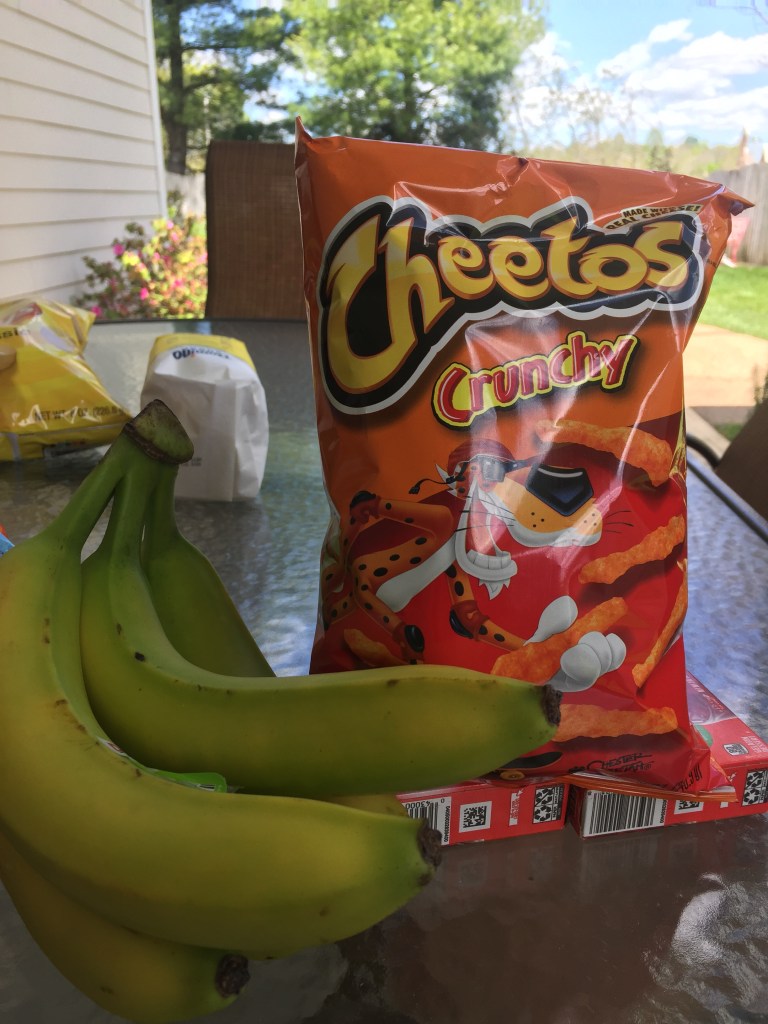
            Husband buys things not on the list:  chips and cookies. I don’t walk down the chips’ aisle because each bag lures me, and when a bag of chips is opened at home, it’s my duty to eat until the bag is empty.  Husband knows that Cheetos – yellow crunchy puffs of cornmeal and oil – are a favorite.  So, guess what he brought me for a treat?   I can’t wash my hands enough to remove the artificial yellow 6 coloring.  And Oreos, with sweet cream filling, are the perfect midnight snack.

            I appreciate Husband’s willingness to do grocery shopping.  When we no longer have to wear a mask and shop more often than once every two weeks, maybe he’ll continue to shop.  Those chips and cookies are mighty tasty.

Heart Tugs are Needed

I promised myself to be mindful of Heart Tugs, the times when heartstrings tighten.  To appreciate happy moments and imprint them in my head and heart.  To make notes so I’ll remember.  I’ve shared Heart Tugs previously, and during this time of upheaval when life isn’t normal, I cherish these moments even more. 

            When all eight Grands were here together in January, they wanted tradition.  (For children, a tradition begins when we do something they like one time.)  “When are we going to the gym and playground?” they asked.  At our church gym, eight-year-old Daniel followed his big cousin, Samuel, who is six years older. Did Samuel realize that Daniel tried to dribble a basketball exactly like he did?  That Daniel stood right beside him and looked up to him?  

            At Heart of the City Playground, five Grands, ages 4-8, played Follow the Leader.  The two eight-year-olds took turns being the leader and the last person in line because, as Lucy told Daniel, “So the little ones will stay between us.” 

            Charlotte, age 4, held Elsie’s hand.  “Gran! Did you know my favorite cousin is Elsie?” Elsie, age 12, smiled and swung hands with her little cousin. While taking a bath, Charlotte hid under a thick layer of bubbles with only her face showing.  “I love bubbles! I love bubbles!” she shouted.  That same exuberance ensured that I’ll continue making dried apple stack cakes.  Charlotte chewed her first bite of cake slowly, leaned her head back, closed her eyes, and then sat up quickly and said, “I love apple cake!”

            A balloon, blown up and tied with a knot, was Henry’s favorite toy for two days.  It was a ball to throw and kick and bat. A pillow to lay his head on.  When it began to lose air, my six-year-old Grand squeezed his balloon until it was flat.  With ceremony, Henry held the deflated balloon over a trashcan and announced, “Well, that was fun! Good-bye balloon!”

            On a cold February day, ten-year-old Annabel and I sat side by side during a journal writing time.  It occurred to me that my Grand was writing on the handmade harvest table that my great-grandparents ate meals on.  That my mother used in her basement for canning beans and soup.  That I use to lay fabric on to make pajama pants for Grands.  And now, Annabel is writing on it.  I held my pen still and looked at Annabel, who said, “Gran, what are you doing? You said to keep writing non-stop for ten minutes.”

            “I’m writing,” I said.  And I wrote, ‘I’m sitting on an old ladder back chair that came from Granny’s house and writing on a table that belonged to her parents, David and Elizabeth Rich.  What a blessing.  Annabel sits beside me.  This table belonged to her great-great-great grandparents and the chairs were her great-great grandmother’s.  A tranquil moment.  Burn it in my heart, my memories.’             Heart Tugs.  I’m catching all I can.

Write Your Memories

During the past few weeks, I have hoped that other people are writing their experiences and thoughts about Spring 2020.  Those writings are for you, your children, your grandchildren, and your great-grands. 

            While I mulled over these thoughts for a columm, two friends shared the same idea and granted me permission to use their words.  Jennie wrote to a group of us who write and share memories. “I urge you to write about what you’re going through.  Write any way you want:  notebook and pen, word document, cell phone notes app. Your descendants may want first-hand accounts of what life was like in the spring of 2020 (for us, both the tornado and coronavirus.)  Equally important is the cathartic benefits of expressing your emotions in writing.  Don’t hold back.  Don’t self-censor.”

            Lori wrote on Facebook. “This is a tough, confusing time, but admit it, there are some bright spots to the slow-down of crazy busy lives and schedules.  I’ve started a ‘Blessings and Burdens’ journal to note down what I’m sad and anxious about and the inevitable bright spots that appear each day.  I want to remember those as a takeaway for this when it becomes a distant memory. And it will become a distant memory.”

            I can hear you say, “That’s easy for them – they’re writers.  No one wants to read my stuff.  I don’t know where to start.  It’s too late.  I should’ve started weeks ago.” 

            If you ever write anything, you’re a writer.  You write grocery lists and to-do lists so make a list of 5-10 things.  What is different today from January 2020? From March 2019?  What wasn’t on the grocery shelves that is always there?  (I was surprised there were empty shelves where flour and cornmeal are usually stacked.) How are you connecting with friends and family since you can’t visit in person? Who and what are you missing most?  Or follow Lori’s practice of listing daily blessings and burdens.

            I guarantee someone will want to read what you write, but maybe not any time soon.  I treasure my parents’ writings, like the story of how Papa and his two sisters bought a pump organ in the early 1900s.  I didn’t appreciate their stories when I was young, just as my Grands don’t value my writings.  I know they will.

            Start with anything that comes to mind. Your first sentence could be that somebody said I should write so I am.  Or I used a paper towel to hold the gas pump handle.  Or I’d really like to bake cookies with my grandchildren.  Or I wore a mask today.

            It’s never too late.  You might think you’ve forgotten, but when you start writing you’ll remember. Don’t be concerned about sentence structure, punctuation, or spelling. If you haven’t been writing, please pull out a pen and paper or put your fingers on a keyboard and write today, even for a few minutes.  Even a few sentences or a list.

            One last suggestion: date and sign every scribble.  Your children and grands will be glad you did.

Connecting with Family and Friends

I’ve never been so thankful for technology.  Since Tuesday, March 3, it’s been a lifeline.  I was sound asleep at 6:00 a.m. that Tuesday morning at Son’s home, when two phones rang.  My first thought wasn’t kind.  Who would call or text so early? 

            I hear Husband say, “Yes, we’re fine,” as I read a text from my Kentucky cousin. “Are you all okay?” he wrote.  I immediately responded, “Why wouldn’t we be?  We’re in Colorado.”  My cousin knew my response meant we were visiting Son’s family, and he simply wrote, “Bad tornado in Putnam County.”  While Husband finished his phone call with a Nashville friend, I scanned Facebook posts and learned about damages west of Cookeville, but none reported near our or Daughter’s homes. 

            As I pulled on my clothes I thought of April, 1974, when a tornado hit Tennessee.  Husband and I lived in Davidson County, and my parents lived in Pickett County. I don’t remember exact details, but I know I called Mom and Dad’s house from the one phone at Old Center Elementary School where I taught and they didn’t answer their phone. Hours later, my principal, Mrs. Granstaff, told me Husband had called the school office, and he’d talked to my parents; they and my grandparents were okay.  With great relief, I cried. 

            How differently we communicate now as compared to 1974.  Husband and I immediately called or texted family and friends in Cookeville, and then out-of-town family and friends, to let them know we were okay, but many people weren’t.  We flew home that day, as planned.

            Then the COVID19 virus pandemic hit and face-to-face meetings discouraged.  Grandparents aren’t hugging grandchildren, some not even visiting them, but we can see them onscreen. Husband and I have Facetimed with our Colorado Grands for years.  We’ve watched them turn somersaults, seen the big gaps in their mouths left from just-pulled teeth, and drunk tea at their pretend tea parties.  We still do that, but now Facetime means even more.

            Last week, we sang “Happy Birthday” to a Grand while other family members watched her blow out 11 candles.  They watched her excitement when she opened gifts they’d wrapped for her.  It wasn’t the same as being together, but it was a birthday celebration that will always be remembered.  Husband and I Facetimed with friends who live a few miles away. We visited from our front porch to their kitchen table.  We compared shopping adventures, projects completed, TV programs watched, toasted technology and friendship, and made plans to “see” each other next week.

            For three Sundays, I’ve “attended” church while sitting at home because First United Methodist, like many churches, has broadcast the morning service electronically.  

            Have you used Zoom, the video conferencing app?  I’d never hear of it until last week.  On Sunday, about thirty Sunday School class members came together for a discussion.  It felt good to see and hear friends and pray together.             I appreciate it all: phone calls, texts, Facebook, Instagram, Facetime, Zoom.   My ways to connect right now.  Thank goodness.